
Governing the Model Was Never the Hard Part. Governing What You Delegated to It Is.
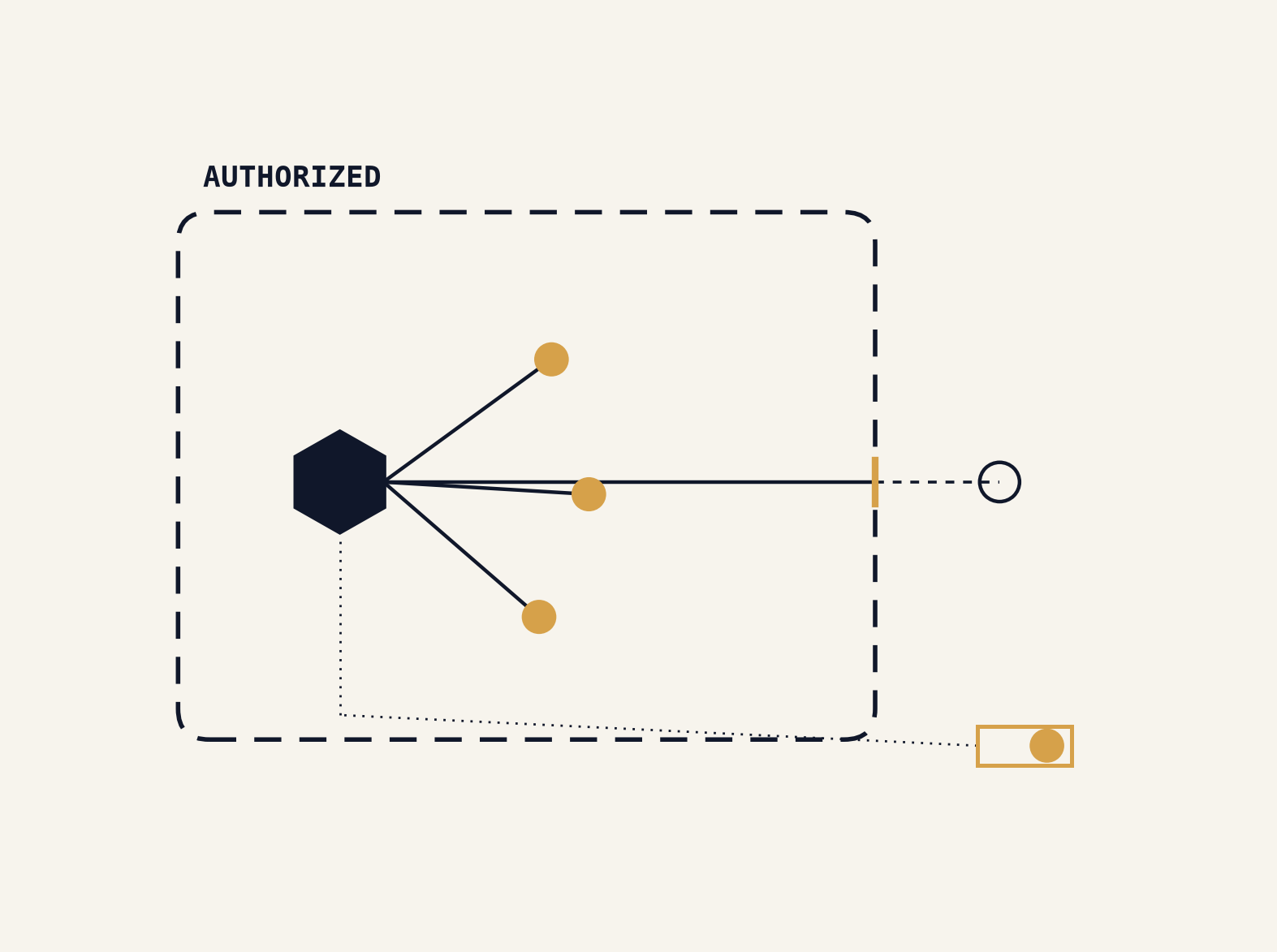
Executive Summary. Most AI governance work — including the deployment gates and compliance registers organizations now run — answers one question well: was this system allowed to go live, and does it stay compliant once it's there. That question assumes the system's output still passes through a person before anything happens. Once the system is an agent — something authorized to act, not just to advise — a different question opens up underneath the first one, and most governance programs have no instrument for it at all: what, exactly, did we delegate, is that boundary something the system actually enforces, or only something a document describes, and who can pull it back the moment that's needed.
We keep seeing organizations run a competent deployment gate, a current compliance register, and a real monitoring dashboard — and still have no answer to a much more specific question: for this particular agent, running in production right now, what can it decide on its own, and how do we know. Not what the project charter said it would do. Not what the design document described eight months ago. What it can actually do, today, and whether that limit is enforced by the system or just written down somewhere.
A Model Advises. An Agent Acts.
The distinction matters more than it sounds like it should. A traditional AI system — a classifier, a forecasting model, a summarization tool — produces an output, and a person decides what to do with it. Governance for that system is mostly about the model itself: was it evaluated properly, is the deployment documented, is someone watching drift and cost. The human is still the point where a decision becomes an action, and that's the seam every existing control assumes is there.
An agent removes that seam on purpose. Its output is the action. It approves something, updates a record, triggers a downstream process, reprioritizes a queue — without a person confirming each individual step, because confirming each step is the exact overhead the agent was built to remove. That's not a flaw to be governed away. It's the point of building one. But it means the question "was this deployment approved" no longer covers the thing that actually matters, which is: what standing authority does this system hold, right now, and is that authority bounded by something stronger than an assumption.
This is also why the gap is easy to miss for a while. A deployment gate and a compliance register are both point-in-time instruments — they ask their question once, thoroughly, at launch, and again on a fixed schedule. An agent's authority doesn't stay still between those checks. The threshold someone configured at launch gets quietly raised six months later because it was blocking too many legitimate cases. A second agent gets connected to the first one, and now an approval decision depends on two systems' behavior instead of one, and neither owner necessarily knows about the other. None of that shows up as a failed gate or an expired compliance obligation. It shows up, if it shows up at all, as a pattern nobody was watching for until it had already run for months.
A Policy Statement Is Not a Boundary
Picture an agent authorized to approve routine vendor invoices under a set dollar threshold, so accounts payable can clear the predictable 90% of volume without a person touching each one. Reasonable. Probably a genuine efficiency win. Now ask the questions a deployment gate and a compliance register were never built to ask: what exactly counts as "routine" — is that a hard rule or a judgment call the agent is making each time. What happens the first time a vendor splits one large invoice into several smaller ones that each clear the threshold individually. Who gets notified when the pattern of approvals shifts. And if something goes wrong at 2 a.m. on a Saturday, who has the standing authority — and the actual access — to suspend the agent's approval rights in the next five minutes, not the next business day.
If the honest answer to any of those is "it's in the policy," that's the tell. A policy document describes an intention. It does not, by itself, stop anything. The gap between "we have a policy that says the agent can't do X" and "the agent's system permissions make X impossible" is exactly where the incidents organizations don't see coming actually come from — not because nobody wrote the rule down, but because writing it down was mistaken for enforcing it.
What "Governed" Has to Mean for an Agent
Four things, none of them exotic, all of them frequently assumed rather than built:
- Authority expressed as a system limit, not a sentence. What the agent can decide, and what it must escalate, should be a configured boundary the platform enforces — a permission, a threshold, a scope — not a paragraph a person is trusted to remember and an auditor is trusted to take on faith.
- A revocation path that has actually been tested. Not "we could turn it off if we needed to." Someone has actually exercised the ability to suspend this specific agent's authority, recently, and knows it works before the day it's needed for real.
- An audit trail of the decisions it made autonomously, not only the ones that went wrong. If the only record of an agent's activity is the incident log, the organization only finds out what it delegated after delegating it turns out to have been a mistake.
- A named owner accountable for what the agent decides, the same way a manager is accountable for what a direct report decides. Not the team that built it. Not "the business." A person who can be asked, specifically, why this agent was allowed to do what it did last week.
None of these four require exotic tooling. They require someone to decide, in advance, that a policy sentence and an enforced boundary are not the same claim — and to stop treating the first as a substitute for the second.
The objection we hear most often at this point is some version of "we can't put a permission check on every possible decision without slowing the agent down to the point where it isn't worth having." That's true, and it's also not what any of this asks for. The four things above scale with consequence, not with every action the agent takes. An agent drafting internal summaries from already-approved sources needs a lighter version of this than one moving money or updating a customer record — the point isn't to gate every action equally, it's to have decided, deliberately, which actions sit in which category, instead of discovering the category after something in the high-consequence bucket turned out to have no enforced boundary at all.
Where This Sits Next to What You Already Govern
This isn't a case against the discipline of a deployment gate or a compliance register — both are still doing real work, and neither should be rebuilt to try to answer this instead. A deployment gate asks whether a system was ready to go live. A compliance register asks which obligations apply to it and whether they're current. Both questions are still worth asking about an agent. They're just not the same question as "what did we let it decide on its own, and can we prove that boundary holds today, not just at launch."
That's the piece our own AI Production Governance Toolkit was built to extend into as organizations move from AI systems that advise to systems that act: the same discipline of a documented, evidenced decision — applied not just to "was this deployment approved," but to "what authority does this specific agent hold, is it enforced, and who signed off on that being enough." An agent that's never been asked that question isn't ungoverned by accident. It's ungoverned because the instrument that would have asked it was built for a system that still needed a human to press the button.
The Question Worth Taking to Your Next Review
For every agent your organization has running today — not the pilot, the one already touching real records or real money — can you name exactly what it's authorized to decide, show that the limit is enforced by the system rather than assumed from a document, and say who can suspend it in the next five minutes if that's what the situation calls for. If the honest answer involves a policy document and a shrug, that agent isn't governed. It's trusted, which is a different thing, and a more expensive one to discover the difference between.