Map the Transition Before You Announce It
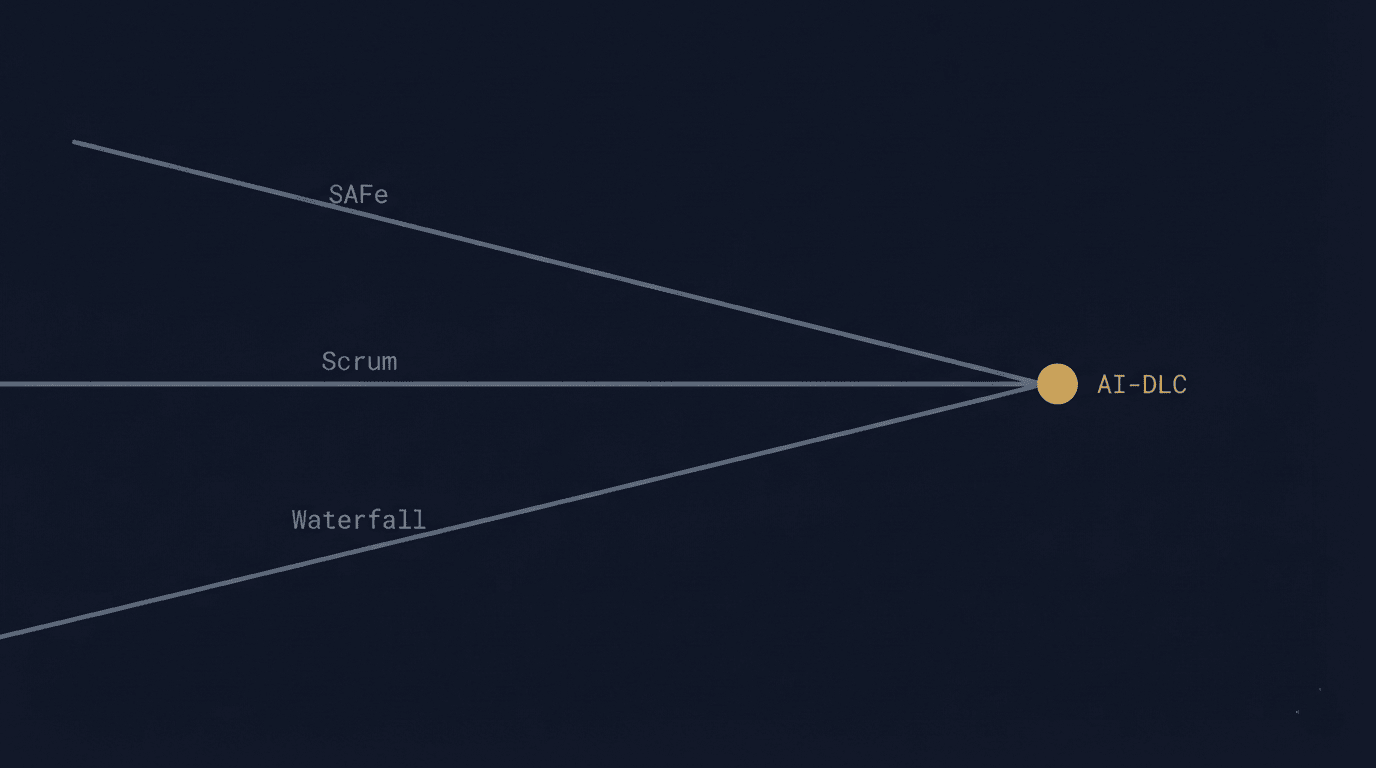
Why SAFe, Scrum, and Waterfall organisations keep re-running their old methodology under a new name — and what an explicit mapping table fixes that a transformation memo cannot.
Most AI-DLC transitions are announced. Real AI-DLC transitions are mapped.
The announcement version reads well in a town hall: new methodology, new ceremonies, new tooling, effective next quarter. It also fails on a predictable schedule, because nobody told the SAFe Release Train Engineer, the Scrum Master, or the Waterfall Change Control Board exactly which of their existing responsibilities map to which AI-DLC equivalent — and which ones simply carry over unchanged. Absent that mapping, two things happen in parallel. Some teams keep running Sprint Planning and PI Planning under new labels, changing nothing but the calendar invite title. Others discard structure altogether in the name of "being AI-DLC" and lose the governance discipline the methodology was supposed to strengthen, not remove.
Both failure modes trace back to the same root cause: no organisation adopts AI-DLC on a blank slate. Every team arrives from somewhere, carrying vocabulary, ceremony muscle memory, and governance instincts that were built for a different tempo. A transition plan that does not explicitly reconcile the old with the new is not a transition plan. It is a rebrand with a go-live date.
EXECUTIVE SUMMARY
Four bottlenecks stall the majority of AI-DLC transitions before they reach a genuine pilot.
- No explicit mapping from SAFe, Scrum, or Waterfall constructs to their AI-DLC equivalents, so teams improvise and drift.
- Ceremony transplantation — old rituals hard-wired onto AI-DLC instead of redesigned for a work-driven cadence.
- Ritual erosion under delivery pressure, where Mob Elaboration and Mob Construction get skipped "just this once," then habitually.
- Ambiguity about what changes versus what stays fixed — accountability, ownership, and the quality bar are frequently assumed (wrongly) to be up for renegotiation.
Why a Mapping Table Beats a Transformation Memo
A transformation memo tells people what is changing in the abstract. A mapping table tells a specific Release Train Engineer, Scrum Master, or Change Control Board exactly which artefact they currently own has a named AI-DLC counterpart — and which of their instincts should carry over untouched. That specificity is what prevents the two default failure patterns, because it removes the interpretive gap teams currently fill with either nostalgia or overcorrection.
SAFe: The Coordination Bottleneck Moves, It Doesn't Disappear
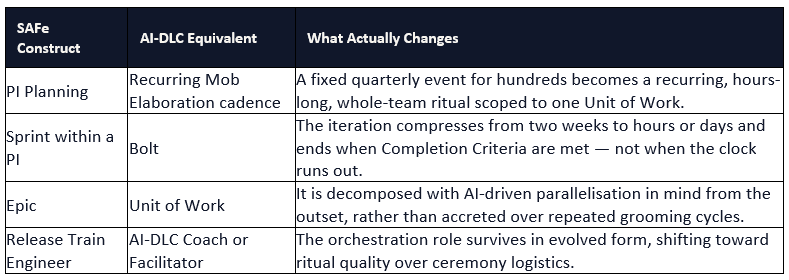
SAFe's core value is coordinating human throughput across many teams. AI-DLC shrinks exactly that problem: once AI absorbs execution, the coordination bottleneck relocates to decision quality and governance velocity, not to headcount planning. That is why most SAFe constructs map to something smaller and faster rather than to a like-for-like replacement.
SAFe construct mapping:
Scrum: The Shortest Distance, and the Easiest Trap
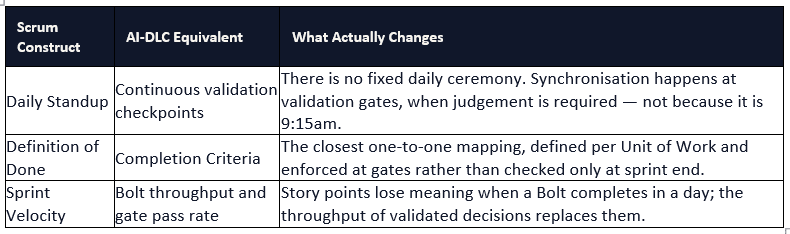
Scrum teams travel the shortest conceptual distance — AI-DLC retains iteration, cross-functional collaboration, and empirical inspection. The risk for these teams is not confusion. It is ceremony inertia: keeping a daily standup and a two-week rhythm that no longer matches how the work actually flows.
Scrum construct mapping:
Waterfall: Structurally Closer Than It Looks
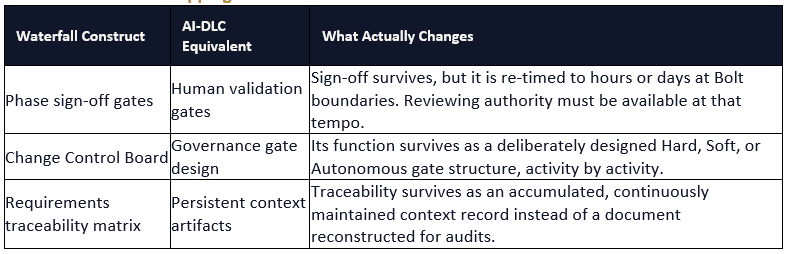
Waterfall organisations are usually assumed to be the furthest from AI-DLC. Structurally, the opposite is often true. Phase discipline, formal sign-offs, and documentation culture map more directly onto AI-DLC's three phases and gate structure than Scrum's ceremony-centric model does. The distance is cultural, not structural — the compression of gate timing from months to hours is the adjustment that actually matters.
Waterfall construct mapping:
A renamed ceremony is not a transition. It is theater with a new backdrop.
The Message Discipline That Actually Prevents Resistance
Every stakeholder communication, training session, and leadership briefing should be able to state both halves of this section without notes. Transitions fail when either half is dropped: dropping the unchanged half creates fear and resistance; dropping the changed half produces cosmetic adoption.
What does not change
- Human accountability for every consequential decision — architectural, scope, release. AI proposes; accountable humans decide.
- Product ownership of business outcomes. The mechanism of elaboration changes; the ownership does not.
- The quality bar for production code. Testing rigour and security posture carry over intact, enforced at validation gates rather than end-of-phase reviews.
- The need for genuine cross-functional collaboration — Mob Elaboration and Mob Construction intensify it rather than reduce it.
What changes
- Ceremony cadence — from calendar-driven to work-driven, compressed from weeks to hours or days.
- Where human effort concentrates — from manual artefact authorship toward review, validation, and context stewardship.
- The mechanism of proposal — AI-initiated and human-validated, inverting the default direction of the workflow.
- The measurement system — story points and sprint velocity give way to Bolt cycle time, gate pass rates, and Completion Criteria throughput.
Sequencing the Transition: Four Phases, One Non-Negotiable Rule
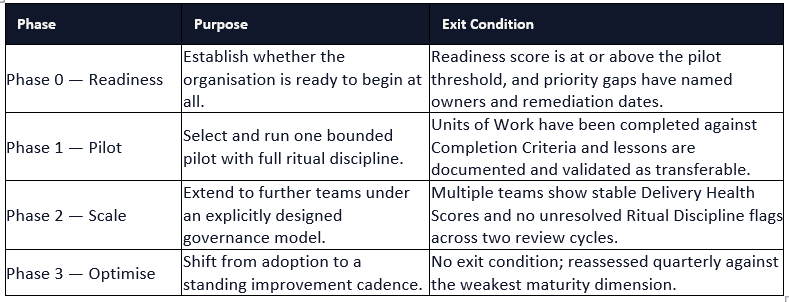
Resist compressing phases. The most expensive transition failures come from scaling before a pilot has produced validated, transferable lessons — not from moving too slowly.
The four transition phases:
Four Failure Patterns That Account for Most Stalled Transitions
All four are observable early, if leadership knows what to look for.
1. The AI-Managed Anti-Pattern
Gates are rubber-stamped or bypassed, and speed becomes the goal in itself. Early signal: gate pass rates near 100% with near-zero rework.
2. The AI-Assisted Anti-Pattern
AI is reduced to narrow task completion while the full old methodology quietly continues underneath. Early signal: Bolts that last exactly two weeks.
3. Ceremony Transplantation
Old ceremonies are hard-wired onto AI-DLC rituals instead of redesigned — PI Planning "but for Bolts." The corrective is the mapping discipline itself: every retained ceremony must be justified against its AI-DLC equivalent, not carried forward by default.
4. Ritual Erosion Under Pressure
Mob Elaboration and Mob Construction get skipped "just this once" under delivery pressure, then habitually. Because these rituals are where context is captured and validated, their erosion degrades everything downstream before anyone notices — context quality decays invisibly before output quality decays visibly.
The Uncomfortable Part: Nobody Wants to Own the Mapping
Every role in the organisation has an incentive to skip this exercise. Delivery leads would rather start building than spend a week reconciling terminology. Agile coaches trained on Scrum ceremonies have a professional stake in believing those ceremonies still apply. Change Control Boards would rather keep their monthly cadence than redesign gate timing for an environment that moves in hours. None of these are bad-faith positions. They are simply misaligned incentives, and misaligned incentives do not resolve themselves without an artefact that makes the mapping explicit, checkable, and hard to argue around.
That is the actual function of a transition playbook: not motivation, not vision-casting, but a reference document specific enough that a Release Train Engineer, a Scrum Master, and a Change Control Board can each find their own role in it — and see, in writing, exactly what survives and exactly what does not.
SAFe / Agile / Waterfall → AI-DLC Transition Playbook
Three explicit mapping tables (SAFe, Agile/Scrum, Waterfall), the full what-changes/what-doesn't framing, a four-phase transition roadmap, four common failure modes, role-by-role transition notes, change management guidance, and a phase-ordered 90-day checklist for the first quarter.
$59 · one-time purchase · typeset PDF
Get the Transition Playbook on Viksya
Prefer to buy directly? Checkout on Payhip
Frequently Asked Questions
Q: Does the AI-DLC Transition Playbook replace our existing SAFe or Scrum training?
A: No. It maps existing constructs to their AI-DLC equivalents so teams retain what still applies and retire what does not. It is a transition reference, not a replacement curriculum.
Q: Which methodology maps most easily to AI-DLC?
A: Scrum has the shortest conceptual distance, since AI-DLC retains iteration and cross-functional collaboration. Waterfall is structurally closer than expected because of its phase and sign-off discipline. SAFe has the most moving parts, since its coordination-heavy constructs largely compress into smaller, faster equivalents.
Q: What does not change when an organisation adopts AI-DLC?
A: Human accountability for decisions, product ownership of business outcomes, the quality bar for production code, and the need for cross-functional collaboration all carry over unchanged.
Q: How long does a typical transition take?
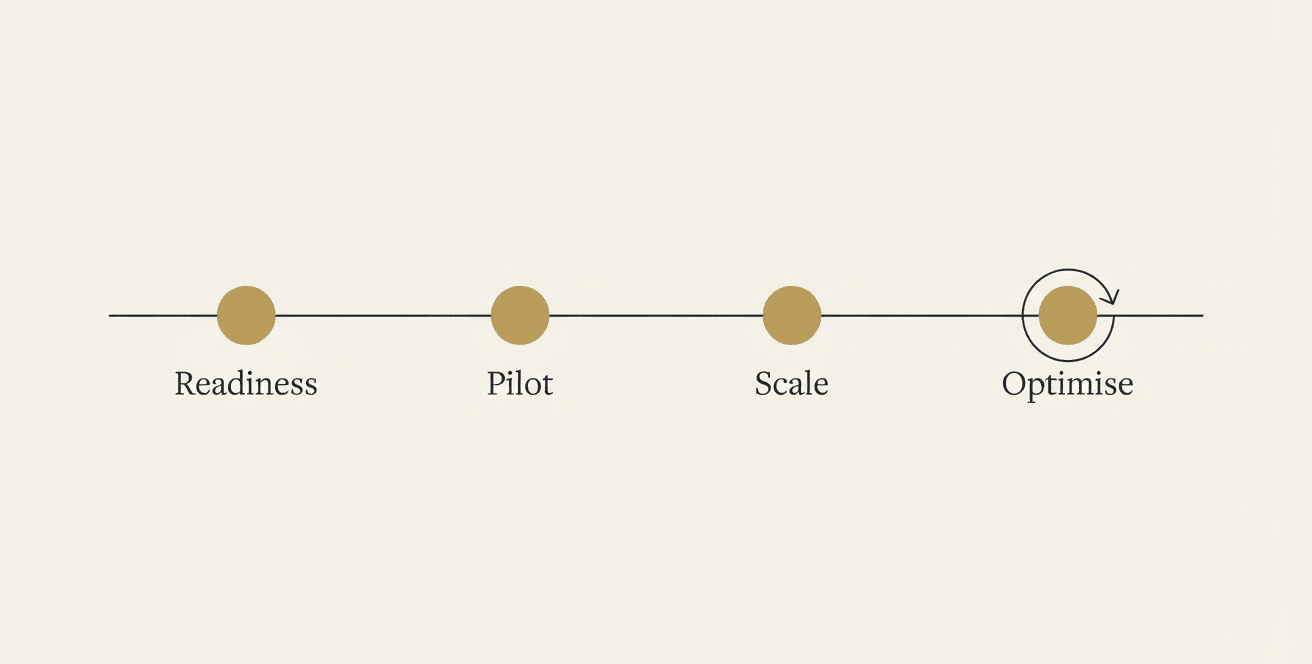
A: The playbook's roadmap sequences into four phases — Readiness, Pilot, Scale, Optimise — with a 90-day checklist covering the first quarter. Phase 3 (Optimise) does not have an exit condition; it becomes a standing improvement cadence.
Q: Is this playbook specific to any one industry or codebase type?
A: No. The mapping tables and roadmap are methodology-specific (SAFe, Agile/Scrum, Waterfall), not industry-specific, and are designed to be applied by CIOs, VPs of Engineering, Agile Coaches, RTEs, Programme Managers, and Management Consultants across sectors.