
AI Regulatory Compliance Risk Register, Now Updated to v1.1 for the EU Digital Omnibus
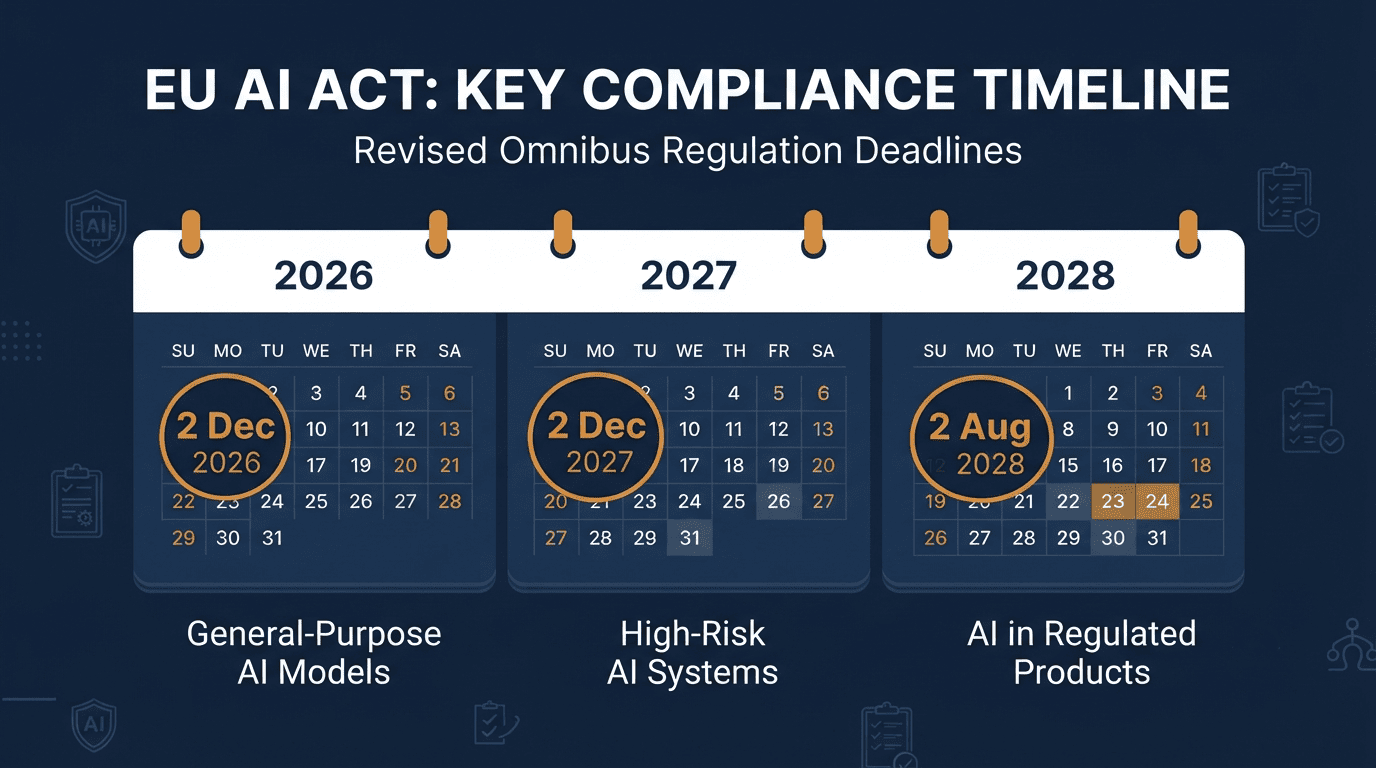
Most compliance tools go stale the moment the regulation they're built on changes. Real ones get updated before the first person notices the gap. On 24 July 2026, the EU published Regulation (EU) 2026/1744 — the Digital Omnibus on AI — in the Official Journal, in force from 27 July 2026. It moved two AI Act deadlines and added a new prohibited practice. The AI Regulatory Compliance Risk Register is now updated to v1.1 to reflect all of it.
What changed
Three things moved. Nothing else did.
• Annex III High-Risk obligations (standalone use cases): now 2 December 2027, not 2 August 2026
• Annex I High-Risk obligations (embedded in regulated products): now 2 August 2028
• Article 5 gains a new prohibited practice — AI-generated non-consensual intimate imagery and child sexual abuse material — applicable from 2 December 2026
Article 50 transparency and Article 4 AI literacy duties are unchanged at 2 August 2026. The India DPDP Act assessment is unaffected — it runs independently of EU AI Act tier and was not touched by this amendment.
What we changed in the workbook
- Use Case Classifier — the Prohibited tier now runs nine checks (P1–P9) instead of seven, with the two new checks covering the Article 5 addition
- Regulatory Timeline — extended to seven tracked milestones to include the new prohibition's applicability date
- Instructions tab and User Guide — version history, legal disclaimer, and every date reference updated and cross-checked against the Official Journal text
- Compliance Gap Register and Board Summary Dashboard — unchanged; the update did not alter these components
A workbook that still shows the old deadline isn't being conservative. It's just wrong, and it will look wrong the moment someone checks.
If you already own v1.0
You don't need to buy anything new. The v1.1 update is folded into the same product — no separate release, no upgrade fee. Re-download the file from your Payhip library to get the current version.
Source: Regulation (EU) 2026/1744 of the European Parliament and of the Council of 8 July 2026 amending Regulations (EU) 2024/1689, (EU) 2018/1139 and (EU) 2023/1230 as regards the simplification of the implementation of harmonised rules on artificial intelligence (Digital Omnibus on AI). Official Journal of the European Union, published 24 July 2026, in force 27 July 2026.
Read the official text: https://eur-lex.europa.eu/eli/reg/2026/1744/oj/eng
LEGAL DISCLAIMER
This tool provides structured guidance based on publicly available regulatory texts as of the version date (28 July 2026). It does not constitute legal advice. Regulatory interpretation evolves, and organisations subject to the EU AI Act or India DPDP Act should obtain qualified legal counsel for binding compliance determinations. Classifications produced by this tool are indicative only.
Frequently Asked Questions
Do I need to pay again for v1.1?
No. The update is folded into the same product. Existing buyers should re-download from their Payhip library.
Did the Compliance Gap Register or Board Summary Dashboard change?
No. Only the Use Case Classifier's Prohibited tier and the Regulatory Timeline tab were updated. The Gap Register's 30 requirements and the Dashboard's calculations are unchanged.
When does the new Article 5 prohibition actually apply?
From 2 December 2026, per Regulation (EU) 2026/1744.
GET THE TOOL
AI Regulatory Compliance Risk Register — v1.1
Updated for the EU Digital Omnibus on AI. Same workbook, same price, current regulatory dates.
▸ Nine-check Prohibited tier, including the new Article 5 addition
▸ Corrected Annex III (2 Dec 2027) and Annex I (2 Aug 2028) dates
▸ Existing buyers re-download at no charge
→ https://viksya.com/ai-regulatory-compliance-risk-register
Direct download: https://viksya.com/ai-regulatory-compliance-risk-register
Classified something High-Risk? The EU AI Act High-Risk Compliance Pack — https://viksya.com/eu-ai-act-high-risk-compliance-pack — is the execution layer: role determination, FRIA, Annex IV evidence.