
Introducing the Location-Adjusted Edition: Why a USD, English-Only AI ROI Model Doesn't Travel
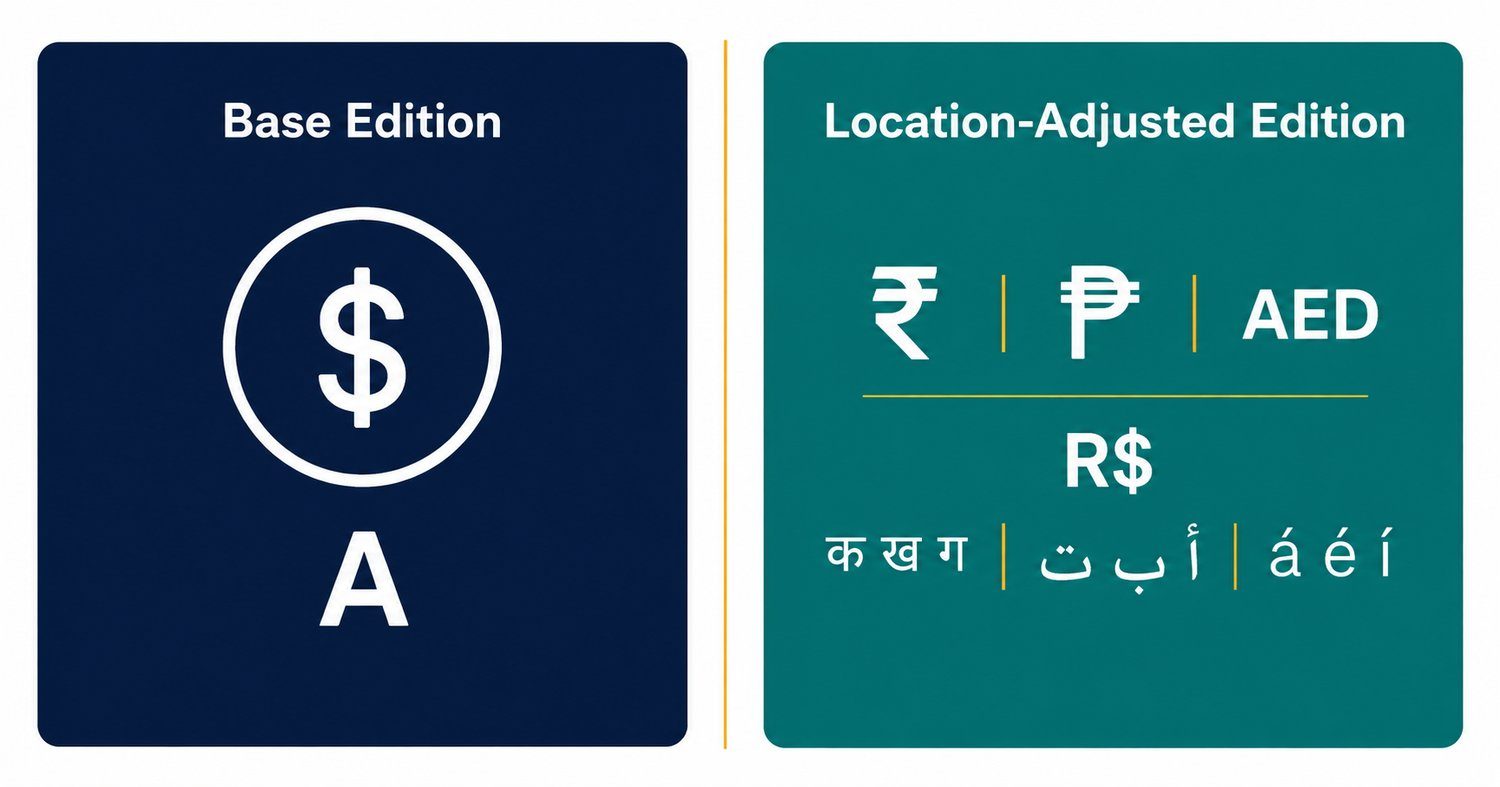
The AI Investment ROI Model works cleanly inside a US/English-only context. Outside it, two assumptions quietly stop holding — and the Location-Adjusted Edition exists to price both back into the case.
The base AI Investment ROI Model carries two assumptions by default: costs and comparisons run in US dollars, and the deployment runs in English. Neither assumption is a flaw — the model is scoped correctly for the context most AI business cases are still built in. But a large share of AI deployment now happens outside that context, and a USD, English-only model applied there does not fail loudly. It simply overstates the case, quietly, in ways a finance review may not catch until the numbers diverge from actuals.
The Location-Adjusted Edition of the AI Investment ROI Model takes the same NPV, IRR, payback, and BCR core as the base model and adds a market and language layer on top of it — so the investment case reflects the market it is actually being built for, not a US benchmark applied by default.
This post sets out the two assumptions the base model treats as fixed, what the Location-Adjusted Edition does about each one, and how to use it correctly.
The Gap in a USD, English-Only Model
Every substitution-based AI business case rests on a ratio: the monthly cost of running the AI system against the fully-loaded monthly cost of the human role it replaces. In a US context, that ratio is typically favourable — a support role costing in the region of $3,500 per month against an AI equivalent costing a few hundred dollars produces a ratio well above 5:1.
The AI side of that ratio does not adjust by market. Global AI providers price infrastructure in US dollars, calibrated to global compute costs, not local labour markets. The human side changes considerably by market. A comparable role in India runs closer to $475 per month. In the Philippines — a large, established, English-speaking BPO market — the same role runs closer to $500 per month. The AI cost is unchanged in both cases. The ratio that was comfortably above 5:1 in the US compresses toward 1:1.
The Location-Adjusted Edition names this the Substitution Ratio, and scores it against three bands.

Where the Substitution Ratio falls below 2:1, the model's own guidance is direct: build the business case on Expansion Logic rather than labour substitution alone. That guidance is built into the Executive Summary tab, not left for the reader to work out.
The Cost Hiding Inside the Language
The second assumption compounds the first, and is the one most AI cost models built for non-English deployments miss entirely.
AI providers price by token volume, and token efficiency is not uniform across languages. Models process English efficiently by default; non-English languages, particularly those using non-Latin scripts, typically require more tokens to represent the same amount of meaning. The practical effect is a higher inference cost per interaction for the same conversation, purely as a function of the language it happens in. The tokenization mechanism behind that multiplier — why non-English languages need more tokens for the same meaning in the first place — is covered in Why Token Costs Run Higher in Non-English Deployments.
The Location-Adjusted Edition applies this as a Blended Token Cost Multiplier — a standard, editable rate per language, blended across a primary and optional secondary language, wired directly into the Cost Model so NPV, IRR, and ROI% recalculate automatically.
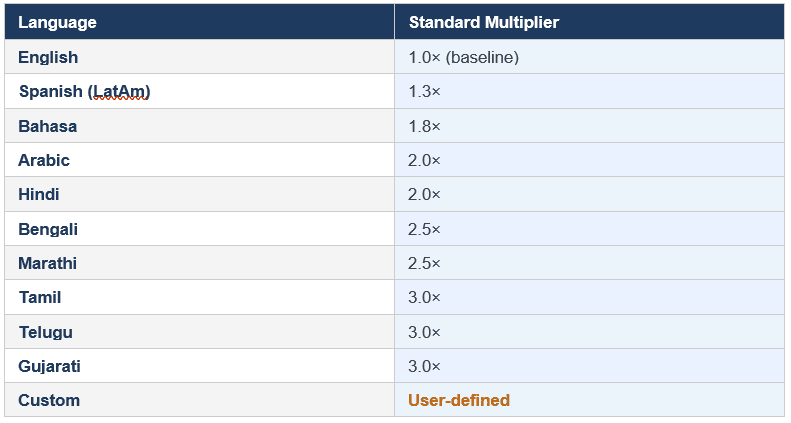
Every value in this table is editable, and a Custom option is available for languages outside the standard list. That editability matters for the next point.
A Related Variable Worth Knowing: Which Model Is Doing the Work
The standard multipliers above reflect typical tokenizer behaviour on general-purpose, frontier AI models — the kind built by OpenAI, Google, and Anthropic, trained predominantly on English-majority data and adapted to other languages afterward. That is the right default assumption for most deployments, and it is what the standard table reflects.
It is not the only category of model available. Some providers build models natively for a specific linguistic context rather than adapting a general-purpose model to it after the fact. Sarvam AI, an Indian model developer, built a tokenizer specifically for ten Indian languages; the same pattern applies to Kimi, built by Moonshot AI in China for Mandarin and long-context Chinese-language tasks. Models built this way can process their target language with meaningfully better token efficiency than a general-purpose model handling the same language as a secondary capability.
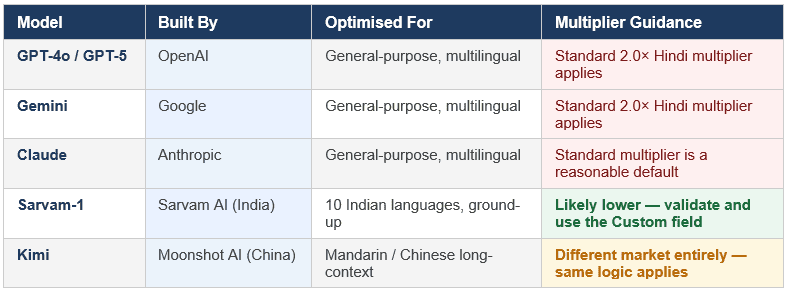
This is not a calculator input — the Location-Adjusted Edition does not ask which model is being deployed, and the standard multiplier table is not calibrated per-model. It is context worth having before finalising a business case: where the deployment already uses, or could use, a model built natively for the target language, the Custom multiplier field is the right place to reflect a lower rate than the standard table — once that lower rate has been validated against the specific model and task, not assumed from the model's marketing.
Where Substitution Is Weak: The Expansion Benefits Module
A compressed Substitution Ratio does not mean the investment case collapses. It means the case needs to be built on a different kind of benefit — value that is only reachable because the AI system exists, rather than value saved by replacing a human who was already doing the work.
The Location-Adjusted Edition adds four benefit lines for exactly this: New Customer Segment Revenue, Long-Tail Revenue Uplift, Language Inclusion Retention Uplift, and Extended Hours Value. Each can be toggled to Include in Base Case, Include in Aggressive Case Only, or Exclude — so a Conservative scenario can stay disciplined while the Base and Aggressive scenarios capture the fuller expansion thesis.
• New Customer Segment Revenue — customers previously unreachable because human service capacity did not extend to them.
• Long-Tail Revenue Uplift — incremental value from the majority of a customer or product base that individual human attention could never economically reach.
• Language Inclusion Retention Uplift — retention and conversion improvement from serving customers in their own language rather than a fallback.
• Extended Hours Value — the value of continuous availability versus business-hours human coverage.
Where the Substitution Ratio sits below 2:1, these four lines — not the substitution savings — should carry the investment case.
Base Edition vs. Location-Adjusted Edition
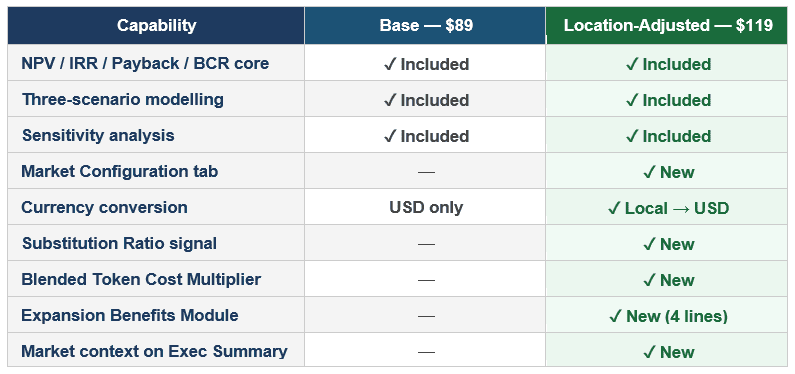
Both editions share the same NPV, IRR, payback period, and BCR financial engine. The Location-Adjusted Edition adds a market and language layer on top of it; it does not replace the base model, and both remain on sale as separate editions.
How to Use It
Four steps, applied in sequence:
• Set the deployment market on the Market Configuration tab and check the Substitution Ratio signal before building anything else.
• Apply the Blended Token Cost Multiplier for the deployment's language mix — use the standard rate, or the Custom field if the deployment uses a model built natively for that language and the lower rate has been validated.
• Where the Substitution Ratio is below 2:1, build the primary case on the Expansion Benefits Module rather than on labour substitution.
• Present the Market Context section of the Executive Summary alongside the standard financial metrics — it states plainly whether the case is substitution-driven or expansion-driven, which is exactly the question a finance reviewer will ask first.
AI Investment ROI Model — Location-Adjusted Edition
$119 · Excel workbook with expanded PDF manual · Instant download · A separate edition alongside the base $89 model
• Market Configuration tab — deployment market, local currency, USD exchange rate
• Substitution Ratio — green / amber / red signal on whether labour substitution economics hold
• Blended Token Cost Multiplier — standard, editable multipliers across 10 languages plus Custom
• Expansion Benefits Module — four new benefit lines for cases where substitution is marginal
• Market context built into the Executive Summary — presentation-ready for finance
→ Get the Location-Adjusted Edition — viksya.com/ai-investment-roi-model-location-adjusted-edition
→ Deploying only in a US/English-only context? See the base edition — viksya.com/ai-roi-calculator
Frequently Asked Questions
What does the Location-Adjusted Edition add to the base AI Investment ROI Model?
Five additions: a Market Configuration tab for deployment market and currency, a Substitution Ratio comparing local labour cost to AI running cost, a Blended Token Cost Multiplier for non-English languages, an Expansion Benefits Module with four new benefit lines, and market context built into the Executive Summary. The core NPV, IRR, payback, and BCR engine is unchanged from the base edition.
Do I need the Location-Adjusted Edition if I already own the base model?
Only if the deployment sits outside a US/English-only context. The base edition remains accurate and complete for US or English-only deployments. The Location-Adjusted Edition is a separate, additional edition for deployments where local currency, non-English inference cost, or true local labour substitution economics materially change the case.
What if my deployment uses a language-native model rather than a general-purpose one?
The standard multiplier table assumes a general-purpose frontier model. If the deployment uses a model built natively for the target language — which can carry a meaningfully lower token cost for that language — use the Custom field in the Blended Token Cost Multiplier section rather than the standard rate, once the lower rate has been validated against the specific model and task.
What is the Substitution Ratio and what should I do if it's below 2:1?
The Substitution Ratio compares the fully-loaded monthly cost of the human role being replaced against the actual monthly cost of running the AI system. Above 5:1 is strong; 2:1 to 5:1 is moderate; below 2:1 is marginal, and the model's own guidance is to build the business case on Expansion Logic — the four benefit lines in the Expansion Benefits Module — rather than on labour substitution alone.
Can I use this for a deployment across multiple markets and languages?
Yes. The Market Configuration tab includes a Custom option alongside the standard India, Southeast Asia, Middle East, and Latin America presets, and the Blended Token Cost Multiplier supports a primary and secondary language blend. For deployments spanning more than two markets or languages, model each material market as a separate scenario run and compare the outputs.