
AI Use Case Prioritization Criteria That Hold Up in a Steering Committee
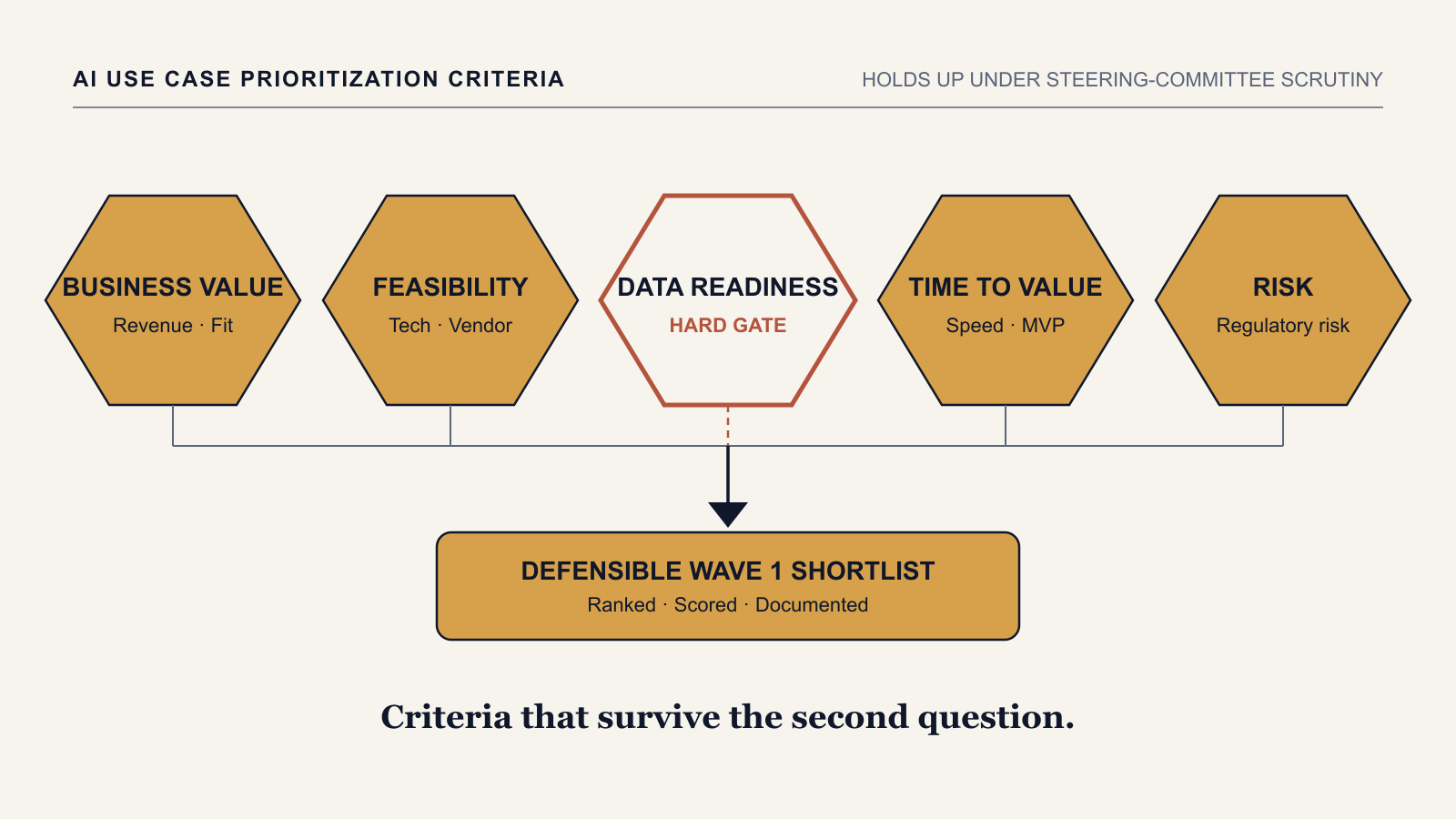
AI use case prioritization criteria are the explicit, scorable dimensions a programme uses to rank candidate AI initiatives before committing delivery resources — typically covering business value, implementation feasibility, data readiness, time to value, and risk, each broken into sub-criteria that can be scored and defended line by line, not reduced to a single gut-feel rating. The test of a good set of AI use case evaluation criteria is not whether it produces a ranked list. It is whether that ranking still holds when a skeptical steering committee asks why one use case beat another.
Where Criteria Collapse Under Questioning
Most AI use case scoring criteria are written once, in a workshop, and never stress-tested against the question a steering committee actually asks: why this one, not that one. Three failure patterns show up repeatedly. A criterion is labeled but never broken down — "feasibility" with no sub-criteria means two reviewers can score the same use case a 2 and a 4 and neither is wrong, because nothing defines what a 2 versus a 4 looks like. A criterion is scored but never allowed to disqualify anything — everything feeds into one weighted average, so a use case with no usable data can still surface near the top of the list if its business value score is high enough to carry it. And a criterion exists on paper but is never actually populated with evidence — a risk score filled in from memory in the same meeting the shortlist gets finalized. Each of these survives a first pass. None of them survives a second meeting where someone asks for the reasoning behind a specific number.
The Five Criteria That Hold Up, and Why
Viksya's AI Use Case Prioritization Framework scores up to 12 candidate use cases across five weighted dimensions, each built from five sub-criteria rather than a single label. Business value is scored on sub-criteria including revenue impact, cost reduction potential, strategic alignment, and competitive differentiation — distinct questions a finance or strategy lead can interrogate individually, not one abstract "is this valuable" judgment. Implementation feasibility covers sub-criteria including technical complexity, integration burden, team capability, and vendor dependency — the engineering-side reality check that keeps enthusiasm from outrunning delivery capacity. Data readiness covers data availability, quality, access, and volume. Time to value covers delivery speed, MVP scope, dependency chain, and regulatory clearance. Risk and sensitivity covers regulatory risk, model explainability requirements, and reputational sensitivity. Each dimension produces a number a reviewer can trace back to a specific, answerable sub-question — the structural requirement for AI use case evaluation criteria built to be defended out loud, not filed and forgotten.
Why Data Readiness Is a Gate, Not Just a Score
The one dimension that behaves differently from the other four is data readiness, and the difference is deliberate. In the framework, a use case that fails the data-feasibility check is removed from Wave 1 regardless of how it scores everywhere else — it is not averaged in with the others and carried along on the strength of a strong value score. That distinction matters specifically because of how weighted-average scoring fails under scrutiny. A single composite number can hide a fatal weakness: a use case that is genuinely valuable and genuinely low-complexity can still be unbuildable this quarter because the data it depends on does not exist yet, is not accessible, or is not clean enough to use — and a value-feasibility-risk composite alone will not surface that until delivery is already underway. A hard gate puts that disqualifying fact in front of the committee at the scoring stage, not six months into a stalled build. It is the one piece of the criteria set built specifically to survive the question "what happens when the data isn't actually there," which is usually the first question a skeptical steering committee asks about any new AI use case.
A Steering Committee Walkthrough
Picture a steering committee reviewing four candidate use cases, one of which — a predictive maintenance model — scores well on business value and time to value but depends on sensor data that three plants still log on paper. Scored as a single weighted average, it could still rank in the top half of the shortlist, carried by its value score. Scored against criteria with a data-readiness gate, it is flagged and moved to Park/Revisit before the meeting, with the specific sub-criterion that failed — data access — named on the page. The committee spends its time on the use cases that are actually buildable this wave, and the deferred use case has a documented, specific reason for the deferral instead of a vague "we weren't sure about that one." That is the practical difference between criteria that produce a ranking and criteria that hold up when someone in the room asks why.
What to Check Before Trusting a Set of Criteria
Three properties separate AI use case prioritization criteria that survive scrutiny from criteria that only look rigorous. Each dimension should resolve into specific, scorable sub-criteria — four or five per dimension, not one label covering several unrelated judgments. At least one dimension should function as a disqualifying gate, not just a weighted input, for whichever failure mode is fatal regardless of other scores — for AI use cases, that is almost always data. And the output should be presentable at the sub-criterion level, not just as a final composite number, so a reviewer can trace any ranking back to the specific scores that produced it. Criteria that meet all three hold up through a second and third round of questions. Criteria that meet only the first — a tidy-looking list of labeled dimensions — tend to collapse the moment someone asks why use case A outranked use case B.
The AI Use Case Prioritization Framework provides a structured, weighted scoring method across five dimensions — business value, implementation feasibility, data readiness, time to value, and risk & sensitivity — each built from five sub-criteria, with a data-readiness hard gate that disqualifies use cases lacking a viable data foundation before they reach a Wave 1 shortlist.
→ Available at www.viksya.com