
Are AI Coding Tools Worth the Token Bill? Testing the Business Case
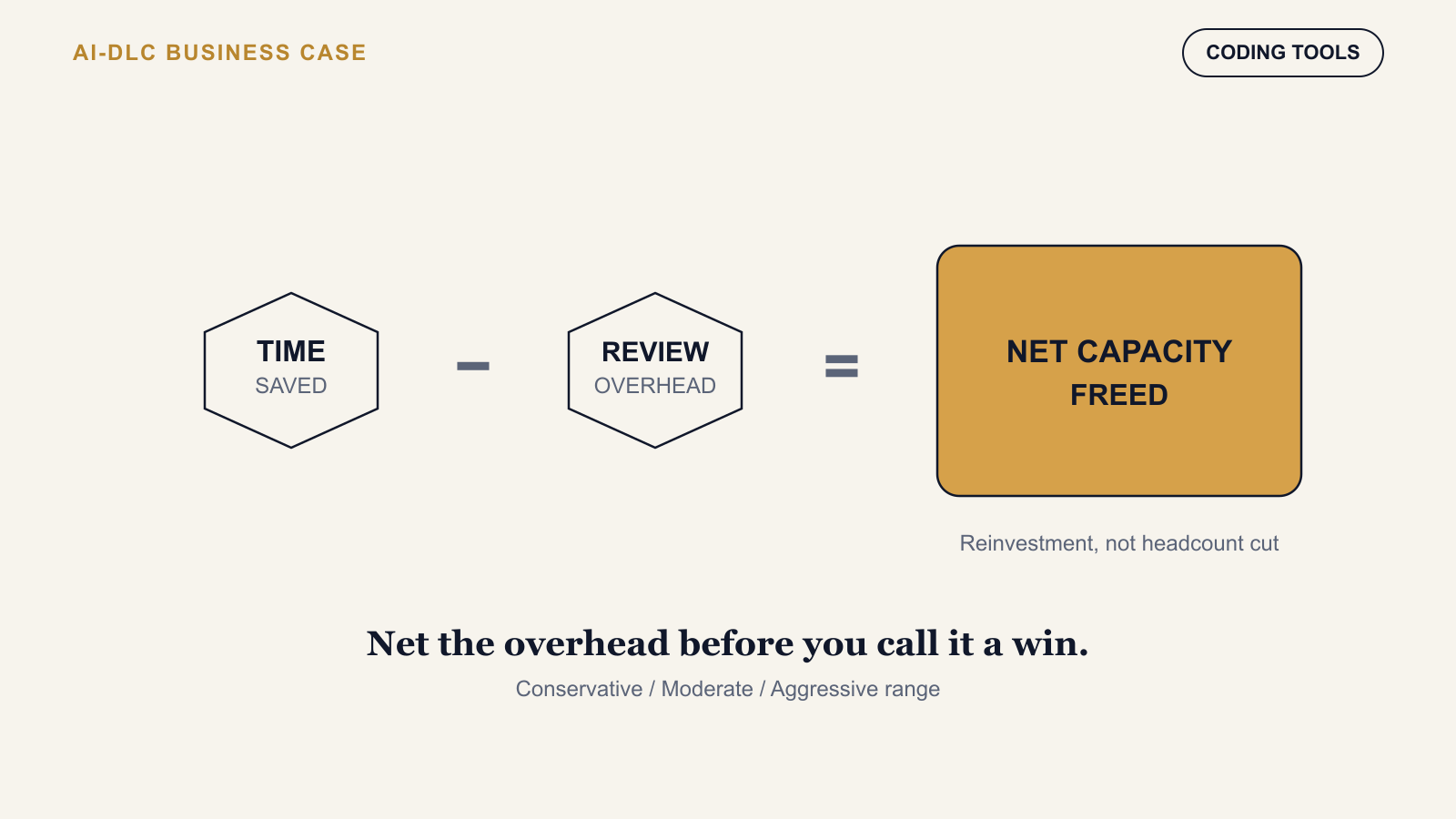
To test whether AI coding tools are worth the token bill, compare the fully-loaded cost of the tool — seat fee or token spend — against the value of the engineering time it actually frees, net of the coordination and review overhead the tool introduces, not against the raw productivity multiple a vendor advertises. A coding assistant that saves two hours of writing code but adds ninety minutes of review and rework has freed thirty minutes, not two hours.
Start From Cost, Not From the Productivity Claim
Whether the tool is priced per seat or per token, get the actual monthly bill for the team using it first, and treat the advertised productivity multiple — "2x faster," "40% less time on boilerplate" — as unverified until it's tested against this team's own delivery data. A multiple measured on someone else's codebase, someone else's task mix, and someone else's review process describes their programme, not yours.
Net Out the Coordination Overhead
AI-generated code that doesn't get reviewed as carefully as human-written code creates rework cost later, and that cost belongs in the calculation even though it shows up downstream rather than at the moment the code is generated. Structured review cycles — the kind an AI-DLC team runs specifically because AI-generated output needs a different review posture than human-written output — add real time of their own. Both reduce the raw speed gain before it reaches the bottom line, and a credible business case deducts them explicitly rather than assuming the vendor's raw multiple survives contact with the team's actual process unchanged.
Run the Comparison in Three Numbers
- Current-state cost — team cost, cycle time, and throughput before the tool, sourced from actual delivery data, not an estimate of how the team feels things are going.
- Tool cost — the actual monthly bill, seats or tokens, plus any licensing or integration cost, not a vendor's list price assumed to be the final number.
- Net benefit — capacity freed by the tool, minus the coordination and review overhead it adds, valued at the team's fully-loaded cost. Compare that net figure's payback period against the tool's cost — not the raw, unadjusted productivity claim against the cost, which is the comparison most vendor pitches implicitly invite and the one that most overstates the case.
Build a Range, Not One Verdict
Run Conservative, Moderate, and Aggressive productivity scenarios rather than settling on a single verdict, because the net benefit depends heavily on task type — boilerplate and scaffolding see larger gains than novel logic — and on team seniority, since more experienced engineers tend to extract more net value per hour of tool use than teams still learning how to review AI output effectively. A single "worth it" or "not worth it" verdict applied across an entire engineering organization is usually wrong for at least some teams in either direction.
A Hypothetical Worked Example
Picture a team where the tool's monthly bill, seats and token usage combined, is modest relative to the team's total fully-loaded cost. Engineers report the tool saves real time on boilerplate and test scaffolding, but the team has also added a review step specifically for AI-generated code, and a few early merges needed meaningful rework after shipping with subtle bugs the original review missed. Netting the reported time saved against the added review time and the rework cost still leaves a positive balance — but a smaller one than the raw "time saved" figure alone would suggest, and the payback period calculated from the net figure runs longer than the payback period a vendor's own case study would imply. The tool is still worth it. The first, unadjusted number overstated by how much.
What "Worth It" Should Never Be Used to Justify
The capacity an AI coding tool frees is a reinvestment figure — more throughput, more scope delivered in the same headcount — not a redundancy case. Using it to justify a headcount reduction misrepresents what the calculation actually measures, and it damages the trust the wider adoption depends on with the exact engineers whose careful review work the net-benefit calculation relies on in the first place.
The Opposite Mistake Is Just as Costly
Rejecting these tools outright because an early, unadjusted trial looked unconvincing is the mirror image of the same error. An honest net-benefit test run once, on a small sample, with a review process not yet adapted to AI-generated code, will understate the tool's value for the same reason an unadjusted vendor claim overstates it — the process hasn't settled yet. The right response to either a disappointing first result or an impressive vendor claim is the same: run the net calculation properly, on this team's own data, and let the range of outcomes across Conservative, Moderate, and Aggressive scenarios inform the decision rather than a single early data point in either direction.
The AI-DLC ROI & Business Case Model provides a 6-tab Excel workbook that turns this organisation's own delivery economics — team cost, cycle time, throughput — into a payback period, Year-1 ROI and multi-year NPV across Conservative, Moderate and Aggressive productivity scenarios, net of mob-ritual review overhead.
→ Available at www.viksya.com