
Budgeting AI Token Costs for 2027: Plan on Consumption, Not Licences
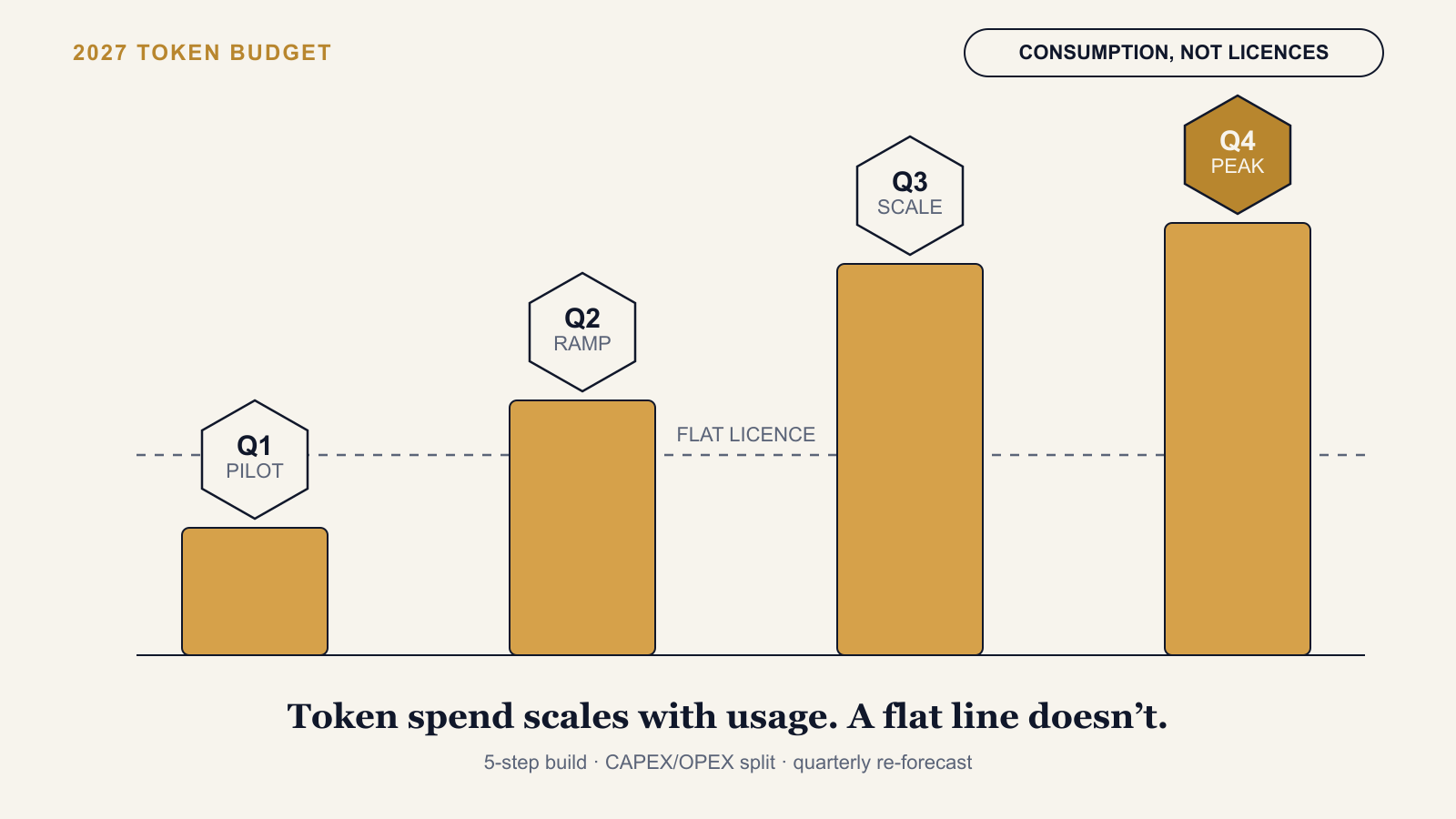
To budget AI token costs for 2027, size the number from projected call volume times the per-token price of the model actually in use, use case by use case, then apply a growth curve across the year — not a flat monthly figure carried over from last year's invoice. Token spend is consumption pricing: it moves with how much the organization actually uses the system, which is the opposite of a seat licence that costs the same whether usage is light or heavy.
Why a Licence Mental Model Undercounts the Number
Most enterprise software is still bought on a seat-licence basis, so finance teams default to that mental model when a new budget line appears: pick a monthly figure, multiply by twelve, done. Token-metered AI breaks that assumption. The bill scales with calls made and tokens consumed per call, not with how many people have access. A 2027 budget built as a flat number inherits none of that variability, and it is wrong the moment usage grows past the month it was estimated from.
Five Steps to Build the 2027 Token Line
- Inventory every workflow on a token meter — owner, use case, and current monthly call volume, for every system that calls a token-priced model today or is planned to by 2027.
- Project 2027 monthly volume per workflow — not a flat run-rate. A workflow in pilot in Q1 2027 should be modelled at a materially higher volume by Q4, reflecting rollout stage, not current usage held constant.
- Price each workflow at the model's current per-token rate, input and output priced separately, and flag any workflow where a model or provider switch is likely during the year — pricing tiers move, and a budget built on a rate that changes mid-year needs a stated assumption, not silence.
- Separate the one-time integration build cost from the recurring token spend — a CAPEX/OPEX split, so the 2027 figure finance sees is read correctly as two different lines rather than one blended number.
- Set a quarterly re-forecast checkpoint — both volume and per-token pricing move during the year, and a number set once in Q4 2026 and never revisited is already a liability by Q2.
The Workflow Where This Most Often Goes Wrong
Retrieval-augmented generation (RAG) workflows are the most common place a token budget undercounts, because retrieved context can multiply input tokens per call 3–6x over a simple prompt, and that multiplier is easy to miss if the budget was built from a demo that queried a small test index rather than the full production knowledge base. Multi-turn conversational workflows carry a related risk: if conversation history accumulates in context across turns, the input token count — and the cost — rises with every turn of a session, not just with the number of sessions. Once the system is in production, that per-call cost becomes the basis for a recurring annual budget line rather than a one-time estimate, which is exactly the step this post covers and Viksya's AI project cost estimation guide does not.
A Hypothetical Illustration
Picture an organization running a single AI-assisted support workflow at a modest pilot volume in Q1 2027. If usage roughly triples by Q3 as rollout reaches the full support team, and average tokens per call rise by a further fifth because the prompt was tuned for accuracy along the way, actual Q3 spend could land close to four times the Q1 run-rate — comfortably outside a flat monthly figure that simply assumed Q1's volume would continue unchanged. Neither the volume growth nor the per-call increase was a surprise in isolation; a budget that only modelled one of the two still understates the total, because the two effects compound rather than add.
What a 2027 Budget Line Should Show Finance
A defensible 2027 token budget line presents three things together: a quarter-by-quarter spend trend reflecting the adoption ramp, not a flat monthly figure; the specific workflows responsible for the largest share of spend, named individually rather than buried in a single total; and the CAPEX/OPEX split, so the one-time build cost and the recurring consumption cost are never mistaken for the same kind of spend. A budget presented this way can be interrogated line by line — which is the difference between a number finance approves with confidence and one that gets sent back with questions nobody prepared for.
One More Variable Worth Naming: Pricing Tier Risk
A 2027 budget line also has to carry an explicit assumption about pricing stability, because the underlying rate is not guaranteed to hold for twelve months. Token prices have historically moved in both directions — new model tiers launch at different price points, and a workflow currently served by one tier may be re-routed to a cheaper or more capable one during the year. State the pricing assumption the budget was built on, and flag it as a line to revisit at the same quarterly checkpoint used to re-forecast volume, rather than treating the per-token rate as a constant that was only ever going to be true on the day the budget was approved.
The AI Project Estimation Model provides an 11-tab Excel workbook with a dedicated LLM Token Cost Model tab that estimates monthly and annual inference spend by model and usage volume, alongside the P50/P80/P90 confidence-ranged cost engine and an automated CAPEX/OPEX split.
→ Available at www.viksya.com