
Cloud Migration Readiness Is Not a Checklist. It Is a Scored, Weighted, Evidence-Based Assessment — and the Difference Is Programs That Reach Production.
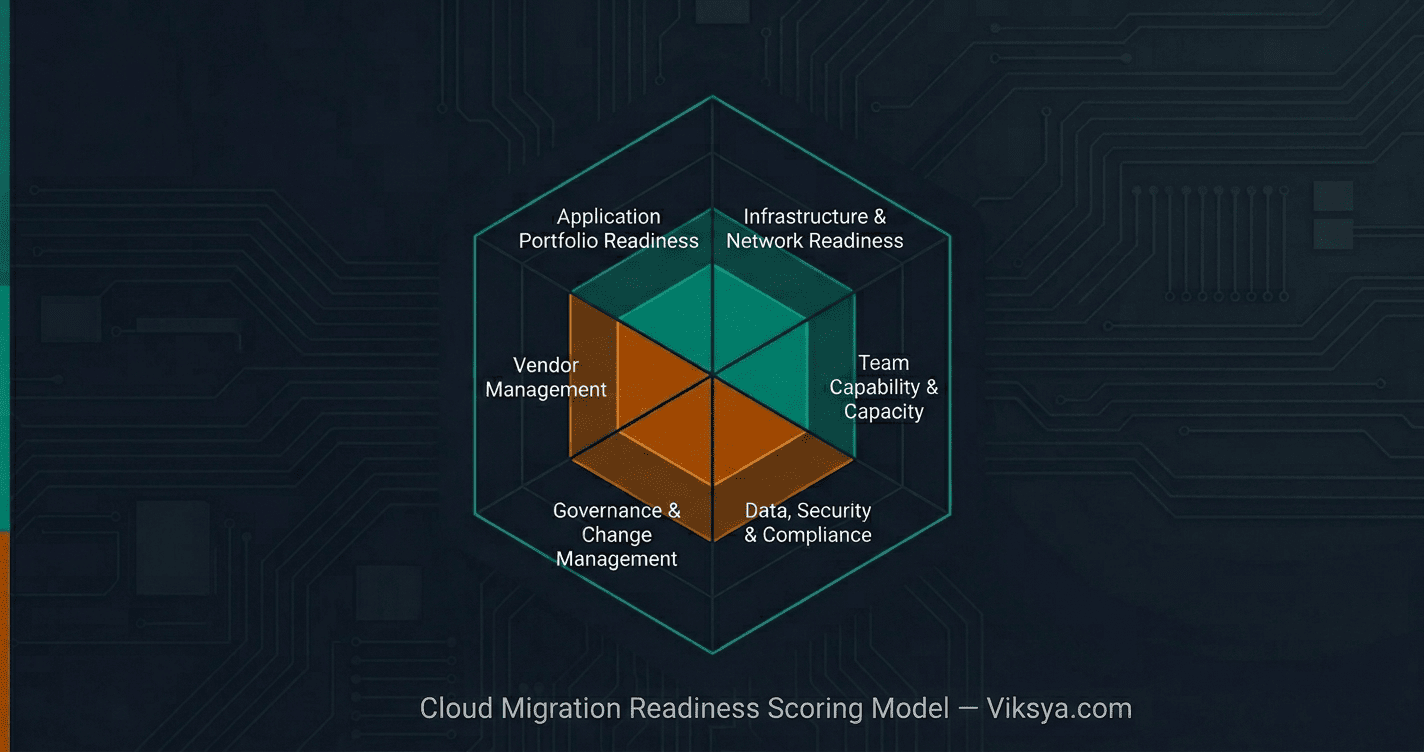
The Cloud Migration Readiness Scoring Model assesses 6 dimensions and 30 criteria before your first workload moves. Here is what it covers, and why every dimension carries a different weight.
Executive Summary
Most enterprise cloud migration programs fail for four predictable reasons: application portfolios are not properly catalogued before wave planning begins; security and compliance obligations are discovered mid-migration rather than mapped upfront; vendor dependency risk is underestimated until a key resource rolls off the program; and change management is treated as a post-cutover activity rather than a parallel workstream. The Cloud Migration Readiness Scoring Model surfaces all four of these failure patterns — and eleven others across 30 criteria — before the first workload moves.
Most Migration Programs Confuse Speed with Readiness. That Is Not the Same Thing.
The pressure to start is real. The board has approved the cloud strategy. Contracts are signed. The system integrator is mobilised. In this environment, running a structured readiness assessment feels like delay — another gate before the program can move.
That instinct is exactly backwards.
The programs that take three weeks at the start to assess readiness against a structured framework consistently outperform the ones that launch fast and discover readiness gaps mid-delivery. An application inventory gap found before wave planning is a planning problem. The same gap found after wave 1 has started is a crisis.
A readiness gap found before the first workload moves costs a conversation. Found after cutover, it costs a rollback, a regulatory incident, or a program reset.
The Cloud Migration Readiness Scoring Model was built to surface these gaps early — systematically, across six dimensions, weighted by their relative impact on program success.
The Six Dimensions — What Each One Covers and Why the Weight Matters
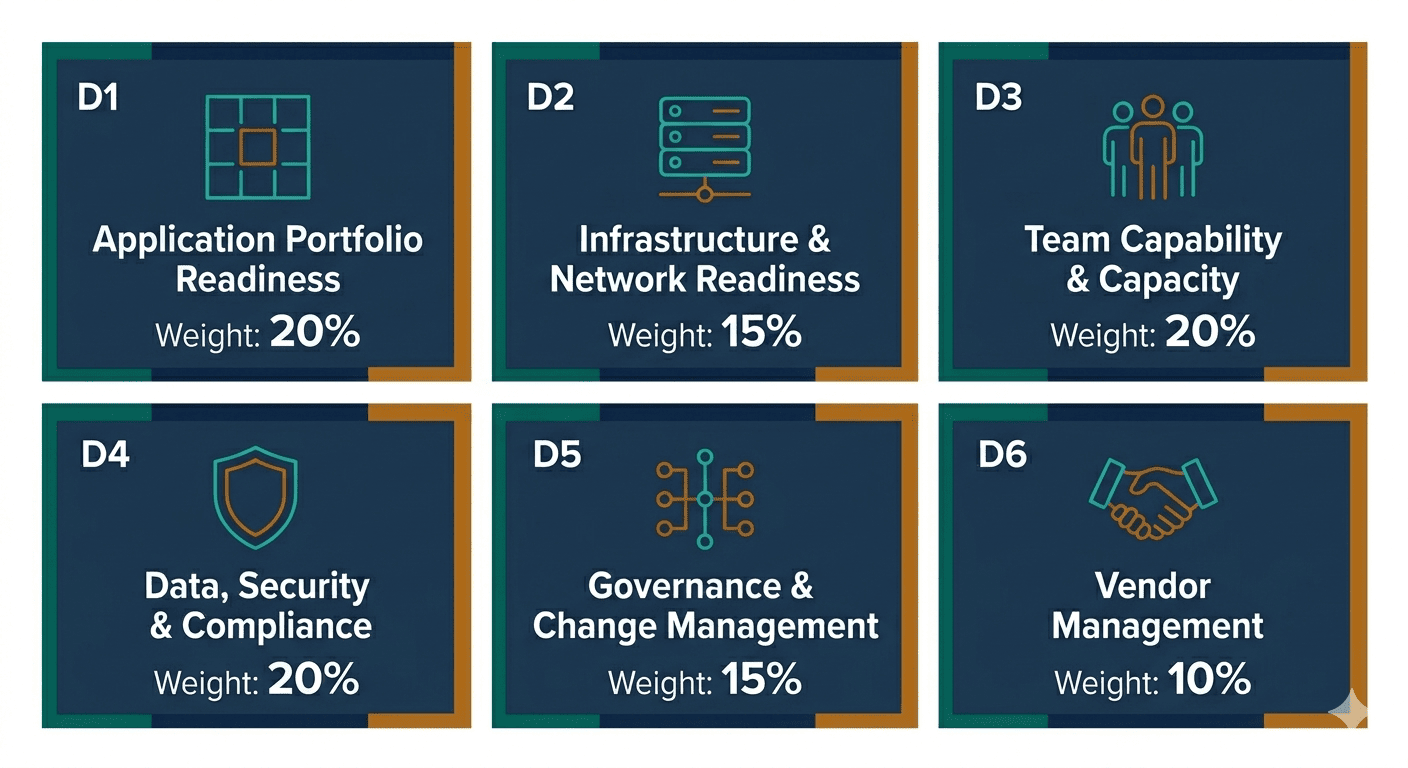
The model distributes its 100% weight across six dimensions — not equally. The weights reflect the actual failure patterns observed in cloud migration programs, not a theoretical framework. Dimensions that most directly predict whether the program reaches production safely carry higher weight.
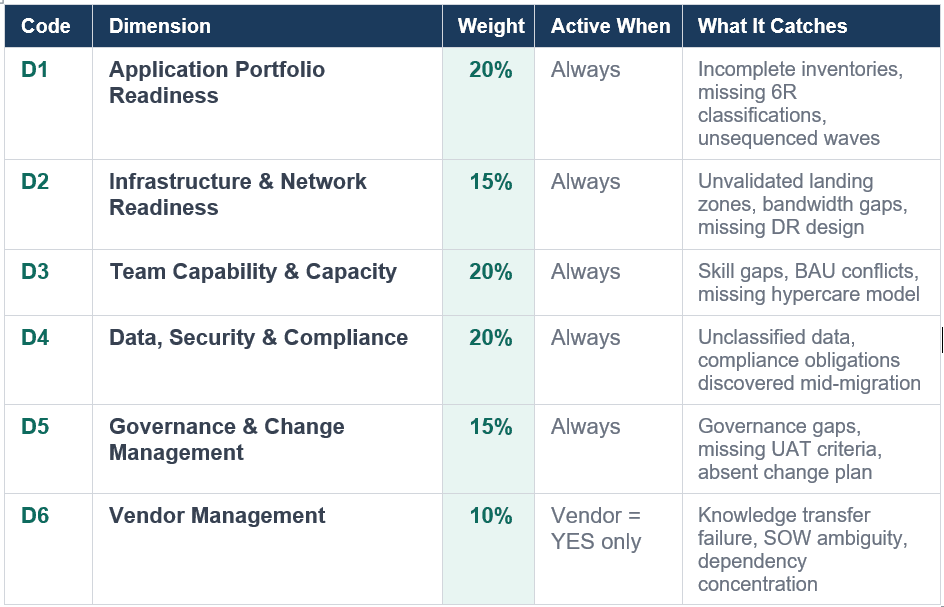
D1 — Application Portfolio Readiness (20%)
Migration cannot begin before you know what you are migrating, where it runs, and how it should be treated in the cloud. This sounds obvious. It is consistently under-done.
The dimension assesses five criteria, starting with whether your application inventory is complete and whether every in-scope application has a cloud suitability classification — the 6Rs framework: Retire, Retain, Rehost, Re-platform, Refactor/Re-architect, or Relocate. Applications without a 6R classification cannot be wave-sequenced. Wave sequencing without 6R classifications is guesswork.
The second criterion — application dependency mapping — is where the largest number of mid-migration incidents originate. Server-to-server dependencies, application-to-database relationships, and third-party integration chains that are not mapped before wave design will surface during cutover, in the worst possible moment.
The remaining three criteria assess whether migration wave sequencing is defined and baselined, whether business continuity and rollback plans exist per wave, and whether application owners have formally signed off on migration plans — not just been informed.
Key signal from D1
If your application owners cannot describe the 6R classification for their own applications, the program is not ready to sequence waves. Formal sign-off is not a bureaucratic step — it is the mechanism that makes application owners accountable for migration outcomes.
D2 — Infrastructure & Network Readiness (15%)
The cloud landing zone is the foundation on which every migrated workload runs. Provisioning it correctly — with the right VPC structure, IAM baselines, security controls, and network configuration — is not a Day 1 activity. It is a pre-wave activity.
This dimension evaluates five infrastructure criteria: whether the landing zone is provisioned and validated before workloads arrive; whether network bandwidth between on-premises and cloud has been assessed against migration data volumes and post-migration traffic profiles; whether the data centre decommissioning timeline is aligned with wave dates; whether monitoring and observability tooling is configured as part of the landing zone build (not after); and whether disaster recovery and backup strategies are defined per workload criticality, with RTOs and RPOs documented.
The monitoring criterion catches a specific pattern: programs that treat cloud-native observability as an afterthought discover their first production incident without the visibility to diagnose it quickly. CloudWatch, Azure Monitor, and equivalent tools need to be configured before the first workload goes live — not retrofitted after the first outage.
Key signal from D2
If DR design and backup strategy are listed as 'post-wave activities', the program is carrying unquantified risk into production. The time to design DR for a migrated workload is before it migrates — not after it fails.
D3 — Team Capability & Capacity (20%)
The most complete migration plan will fail if the team executing it does not have the skills to deliver it — or the protected time to do so.
This dimension assesses whether the internal team has sufficient cloud architecture and engineering capability, whether the PMO is resourced specifically for cloud migration delivery (wave planning, dependency management, and cutover coordination are distinct disciplines from general project management), and whether team capacity is formally protected from BAU conflicts for the program duration.
The capacity question is consistently underestimated. The most experienced cloud engineers in any organisation are typically the same people carrying the heaviest BAU workload. If their time has not been formally ring-fenced — with documented agreements from functional managers — the program is effectively borrowing capacity it does not have a claim on.
The final two criteria assess whether a hypercare and on-call support model is defined for each wave post-cutover, and whether a cloud operations training program is in place for the teams who will operate migrated workloads in steady state.
Key signal from D3
Ask the lead cloud engineer on your program what percentage of their time is formally allocated to the migration. If the answer is 'I am trying to make it work around my other commitments', the capacity model is not real.
D4 — Data, Security & Compliance (20%)
Security and compliance issues discovered mid-migration are not inconveniences. They are program-stopping events that can trigger regulatory consequences and force rollbacks of workloads already in production.
This dimension covers five criteria: data classification across all in-scope assets (Public / Internal / Confidential / Restricted), encryption standards for data in transit and at rest implemented in the landing zone, compliance and regulatory mapping to cloud controls, security testing planned per wave, and cloud IAM and identity governance operational before wave 1.
The compliance mapping criterion warrants specific attention. Applicable regulations — HIPAA, PCI-DSS, ISO 27001, and for organisations operating in India, the Digital Personal Data Protection Act (DPDP) — each impose specific controls on how data is stored, processed, and accessed in cloud environments. Mapping these obligations to specific cloud service configurations is work that must happen before wave design, not during it.
Security testing — penetration testing and vulnerability scanning — is assessed as a wave completion criterion, not a program-level afterthought. A migrated workload that has not been security-tested before being declared production-ready is a liability, not an asset.
Security reviews that happen after cut-over are not a programme success. They are a risk management failure that happened to go undiscovered — until it didn't.
D5 — Governance & Change Management (15%)
Technical readiness without governance is a program waiting to derail. This dimension assesses the management and organisational infrastructure that determines whether the technical execution actually stays on track.
Five criteria are evaluated: whether a formal governance structure with a steering committee, workstreams, and a RACI is in place; whether a risk and issue management process is active and reviewed regularly; whether a stakeholder communication plan is running and tailored by audience; whether a UAT process with defined entry and exit criteria exists per wave; and whether a change management plan addresses the operational model changes that cloud migration introduces.
The UAT criterion is where many programs have structural gaps. Business teams must validate that migrated workloads perform correctly in the cloud environment before each wave is declared complete. Without defined entry and exit criteria — not just a general sign-off process — UAT becomes a rubber stamp that does not protect against operational failures post-cutover.
The change management criterion is equally significant and more commonly absent. Cloud migration changes how teams operate, which tools they use, and where accountability for system performance sits. Treating this as a post-migration communication exercise rather than a parallel program workstream is one of the most consistent predictors of poor adoption outcomes.
Key signal from D5
If the change management plan was written after the technical workstreams were already running, it is not a plan — it is a retrospective. Change management that runs in parallel from day one has measurable impact. Change management that starts at wave 3 is damage control.
D6 — Vendor Management (10%) — Active When Vendor = YES
Most enterprise cloud migration programs involve an external partner. A system integrator, a hyperscaler professional services team, or a managed service provider typically handles anywhere from 30% to 90% of the technical migration delivery work. The risks this creates are real, distinct, and frequently underweighted in program governance.
This dimension is uniquely configurable. It activates only when the vendor flag is set to YES in the model settings. The model also requires you to specify the Vendor Allocation % — the proportion of migration delivery work performed by the external partner. A program where the vendor handles 70% of technical delivery has materially different governance requirements than one where the vendor is providing specialist support on specific waves.
The five criteria in this dimension assess: vendor delivery governance and performance management (KPIs, SLA tracking, escalation paths); Statement of Work clarity and risk allocation; the knowledge transfer plan from vendor to internal team; internal oversight capability to manage and challenge the vendor; and vendor dependency risk with a documented mitigation plan.
The knowledge transfer criterion catches the most common failure mode in vendor-led programs. Vendors who design and build the cloud environment without executing a structured knowledge transfer leave the internal team operationally dependent on external support for steady-state cloud operations. The day the vendor's lead architect rolls off the program is not the moment to start thinking about knowledge transfer.
Key signal from D6
Ask the vendor: 'What does your knowledge transfer plan look like, and what does internal capability look like six months after you exit?' If the answer is a training schedule and some documentation, that is not a knowledge transfer plan. That is offboarding.
How the Scoring Works — Evidence, Not Aspiration
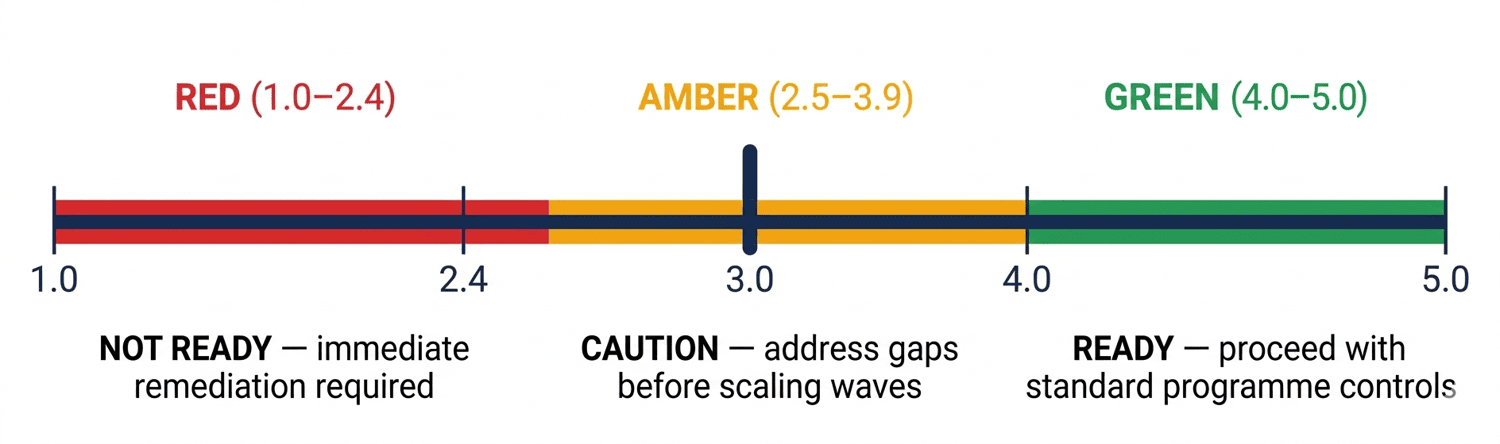
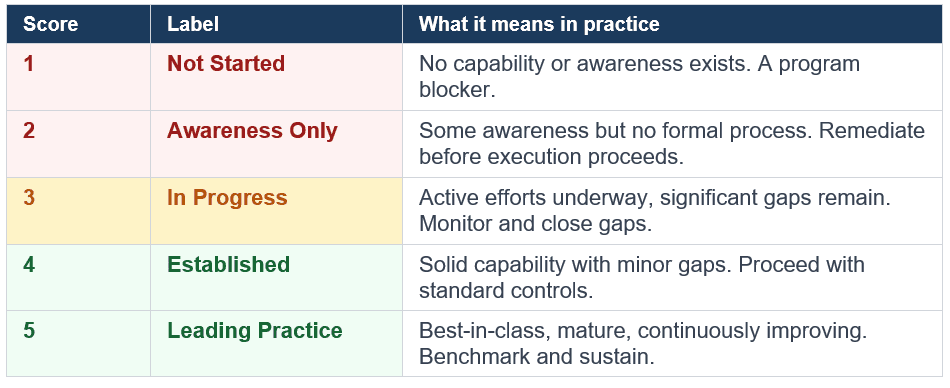
Every criterion is scored on a 1–5 scale:
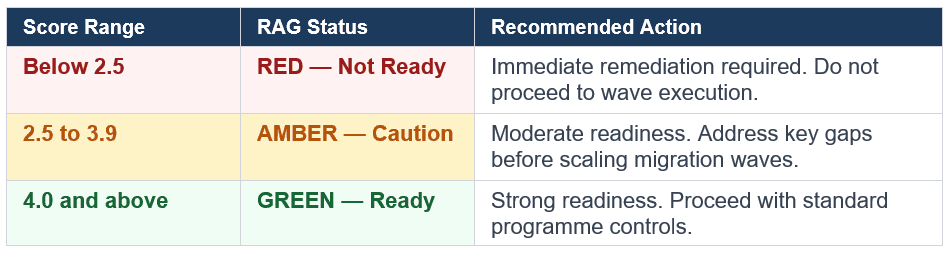
The model calculates a weighted dimension average for each of the six areas. These feed into a single overall Cloud Migration Readiness Score on the same 1–5 scale. The Dashboard maps this score and each dimension to a RAG status:
One principle governs scoring: score what exists today, not what is planned or budgeted. A score of 4 means solid capability exists now. A planned capability that has not yet been tested or implemented is a 2 or 3 at most. Scoring aspirationally produces a dashboard that looks green and a program that is actually amber.
What the Model Delivers
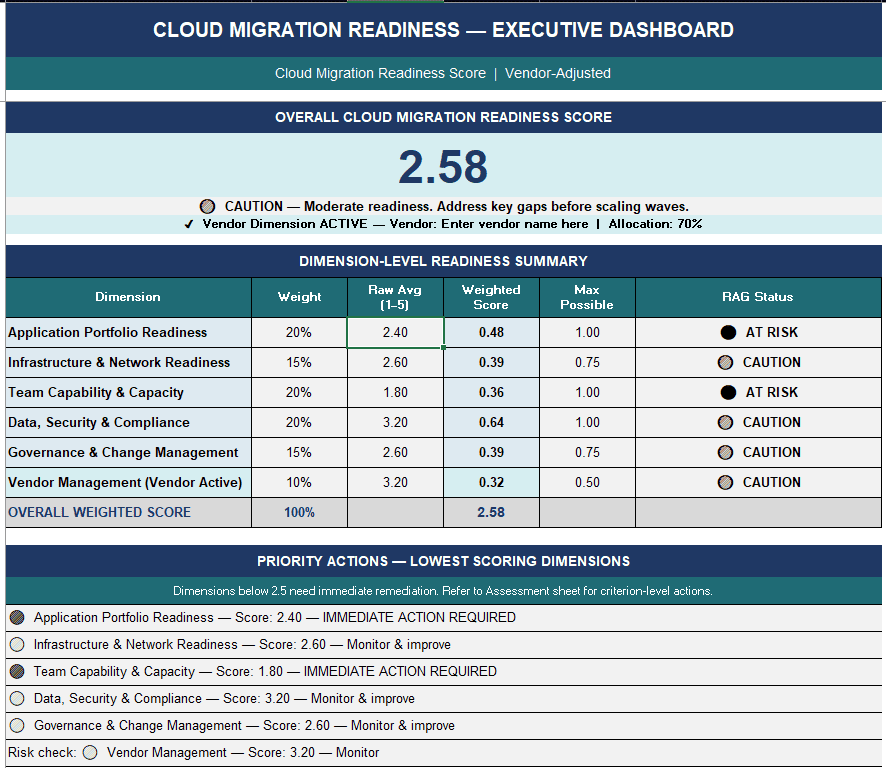
The Cloud Migration Readiness Scoring Model is a four-sheet Excel workbook:
• Instructions — scoring guide, vendor model explanation, and step-by-step usage guidance
• Settings — vendor configuration (YES/NO flag, vendor name, allocation %, contract type), dimension weight adjustments, and programme context inputs
• Assessment — all 30 criteria across the six dimensions, with 1–5 dropdown scoring, an evidence/justification column, and a pre-written recommended action for every criterion
• Dashboard — overall readiness score, dimension-level RAG status, weighted scores, and a priority actions section identifying the dimensions most in need of attention
The model is configurable, not fixed. Dimension weights can be adjusted in Settings to reflect your program's specific risk profile — a financial services migration weights security above all else; a retail cloud consolidation may weight infrastructure decommissioning most heavily. The model enforces that weights always sum to 100%.
It is designed for repeated use. Save a dated copy at each major milestone — wave planning, pilot completion, wave 1 cutover — and use successive assessments to track readiness progression over time. A trend line across three assessments tells a steering committee more than a single snapshot.
Cloud Migration Readiness Scoring Model v1.0
6 Dimensions · 30 Criteria · Vendor-Configurable · RAG Dashboard
Excel workbook — instant download — compatible with Microsoft Excel 2016 and above
→ Download on Viksya.com
Who This Is Built For
The Cloud Migration Readiness Scoring Model is designed for the professionals who are accountable for whether a cloud migration program reaches production on time, on budget, and without regulatory incident:
• Cloud Programme Managers and Directors who need a structured readiness gate before each major milestone
• Enterprise Architects assessing technical readiness across application, infrastructure, and security dimensions
• IT Risk and Compliance teams who need a documented readiness evidence trail for governance and audit purposes
• System Integrators and Cloud Consultants who want a professional, vendor-configurable assessment framework to use with clients — the model contains no vendor or employer branding and is fully white-label ready
• CIOs and CTOs who need an executive-ready readiness picture before committing program resources and timelines to leadership or the board
A note on honest scoring
The evidence column in the Assessment sheet is there for one reason: to anchor scores to reality, not intention. If you cannot point to a specific document, tested process, or operational artefact as evidence for a score, that score should be one lower. A score of 3 that is honest is worth more than a score of 4 that is aspirational.
Frequently Asked Questions
What cloud providers does the model support?
The framework is cloud-provider agnostic. It covers AWS, Azure, GCP, and hybrid environments. Provider-specific tooling is referenced in the recommended actions — for example, AWS Migration Hub for dependency mapping, Azure Migrate for workload assessment — but the scoring criteria apply equally across all platforms.
Can the model be used for a vendor-led migration program?
Yes — that is one of the specific design scenarios for the model. Set Vendor = YES in the Settings sheet, enter the vendor's name and allocation percentage, and the Vendor Management dimension (D6) activates automatically with five dedicated criteria covering governance, SOW clarity, knowledge transfer, internal oversight capability, and dependency risk. When Vendor = NO, D6 is inactive and its weight is redistributed across the remaining five dimensions.
How long does a full assessment take?
A first-pass assessment by an experienced Programme Manager or Enterprise Architect typically takes 1.5 to 2.5 hours. Subsequent reassessments, once the team is familiar with the framework and evidence sources, take 45 to 60 minutes.
Can I adjust the dimension weights?
Yes. The Settings sheet allows you to modify the weight assigned to each dimension to reflect your programme's specific risk profile and priorities. The model includes a validation indicator to confirm that weights sum to 100%.
Is this a one-time tool or can it be used across the programme lifecycle?
It is designed for repeated use. Save a dated copy at each major milestone — wave planning, pilot completion, wave 1 cutover — and use the successive scores to track readiness progression and demonstrate programme maturity to steering committees and executive sponsors over time.
Can consultants use this framework with their clients?
Yes. The model contains no vendor branding, employer references, or proprietary identifiers. Management consultants and independent advisors can use it as a client-facing assessment tool, customise the dimension weights per engagement, and present the Dashboard output directly in steering committee packs or executive briefings.
Start Your Assessment
The Cloud Migration Readiness Scoring Model v1.0 is available for immediate download. It includes all four sheets, all 30 scored criteria across the six dimensions, pre-written evidence guidance and recommended actions for every criterion, the vendor-configurable architecture, and the weighted scoring engine with RAG executive dashboard.
→ Download the Cloud Migration Readiness Scoring Model on Viksya.com
Whether you are running a migration internally, managing a vendor-led delivery, or advising a client on program governance, this framework gives you a structured, defensible, and executive-ready view of readiness — before the first workload moves.