
Hard and Soft Benefits in an AI ROI Case: What Finance Accepts
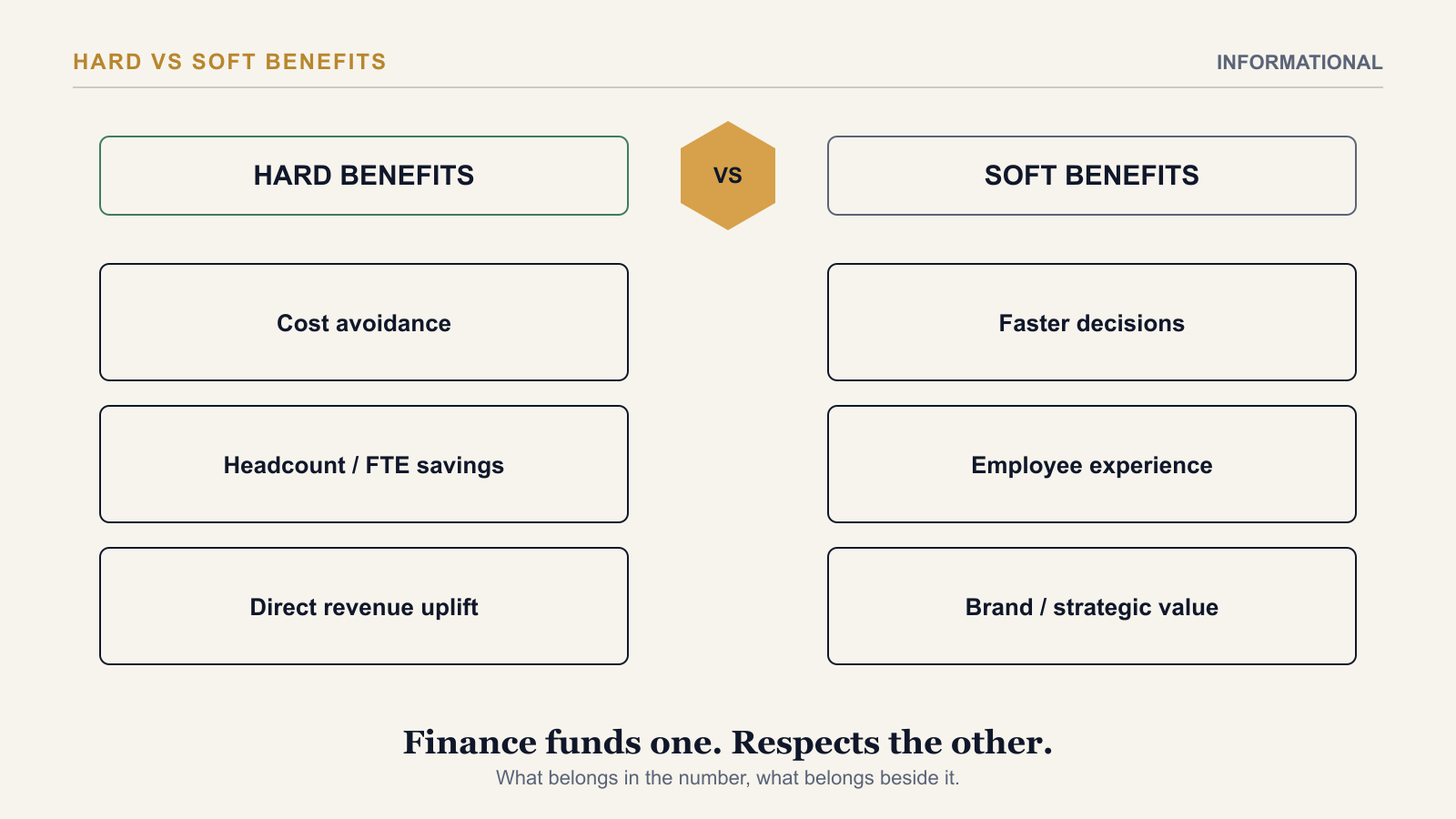
Hard benefits in an AI ROI case are the ones finance will fund on their own — cost avoidance, headcount or FTE savings, and direct revenue uplift, each measurable in dollars with a defensible method. Soft benefits — faster decisions, better employee experience, brand or strategic value — are real, but a business case built primarily on them will not clear a finance review; they belong alongside the hard numbers, not instead of them.
What Makes a Benefit "Hard"
A hard benefit has three properties: it can be quantified in dollars, it can be attributed specifically to the AI initiative rather than to something else happening at the same time, and it can be verified after the fact by re-measuring it. Cost avoidance — fewer errors, less rework, reduced manual processing — qualifies when the baseline error or processing rate was measured before the system went live. Headcount or FTE savings qualify when a specific role's hours are freed up and reallocated or reduced. Revenue uplift qualifies when it can be traced to the AI system's output, not to a marketing campaign or a seasonal pattern running in parallel.
What Makes a Benefit "Soft"
A soft benefit is real — faster decision cycles, better employee experience, stronger brand positioning, reduced strategic risk — but resists at least one of the three hard-benefit properties. Faster decisions are genuinely valuable, but putting a precise dollar figure on "decided two days sooner" requires assumptions stacked on assumptions. That does not make the benefit fake. It makes it the wrong kind of evidence to carry the primary funding argument.
Where the Line Actually Moves
Some benefits that start soft can be converted to hard with the right measurement design. "Faster decisions" is vague; "reduced inventory carrying cost because replenishment decisions that used to take five days now take one" is a hard benefit, because it is quantifiable, attributable, and verifiable once the system is live. The conversion requires deciding, before launch, exactly what downstream outcome the faster decision is supposed to produce — and measuring that outcome, not the speed itself.
How to Present Both Without Inflating the Case
Let hard benefits drive the funded ROI number — the figure that feeds NPV, IRR, payback, and the approval decision. Name soft benefits explicitly in the business case, described qualitatively, without assigning them a speculative dollar value just to make the headline number bigger. A business case that monetises a soft benefit with a guessed figure is easy for an experienced finance reviewer to spot, and it damages the credibility of the hard numbers sitting right next to it. The common mistake runs the other way, too: dropping soft benefits from the document entirely because they cannot be monetised cleanly — which throws away genuinely useful context a steering committee will want, especially when the case's hard-benefit total is thin and needs a secondary rationale.
A Hypothetical Illustration
Picture an AI deployment that reduces average case-handling time by 20%. Converted into a hard benefit, that is straightforward: baseline handling time was measured before launch, fewer hours means fewer FTE-hours needed for the same volume, and the saving can be priced at the fully-loaded hourly cost of the role. The business case also notes, qualitatively and without a dollar figure, that agents report the tool makes the job less repetitive and turnover on the team has fallen since launch. Finance funds the case on the handling-time saving. The retention observation sits in the document as context — real, worth mentioning, and not asked to carry weight it was never measured carefully enough to bear.
The AI Investment ROI Model's Benefit Modelling tab separates quantified categories — productivity gains, cost avoidance, revenue uplift, and risk reduction — each risk-weighted and time-profiled, so the funded ROI number is built entirely from benefits that meet the hard-benefit bar.
→ Available at www.viksya.com