
How Much Does an Enterprise AI Project Cost, and What Drives the Range
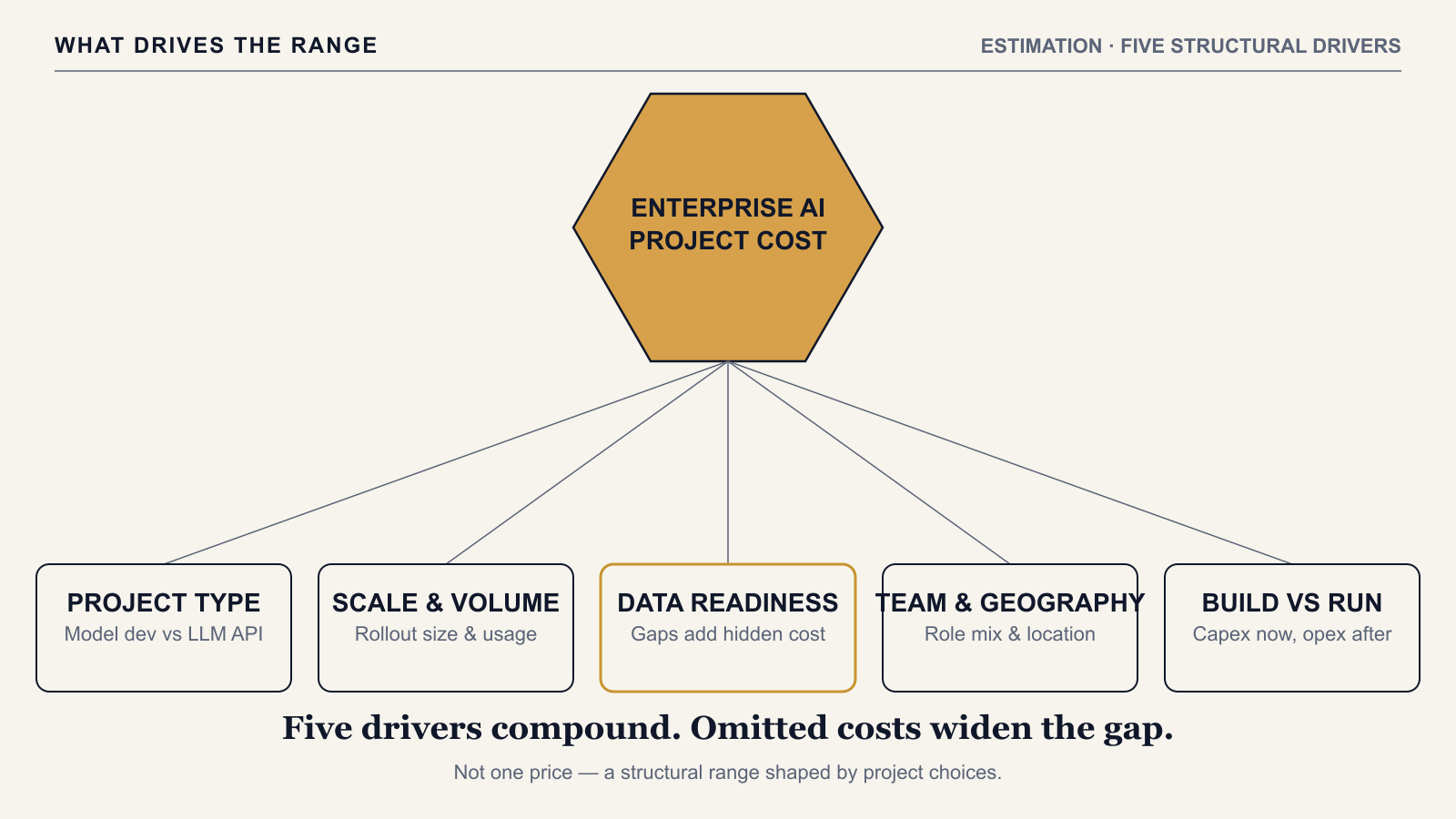
There is no single number that answers how much an enterprise AI project costs, because AI programmes do not sit on one cost curve — they sit on several, set by a handful of structural choices made early in scoping: which kind of AI project this actually is, how large the rollout gets, how ready the organization's data already is, who builds it and where, and whether the figure in front of you is the one-time build or the ongoing bill after go-live. Get those choices right early and a defensible range follows. Guess at them, and the number presented to a steering committee will not survive contact with delivery.
Why "What Will This Cost" Has No Single Answer
Most AI project budget conversations start with a single number pulled from a vendor pitch deck or a peer's hallway story. Real AI project budgets start with the handful of variables that actually move it, because the same stated scope — "build us an AI system for X" — can land anywhere across a wide range depending on which of the drivers below apply to it. We cover the full mechanics of building a credible estimate, phase by phase, in How to Estimate an AI Project Cost: Model Development vs LLM Integration. What follows is the shorter version: the structural reasons the number moves at all, so a sponsor reading an estimate knows what to interrogate before signing off on it.
Driver One: Which Kind of AI Project This Actually Is
The single biggest swing factor is whether the project trains or fine-tunes a machine learning model, or whether it builds application logic around an existing model reached through an API. These are structurally different undertakings, with different effort drivers and different non-linearity profiles — the degree to which added complexity multiplies cost rather than simply adding to it. Applying a model-development cost structure to an LLM-integration project, or the reverse, does not just nudge the total a little: it can overstate costs by 40 to 80 percent in one direction, or understate them by the same margin in the other, which is exactly why the project-type decision has to be made before any other line item is estimated, not inferred from the total afterward.
Driver Two: Scale, Volume, and How Far the Rollout Goes
A pilot serving one team through a single workflow and the same system rolled out across every regional office scale very differently, and in different ways depending on project type. For a model-development project, non-linearity shows up again here: broader scope usually means more data sources, more edge cases, and more integration points, each adding complexity rather than simply adding hours. For an LLM-integration project, scale shows up primarily as call volume — how many requests the system handles per day, and how much context each one carries — which becomes the largest driver of the ongoing token bill once the system is live. Picture an organization that scopes and budgets a pilot for fifty users, then approves a full rollout to its entire customer-service organization three months later: the one-time build cost barely moves, but the ongoing token bill, which scales with usage rather than with the original scope statement, can grow by an order of magnitude without a single line of code changing.
Driver Three: How Ready the Organization's Data Already Is
The AI Project Estimation Model's non-linearity engine treats data maturity as one of the factors that multiplies cost rather than simply adding to it, alongside model novelty and integration burden. An organization with clean, governed, well-documented data moves through discovery and data engineering close to the base estimate. An organization that discovers mid-project that the data it assumed was usable needs cleaning, relabeling, or a governance fix absorbs that cost on top of the original number, not instead of it. Data readiness is rarely visible at the point a budget is first approved, which is exactly why it belongs in the estimate as a named multiplier rather than an assumption carried silently inside a contingency line.
Driver Four: Who Builds It, and Where
Labour is the largest single cost category in almost every AI project, and who does the work — their seniority, their role, and where they are based — moves the total as much as anything on this list. Day rates for the same role can vary by well over half depending on geography, and the mix of roles required — data engineers, ML engineers, MLOps, project management, change management, QA — shifts depending on project type. Two projects with an identical scope statement can land at very different totals once the delivery model — an in-house team, a specialist consultancy, or staff augmentation across a distributed workforce — is decided, which is why the team and geography assumptions behind an estimate deserve as much scrutiny as the technical scope itself.
Driver Five: Whether You're Pricing the Build or the Run
An estimate that stops at go-live is not the full economic picture, and conflating the two is one of the more common ways an AI project's true cost of implementation looks smaller than it turns out to be. Development and training compute are capital costs, incurred during the build and finished at go-live. Production inference, hosting, and the ongoing MLOps work of monitoring and retraining a live model are operational costs that start at go-live and continue for as long as the system runs — for an LLM-integration project in particular, this ongoing line can overtake every other cost category at production scale. A credible AI project budget keeps these two figures separate rather than quoting the capital number as if it were the whole answer.
The Costs That Don't Show Up Until They Do
A smaller set of costs sits outside the core estimate entirely, and widens the gap between what was budgeted and what delivery actually spends: the change-management work of getting an organization to adopt what gets built, the ongoing monitoring and retraining a deployed model needs once it is no longer new, the data labelling a supervised model needs if the right labelled data does not already exist, and the internal time business teams spend on requirements and testing that never shows up as a line on an invoice. None of these are exotic. They are simply the costs most initial estimates leave out, because they only become visible once the project is already underway — which is why a defensible estimate accounts for them by name rather than folding them into a generic contingency line and hoping it is large enough.
Why a Range Beats a Single Number
Put the five drivers together and a single-point estimate is not more precise than a range — it is less honest about where the uncertainty actually sits. A confidence-ranged estimate, stating a most-likely figure alongside more conservative, risk-adjusted figures, tells a sponsor what the organization is actually confident about, and what it is still assuming. That is the structural reason "how much does an AI project cost" resists a one-line answer: the honest answer is a range, built from the five drivers above, not a single figure rounded to look more precise than it is.
The AI Project Estimation Model provides a P50/P80/P90 confidence-ranged cost and effort estimate across 11 Excel tabs, applying a non-linearity multiplier for AI-specific complexity, a dedicated LLM token cost model, and an automatic CAPEX/OPEX split — the five drivers above, modelled rather than guessed.
→ Available at www.viksya.com