
How to Build an AI Use Case Scoring Model
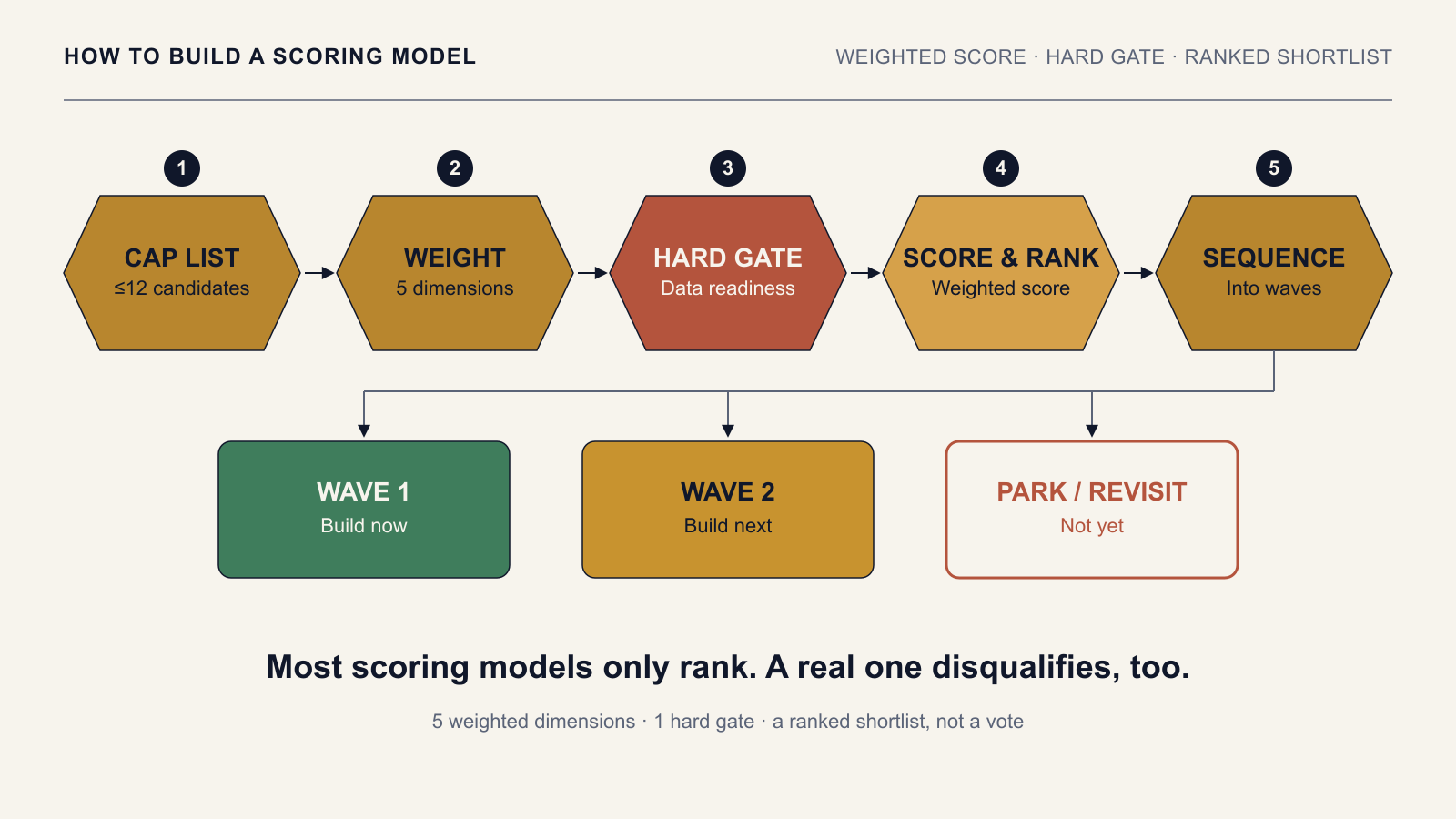
An AI use case scoring model is a weighted scorecard that ranks a bounded list of candidate AI initiatives against a fixed set of dimensions — typically business value, feasibility, data readiness, time to value, and risk — so a composite number decides which use case gets built first, not a show of hands in a steering committee. Building one well comes down to four mechanics: capping the candidate list, assigning weights before anyone sees a score, building in at least one hard gate that disqualifies rather than merely penalizes, and scoring against a rubric consistent enough that two raters land close to the same number. Get those four right and the model produces a defensible Wave 1 shortlist; get them wrong and it produces an elaborately justified version of whichever use case the loudest person in the room already wanted.
Why a Scoring Model Replaces a Workshop Debate
Most AI programs don't lack candidate use cases. They lack a way to choose among them that survives contact with a steering committee. A workshop where five sponsors each argue for their own initiative produces a list ordered by seniority and conviction, not evidence. A scoring model fixes that by forcing every candidate through the same dimensions, the same weights, and the same rubric before a ranking exists at all. The model doesn't remove judgment from the room — someone still decides which dimensions matter and how heavily to weight each one — but it moves that judgment to before scoring starts, where it's visible and gets debated once, instead of after scoring, where it quietly resurfaces as "let's just bump this one up a bit."
Step 1: Cap the List Before You Score Anything
A scoring model that tries to rank fifty ideas produces fifty mediocre data points and a facilitation exercise that collapses under its own weight. Fix the list first. A dozen candidates is a workable ceiling for a single scoring pass — not because good ideas beyond that number don't exist, but because a model only earns its keep when every rater can hold the full candidate set in their head while scoring any one of them against it. Candidates beyond the cap don't disappear; they wait for the next cycle, re-scored against whatever made this wave's cut. The AI Use Case Prioritization Framework caps its use case register at twelve entries for exactly this reason — the ceiling is a feature of a workable model, not a limitation of the tool enforcing it.
Step 2: Pick Dimensions, Then Make the Weights Do Something
Which specific criteria belong in the model, and how many of them, is its own question — worth settling deliberately before weighting starts. What matters here is what happens once that list exists: every dimension needs a weight, and the weight needs to be decided before any use case is scored, not adjusted afterward to make a preferred candidate land where the room already wanted it. A model with uneven weights behaves very differently from one where every dimension counts the same, and an organization that skips the weighting conversation entirely is making that choice by default, not avoiding it.
A concrete anchor for what a dimension set looks like once it's actually scored, not just discussed in a workshop: the Viksya framework uses five dimensions — business value, implementation feasibility, data readiness, time to value, and risk and sensitivity — each broken into five sub-criteria. Revenue impact and strategic alignment sit inside business value; technical complexity and vendor dependency sit inside implementation feasibility; regulatory risk and model explainability sit inside risk and sensitivity. That structure matters for the mechanics of a scoring model generally, independent of which five dimensions a given organization lands on: a dimension scored as a single number from a vague prompt ("how feasible is this, one to five?") produces a different number from every rater; a dimension broken into specific sub-criteria and rolled up into one score is closer to repeatable.
Step 3: Build In a Hard Gate, Not Just a Penalty
A weighted score alone has a structural weakness: a use case can be weak on one dimension and strong enough everywhere else that the weighted average still looks respectable. For most dimensions, that's a fair outcome. For at least one dimension in most AI programs, it isn't — a use case with no viable data foundation doesn't become buildable because its business-value score is high, and averaging the two together just defers the discovery of that problem to six months into delivery.
The fix is a hard gate: a dimension where a low score removes the use case from the current wave outright, rather than dragging its composite average down a little. The Viksya framework applies exactly this logic to data readiness — a use case that fails the gate is flagged and excluded from Wave 1 regardless of how it scores elsewhere, with its own dedicated hard-gate check step in the workflow rather than being buried inside the composite number. Decide which dimension in your own model deserves that treatment before scoring starts, not after a use case everyone likes turns out to fail it.
Step 4: Score Against a Rubric, Not a Vibe
A scoring model is only as consistent as the instructions given to whoever fills in the numbers. Two raters scoring the same use case against "implementation feasibility, one to five" without a shared definition of what a 3 looks like versus a 4 will produce two different numbers — and the gap between them has nothing to do with the use case. It reflects who scored it. A written rubric, one short description per score per dimension, closes most of that gap before it opens: it defines what evidence justifies a 5, what justifies a 2, and what a "we don't actually know yet" response should score as, rather than leaving that case to whichever rater is feeling optimistic that day.
Step 5: Weight, Sum, Rank
Once every candidate has passed any hard gates and has a rubric-backed score on each remaining dimension, the model itself is mechanical: multiply each dimension's score by its weight, sum the results into one composite number per use case, and rank the surviving candidates by that number. Nothing about this step should involve judgment — the judgment already happened when the dimensions, weights, and rubric were set, and when the hard gate removed whatever didn't belong in the ranking at all. If the composite ranking produces a result the room doesn't like, the honest response is to revisit the weights openly, not to override the ranking quietly.
Step 6: Turn the Ranking Into a Build Sequence
A ranked list isn't yet a plan. It still has to turn into a decision about what gets built now versus later. The common pattern is a small number of bands: a top band funded immediately, a middle band deferred to the next wave, and a bottom band parked pending more information or a materially different score next cycle. The Viksya framework automates this step directly off the composite ranking, sorting surviving use cases into Wave 1, Wave 2, or Park/Revisit without a separate manual ranking exercise. Whatever thresholds a given organization sets for its own bands, the principle holds: the bands should follow from the score, not from how senior the sponsor is.
Step 7: Check the Shape of the Shortlist, Not Just the Order
A ranking can be individually correct and still produce a bad shortlist if the shape of the result creates a different kind of risk — five of the top six use cases all sponsored by the same business unit, say, or a first wave with no quick, low-complexity win anywhere in it to prove the delivery team can ship. That's a portfolio question, not a per-use-case scoring question, and it needs its own check after ranking, not instead of it. The Viksya framework runs a portfolio balance check for exactly this reason, flagging concentration risk — for example, when Wave 1 leans too heavily on a single business unit — before it becomes a delivery problem rather than after.
A Worked Hypothetical
Picture an organization that has fixed its candidate list at ten AI use cases, scored each one across the five dimensions above, and applied the data-readiness hard gate. Two candidates fail the gate outright — a predictive-maintenance idea with no usable sensor history, and a personalization engine with customer data still spread across three unreconciled systems — and move to Park/Revisit regardless of how promising their business-value score looked on paper. Of the eight that pass, the composite ranking puts a customer-support deflection tool and an internal document-search assistant at the top, both sponsored by the same operations leader. The portfolio check flags that concentration before Wave 1 is finalized, and a sales-proposal generator sponsored by a different business unit is added to balance it, even though its composite score is lower than the next-ranked candidate it displaces. Nobody overrode the scoring. The portfolio check simply did the job it was built to do.
None of this requires more than a shared spreadsheet, a defined set of dimensions, and the discipline to set weights and gates before scoring starts rather than after. The mechanics — cap the list, weight deliberately, gate what deserves gating, score against a rubric, sum and rank, then check the portfolio shape — hold whether an organization builds its own model from scratch or starts from an existing one. The model exists to make the first wave defensible to a board, not merely plausible to the room that picked it.
The AI Use Case Prioritization Framework provides a 7-tab Excel workbook that scores up to 12 candidate use cases across five weighted dimensions (25 total sub-criteria), applies a data-readiness hard gate that excludes use cases lacking a viable data foundation from Wave 1, and outputs a ranked Wave 1 / Wave 2 / Park-Revisit shortlist with a portfolio balance check and a one-page executive summary.
→ Available at www.viksya.com