
Seat Licences vs Consumption Pricing: Modelling Copilot and Agent Costs
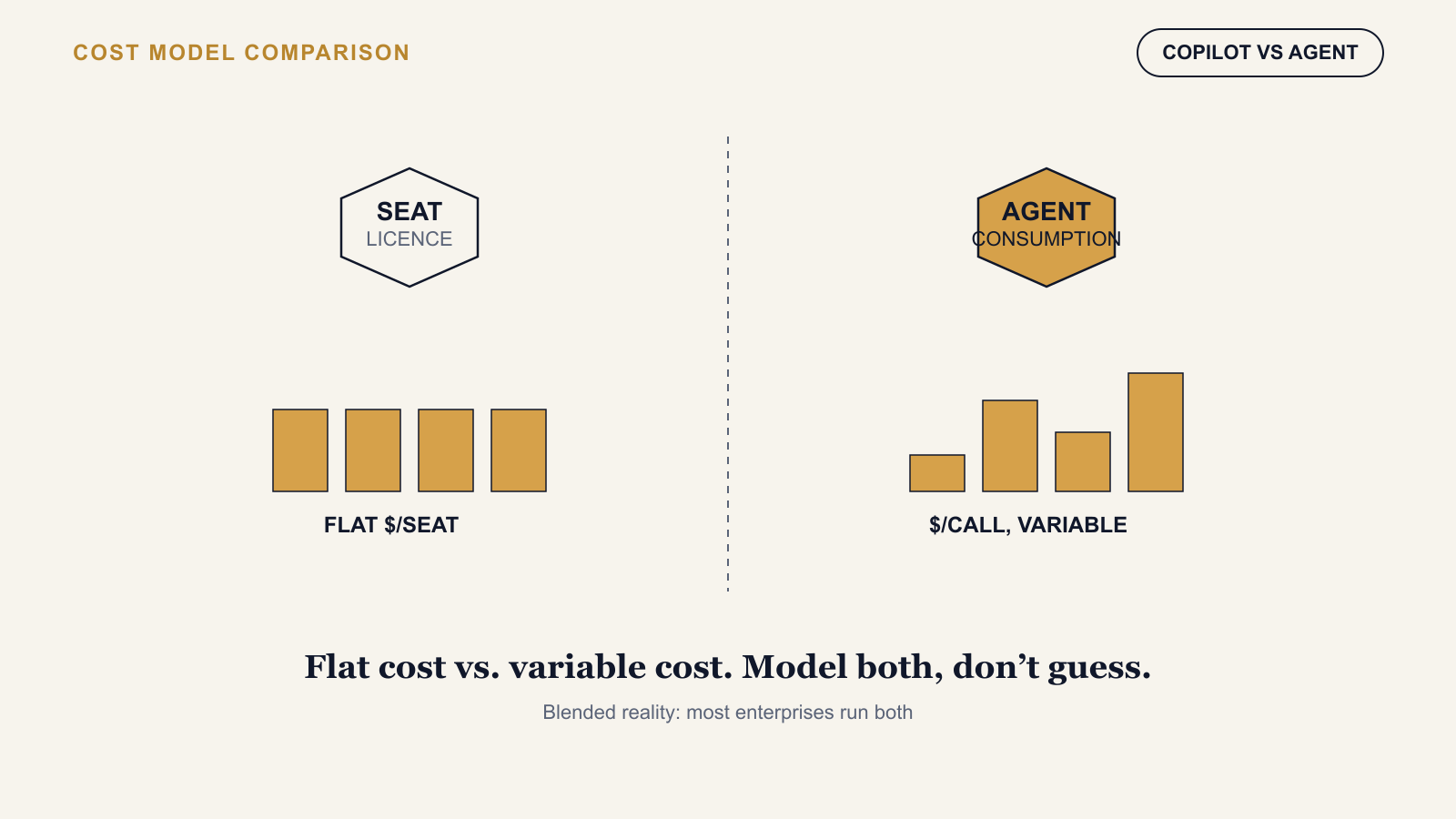
Seat-licence pricing (a fixed per-user monthly fee, like Microsoft Copilot) and consumption pricing (a per-token or per-call charge, like a custom agent built on an LLM API) model AI cost in fundamentally different ways: licence cost is flat and scales with headcount, consumption cost is variable and scales with usage. Modelling them side by side means building two different cost curves, not applying one cost model to both and rounding.
How Each Model Behaves as Usage Changes
A seat licence costs the same once headcount is set, whether a given seat is used fifty times a day or once a month — the fee is a sunk cost either way, which means cost is predictable but does not fall when usage is low. Consumption pricing sits near zero at idle and rises with every call made, which means monthly cost is harder to predict in advance but stays proportionate to the value actually being extracted, with no "paid-for-but-unused" seat sitting on the books.
Where Seat Licensing Wins
Flat-fee licensing amortizes well when usage is high, predictable, and broad across many users doing similar light tasks — drafting emails, summarizing documents, routine assistant-style work. When most licensed seats are actually used regularly, a flat fee is simpler to budget and easier for finance to approve than a variable line, and budget predictability often matters more to a finance review than squeezing out the last percentage point of usage efficiency.
Where Consumption Pricing Wins
Consumption pricing wins on narrow, high-volume, automatable workflows — a single agent processing thousands of support tickets or document reviews — where the per-unit cost at scale undercuts what an equivalent number of seat licences would cost. It also wins structurally wherever usage is sparse or uneven across a large notional user base, avoiding the classic "shelf-ware" problem of enterprise software: licences purchased for access that goes mostly unused, a cost consumption pricing never generates in the first place because there is no fee for a call that was never made.
The Blended Reality Most Enterprises Actually Face
Most organizations running both a broad, Copilot-style assistant and one or more narrow, custom agents end up with a blended cost model rather than a single pricing lens: licence cost for the tools used broadly and lightly, consumption cost for the agents used narrowly and heavily. The business case has to carry both cost types side by side, compared each against the specific benefit it drives, rather than forcing either pricing model onto a workflow it doesn't fit.
A Hypothetical Illustration
Picture a two-hundred-person department with a broad Copilot-style licence rolled out to every employee, alongside a single custom agent handling a narrow, high-volume document-classification workload. Utilization on the broad licence turns out to be uneven — a meaningful share of seats see light, occasional use, while a smaller group uses it daily. The narrow agent, by contrast, runs at near-constant volume because it is wired directly into a production workflow rather than opened voluntarily by a user. Modelled honestly, the broad licence's true cost per active user is higher than the sticker price suggests once the unused seats are accounted for, while the agent's consumption cost tracks almost exactly with the value it produces, because every call it makes corresponds to a document actually processed. Neither pricing model is wrong for its workload. Applying the wrong one to either workload would be.
Building the Comparison Into the Business Case
Model seat cost as seats multiplied by the monthly fee, and treat utilization rate — the share of licensed seats actually active — as an explicit variable rather than an assumed 100%, since that assumption is almost always wrong in the direction that flatters the licence case. Model consumption cost as projected call volume multiplied by per-call cost at the model's current pricing tier. Compare each line against the specific benefit it drives rather than against a single blended ROI figure, so a steering committee can see which pricing model is actually earning its cost and which is carrying unused capacity.
A Question Worth Asking Before Either Model Is Locked In
Before committing to a pricing model for a given workflow, it is worth asking a simple question the comparison itself tends to answer: would a flat fee still be worth paying if usage dropped to the lowest realistic level this workflow might see, and would a consumption fee still be affordable if usage spiked to the highest realistic level it might reach? A workflow that fails the first test is a weak candidate for seat licensing. A workflow that fails the second is a weak candidate for unmanaged consumption pricing, and may need a spend cap or tiered-rate agreement built into the contract before it goes live, not after the first unexpectedly large invoice.
The AI Investment ROI Model provides a 10-tab Excel workbook with NPV, IRR, payback period and benefit-cost ratio calculated across Conservative, Base and Stretch scenarios, with a Cost Model tab covering full total cost of ownership — one-time build costs, ongoing operational costs, and licence and infrastructure spend — so either pricing model's cost line can be entered and compared against the benefit it drives.
→ Available at www.viksya.com