Staged AI Investment Gates: The Smarter Way to Fund AI Programs
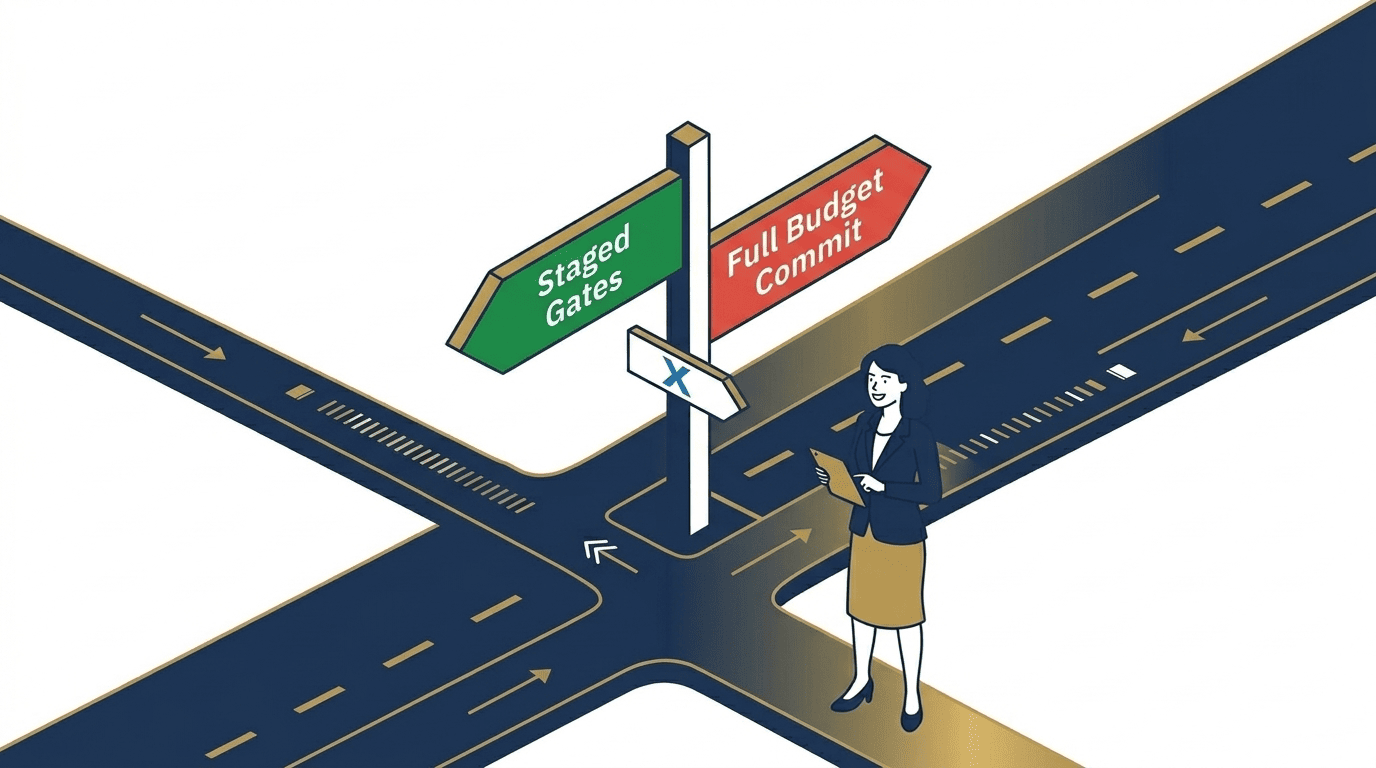
A single lump-sum budget request signals that you do not understand how AI delivery actually works. Staged investment gates signal that you do — and finance responds to that difference.
There is a particular kind of silence that falls in a finance review when a program leader presents a full AI program budget as a single upfront number.
It is not the silence of agreement. It is the silence of a CFO calculating how much of that number they actually believe, and how much buffer they should cut before approving it.
The problem is not the number itself. The problem is the structure. A single lump-sum AI budget request implicitly claims something that no AI program team can honestly claim: that the outcome is predictable enough to justify committing the full investment before a single line of model code has been validated against real data.
AI delivery does not work that way. The organisations that fund AI programs most effectively — and that maintain finance team trust throughout delivery — do not request full program budget upfront. They structure the investment as a series of staged gates, each tied to a defined model performance milestone, each releasing the next tranche of funding only if the previous gate criteria are met.
This post explains why that structure matters, how to design it, and what the financial mechanics look like when it is presented correctly to a finance team.
A program leader who voluntarily ties their funding to performance milestones is signalling confidence in the work — not uncertainty about it. Finance reads that signal correctly. A staged gate structure is not a hedge. It is a demonstration of delivery discipline.
The Fundamental Mismatch Between AI Delivery Economics and Traditional Budget Approval
Standard enterprise budget approval assumes that the scope of what is being built is knowable upfront. In software development — even Agile — this is roughly true. You can scope a feature, estimate the build effort, and forecast the cost within a reasonable confidence interval. The cone of uncertainty narrows as delivery progresses.
AI model development breaks this assumption at its foundation. You cannot fully specify the output of an AI model upfront — you discover what the model can and cannot do by building it. That discovery process is not a failure of planning. It is the nature of the work.
Three things happen during AI model development that do not happen during standard software delivery:
• Data distributions surprise you. The data that looked sufficient during scoping turns out to have quality issues, gaps, or distributions that do not reflect the production environment the model needs to serve. Addressing this sends you back to an earlier stage.
• Feature engineering takes longer than estimated. The variables that the model needs to be useful are not always the ones that are cleanly available in the data. Constructing and validating the right feature set is iterative work that resists point-estimate planning.
• The first model fails the performance threshold. This is the scenario that breaks most single-budget AI business cases. The model performs well on training data and poorly on production data. Or it reaches UAT and the business stakeholders reject it because the accuracy is not sufficient for the decision it is meant to support. A second full training and tuning cycle is required. The cost of that cycle was not in the original budget.
None of these scenarios are failures of execution. They are normal occurrences in AI delivery that experienced practitioners plan for. The organisations that experience them as crises are the ones that structured the investment as a single upfront commitment — because by the time these issues surface, the full budget has already been approved and spent on a plan that no longer reflects reality.
The organisations that manage through them without program-threatening credibility damage are the ones that structured the investment as staged gates — because each gate is a genuine decision point, not a spending checkpoint.
AI development cost is a range, not a number. Any business case that presents a single-point development cost estimate without confidence bounds is either uninformed or optimistic for approval purposes. Finance teams that understand AI delivery know this. The ones that do not will find out mid-program — at which point the conversation becomes significantly harder.
What a Staged Investment Gate Model Looks Like in Practice
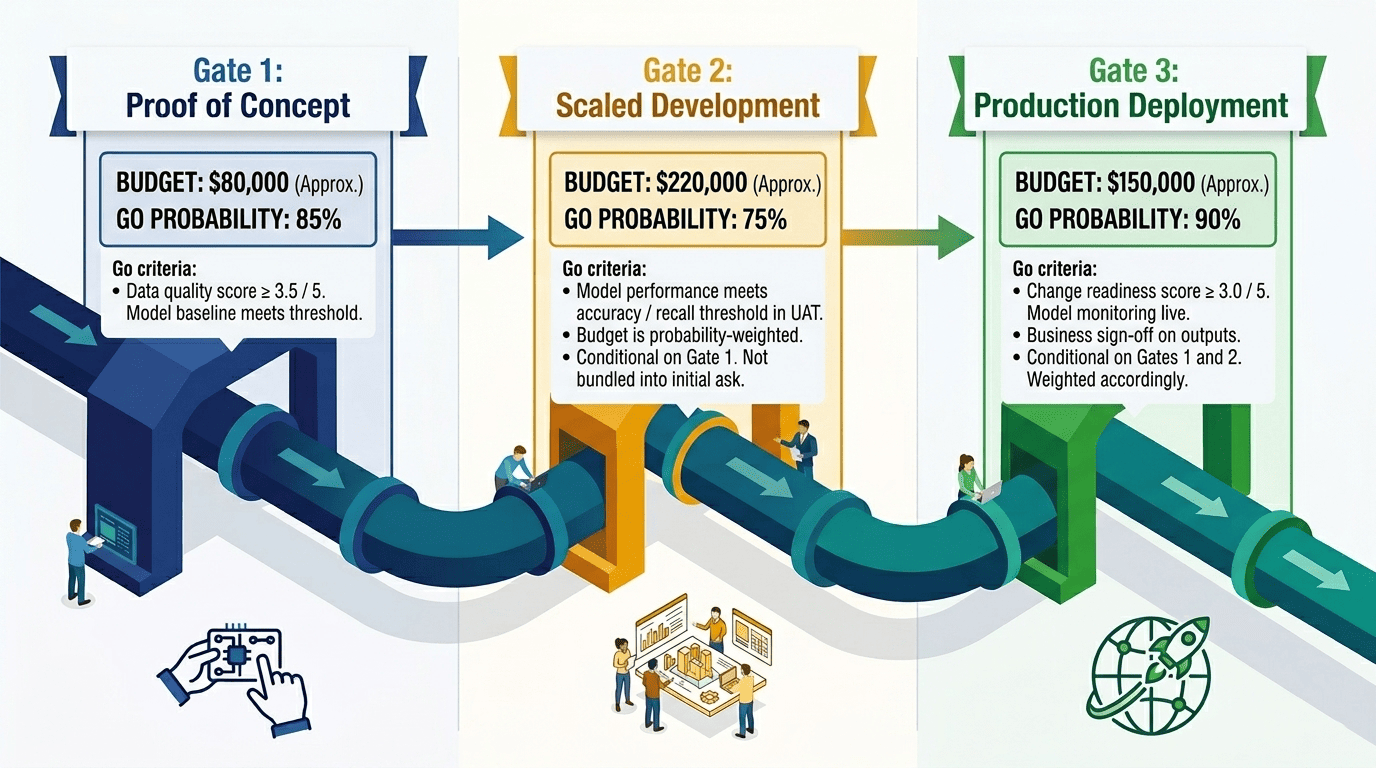
A staged investment gate model structures the total AI program budget into three sequential tranches, each released only if the previous gate's go/no-go criteria are met. The gate criteria are performance-based, not calendar-based — funding moves when the work proves itself, not when time passes.
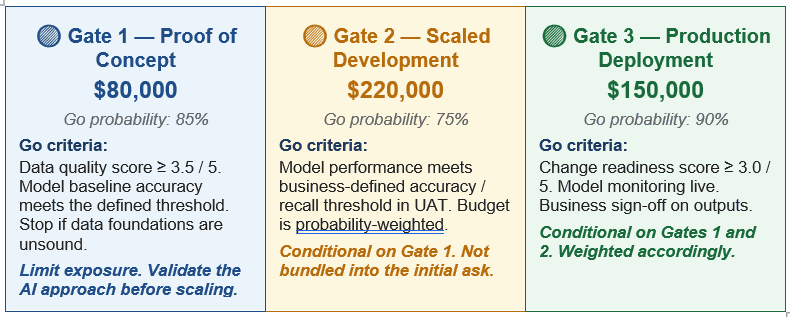
Gate 1 — The Minimum Viable Investment
Gate 1 funds the proof of concept — enough investment to validate that the data foundations are sound and that the AI approach chosen is viable for the business problem at hand.
The Gate 1 budget is the only budget that should be in the initial approval request. Present it to finance as the investment required to answer a specific question: can this AI approach work, given the data we actually have? Gate 1 is not a pilot — it is an evidence-gathering exercise with defined go/no-go criteria built in.
The single most important Gate 1 criterion is data quality. Data quality issues discovered at Gate 1 are manageable. The same issues discovered six months into model development, after Gate 2 budget has been spent, are program-threatening. Stopping at Gate 1 due to data quality failure is not a program failure — it is the gate system working exactly as intended.
Gate 2 — Conditional on Gate 1 Performance
Gate 2 funds scaled model development: the full build, training, and validation cycle for the AI model against production-representative data. Gate 2 budget is presented to finance as conditional on Gate 1 outcomes — it is a contingent request, not a bundled one.
The key Gate 2 criterion is model performance in UAT. Define the performance threshold before Gate 1 begins — not after. A model that meets a threshold the business unit agreed to before it was built has a fundamentally different credibility position than one where the threshold shifts to accommodate whatever the model actually achieved.
Present the Gate 2 budget as a probability-weighted expected investment. If Gate 1 has an 85% go probability, the expected cost of Gate 2 (from the perspective of the initial approval request) is Gate 2 budget × 85%. Present this figure to finance alongside the maximum exposure. A CFO who sees expected cost rather than maximum cost is looking at a program leader who has done the probability arithmetic — which is a material credibility signal.
Gate 3 — Production Commitment, with Change Readiness as a Hard Criterion
Gate 3 funds production deployment and the first wave of adoption. It is the largest single commitment in terms of the program's long-term impact, because it is the gate after which the organisation begins to incur the ongoing operational run cost that continues indefinitely post-program.
Gate 3 criteria should include a change readiness assessment alongside the technical performance criteria. A model that is technically ready for production but being deployed into a business unit that is not prepared to use its outputs will not generate the benefits in the ROI model. Change readiness at Gate 3 is a performance risk, not an organisational nicety.
Gate 3 also marks the transition from CAPEX to OPEX. The deployment and adoption costs in Gate 3 may still be capitalised, but the model monitoring, retraining, and MLOps costs that begin from go-live are operational expenditure. Make this explicit in the Gate 3 approval request — the business unit needs to have its ongoing OPEX budget confirmed before Gate 3 proceeds.
The Financial Mechanics: What to Present to Finance
The gate model produces three investment figures that should all appear in the program's financial presentation to finance. Presenting only one of them — typically the maximum — misses the analytical value of the staged structure.
Risk-Adjusted Expected Investment: The Number Finance Should Focus On
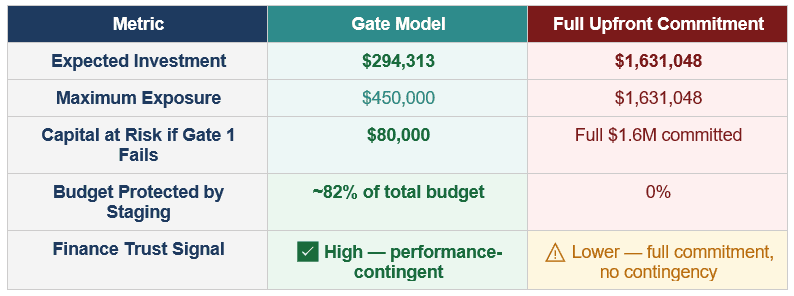
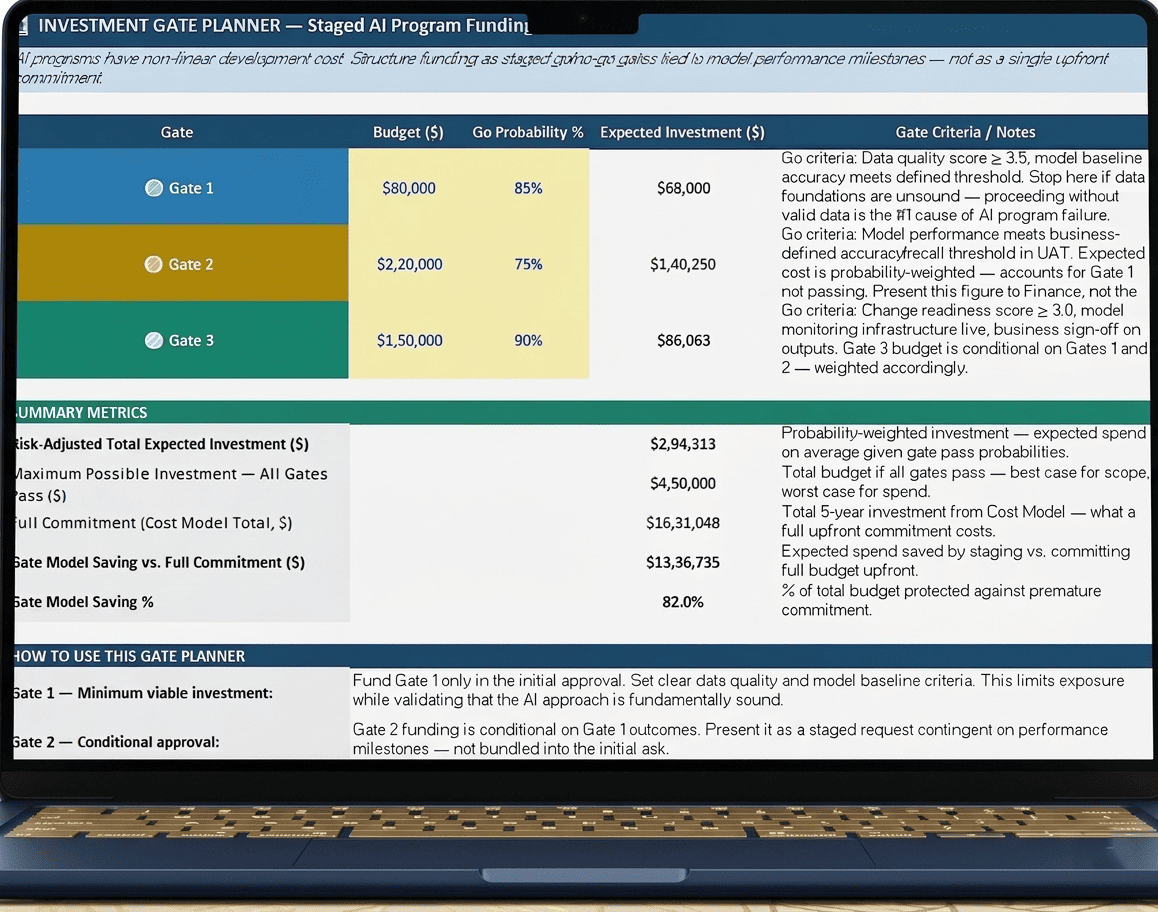
The risk-adjusted expected investment is the probability-weighted total — what the program is expected to cost on average given the go probabilities at each gate. For the representative program above, that figure is $294,313 against a full program commitment of $1,631,048.
That difference — $1.33M — is the budget protected against premature commitment by the gate structure. That is not a small number. It is the financial case for staging in a single line.
Present the expected investment, the maximum exposure (all gates pass), and the full program cost model total as three distinct figures. The CFO will see immediately what the gate structure is protecting — and what the cost of that protection is, in terms of the additional approval process required for each gate.
Setting Gate Go Probabilities Honestly
The go probability at each gate should reflect an honest delivery risk assessment, not an optimistic one. Program leaders who set Gate 2 probability at 95% because they believe strongly in the use case are not doing the probability analysis — they are doing advocacy.
Use program risk factors to calibrate gate probabilities downward from a baseline:
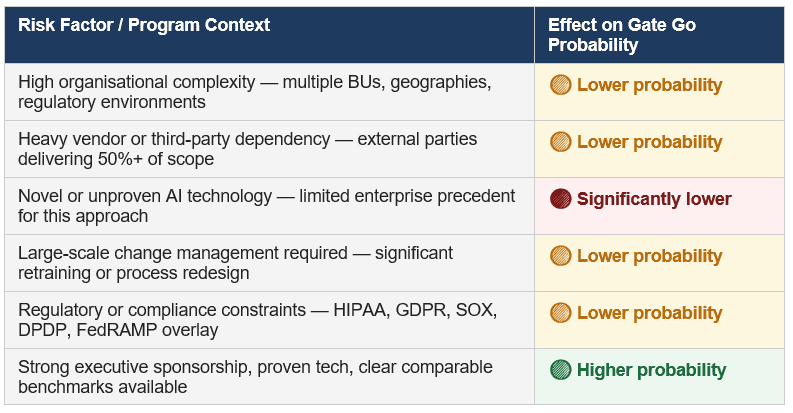
A program with high complexity, vendor dependency, and novel technology should have Gate 2 and Gate 3 probabilities in the 60–75% range, not 90%. The lower probabilities produce a more conservative expected investment figure — which may feel uncomfortable but is significantly more credible, and significantly more defensible, than one built on optimism.
Staged Gates vs. Full Upfront Commitment: The Comparison Finance Will Make
Finance teams that have seen AI program overspends — and most have — will compare a staged gate proposal against a full upfront commitment instinctively. Here is how that comparison actually plays out:
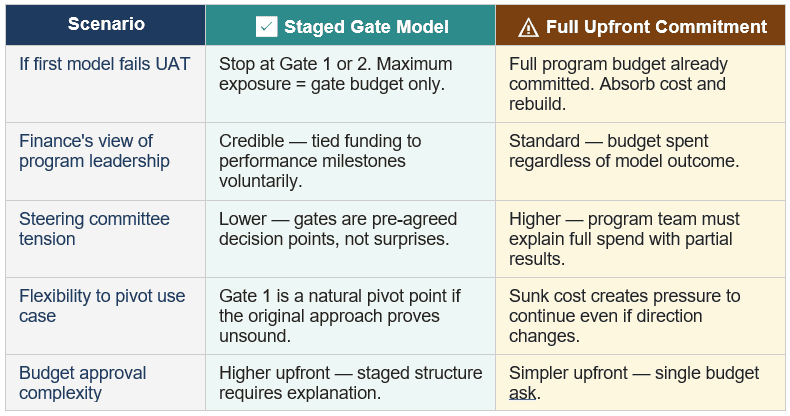
The one genuine disadvantage of the staged model — higher upfront approval complexity — is worth addressing directly in the presentation to finance. Acknowledge it, explain the mechanism simply (three tranches, three performance criteria, three go/no-go decisions), and then show the expected investment versus the maximum exposure. The complexity is manageable. The budget protection is material.
A CFO who receives an AI business case with staged investment gates tied to defined performance milestones is looking at a program leader who understands how AI delivery actually works. That credibility is worth more than any individual number in the model — because it carries through the entire program, not just the approval meeting.
The AI Non-Linearity Adjustment: The Cost Nobody Puts in the Conservative Scenario
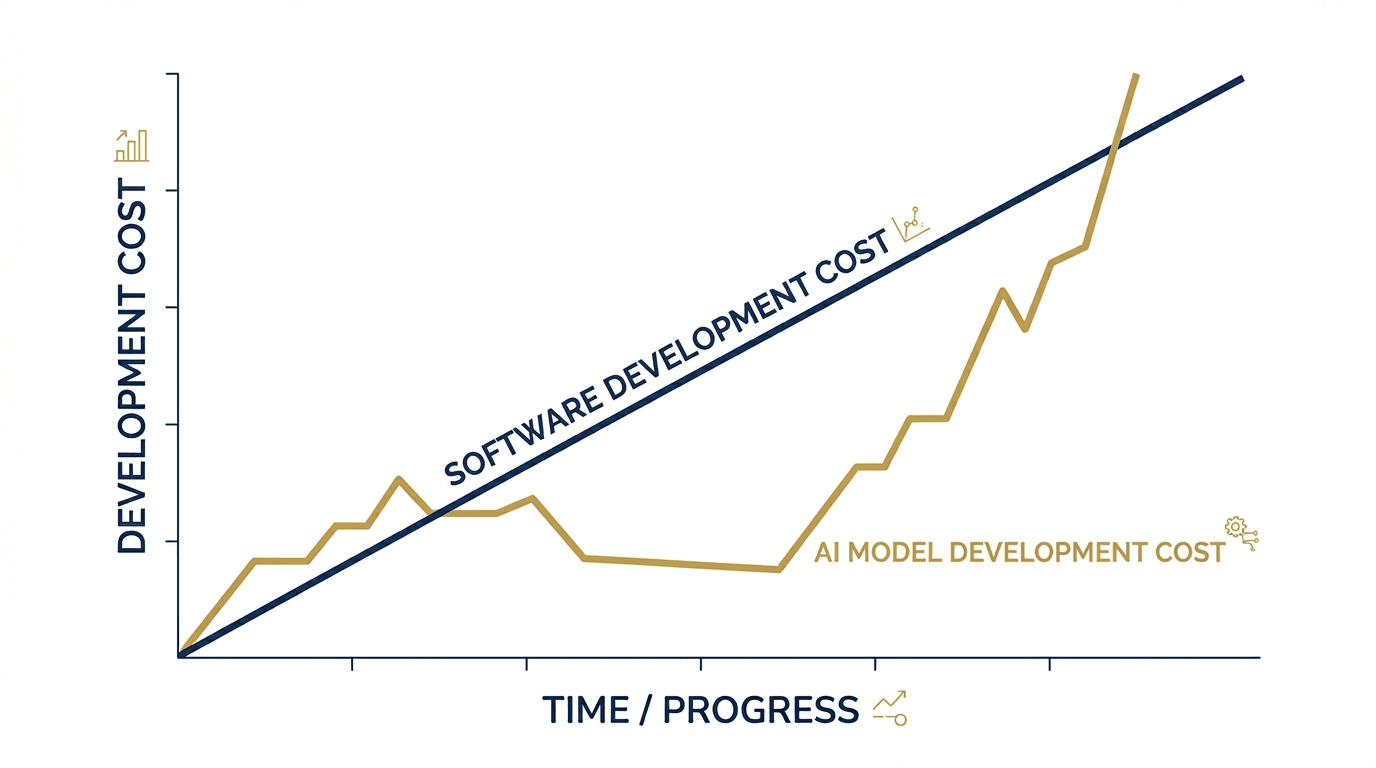
Standard ROI models — including most AI business cases — assume linear, predictable development cost. AI programs do not have that property. The single most credible addition a program leader can make to an AI Conservative scenario is an explicit model of what happens if the first model fails performance threshold and requires a second full training and tuning cycle.
This is not a remote scenario. It is common enough in AI delivery that experienced practitioners treat it as a planning assumption rather than a risk to be mitigated. The data distribution is not what the team expected. The model accuracy is insufficient for the business use case at the threshold the business agreed to. A second cycle is needed. This adds cost, adds time, and shifts the ROI timeline. None of that is catastrophic — but it needs to be in the model.
The Conservative scenario in a well-structured AI business case includes three adjustments that standard Conservative scenarios miss:
• Reduced benefit realisation: 30% below base case, reflecting slower adoption or a model that is useful but not fully optimised for the business use case.
• Cost overrun: 25% above base case, reflecting integration complexity, data preparation rework, and change management underestimation.
• AI non-linearity adjustment: The cost of one additional full model development and tuning cycle, explicitly flagged as an AI-specific risk absent from standard software programs.
If the Conservative ROI — including all three adjustments — is still positive, the program has genuine financial resilience. That is the signal worth presenting to finance, because it means the investment case holds up even in the scenario where delivery does not go as planned. If the Conservative ROI turns negative when the non-linearity adjustment is included, that is important information that the steering committee needs before approval — not after.
Presenting both the standard Conservative scenario and the AI-adjusted Conservative scenario side by side is the single most credible thing a program leader can do in an AI business case. It shows the finance team that the team has thought through the failure mode — and still believes the program is worth doing.
Building the Gate Planner and Non-Linearity Model Without a Blank Spreadsheet
The Gate Planner and AI non-linearity adjustment described in this post are both features of the AI ROI Calculator available at Viksya. The Gate Planner tab covers all three gates with configurable budget, go probability, and criteria fields — and auto-calculates the risk-adjusted expected investment, maximum exposure, and the savings versus full upfront commitment. The What-If Scenarios tab includes an explicit AI non-linearity adjustment row with a flag to include or exclude it from the Conservative scenario.
Both are designed so that program leaders can present the output directly to a finance team without translation — the numbers and the structure are already formatted for an executive audience.
AI ROI Calculator — Executive Excel Toolkit
Available at Viksya.com | Excel — instant download | Compatible with Microsoft Excel 2016+
• Investment Gate Planner — configurable 3-gate structure with go probability and risk-adjusted expected investment calculation
• AI non-linearity adjustment — explicit Conservative scenario modelling for additional model training cycle cost
• What-If Scenarios tab — Conservative / Base / Aggressive with full financial metrics per scenario
• Complete cost model with automated CAPEX vs OPEX separation — ready for finance presentation
• Auto-calculated NPV, IRR, ROI %, and Payback Period — updated live from your inputs
• Sensitivity analysis — two-variable tables stress-testing ROI against benefit realisation and cost variance
• Print-ready Executive Summary tab with Go / No-Go signal, scenario comparison, and investment breakdown
→ Available at viksya.com | Stop presenting AI investment as a vision. Present it as a financial decision — with the structure to back it up.
The Bottom Line
Requesting full AI program budget upfront is not wrong because the number is too large. It is wrong because it misrepresents the economics of AI delivery — implying predictability that does not exist, and committing capital to a plan that will need to change as the model development process surfaces what the team does not yet know.
Staged investment gates solve this by aligning the funding structure with the actual delivery structure. They limit financial exposure at each stage. They create natural decision points that governance structures understand. And they signal to finance that the program leadership team has the delivery experience to know what they do not know yet — which is one of the most credible signals a program leader can send.
The organisations that get AI funding right are not the ones with the most compelling vision decks. They are the ones whose investment structures are as rigorous as their technology architectures.
Build the funding model properly. Not to minimise the budget ask — but to make the structure trustworthy.
Frequently Asked Questions
What is a staged investment gate model for AI programs?
A staged investment gate model structures an AI program's total budget into sequential tranches — typically three — each tied to a defined model performance milestone. Funding for the next tranche is released only if the previous gate's go/no-go criteria are met. This limits financial exposure at each stage, aligns the funding structure with the non-linear nature of AI development, and creates formal decision points for program leadership and finance to review progress before committing the next tranche of capital.
How is staged AI investment different from a standard phased project approach?
A standard phased project approach releases budget by time period or project milestone — gate criteria are typically calendar-based or deliverable-based. A staged AI investment gate model makes the release of funding explicitly conditional on model performance — data quality scores, model accuracy thresholds at UAT, and change readiness scores. The gate criteria are technical and organisational, not just schedule-based. If the model does not meet the performance threshold at Gate 2, the next tranche does not release regardless of how much time has passed.
What is the risk-adjusted expected investment in an AI gate model?
The risk-adjusted expected investment is the probability-weighted total cost of all gates — calculated by multiplying each gate's budget by the probability that all preceding gates are passed and that gate is reached. For example, if Gate 1 has an 85% go probability and Gate 2 has a 75% go probability, the expected cost of Gate 2 is: Gate 2 budget × 85% × 75%. This produces a figure that reflects what the program is expected to cost on average, rather than the maximum exposure if all gates pass. Presenting this figure to finance alongside the maximum exposure is a key part of making the gate model financially transparent.
How should go probabilities be set for each gate?
Go probabilities should reflect an honest delivery risk assessment calibrated to the program's specific risk profile. A baseline of 85–90% for Gate 1, 75–85% for Gate 2, and 85–95% for Gate 3 is reasonable for a standard enterprise AI program with solid data foundations and proven technology. Programs with high organisational complexity, heavy vendor dependency, novel AI technology, or weak data foundations should carry lower Gate 2 and Gate 3 probabilities — in the 60–75% range. Probabilities above 90% for Gate 2 on a first-time AI deployment should be scrutinised carefully.
What is the AI non-linearity adjustment in the Conservative scenario?
The AI non-linearity adjustment is the explicit modelling of the cost of one additional full model development and tuning cycle — the scenario where the first model does not meet the performance threshold required for business use and a second cycle is required. This is an AI-specific cost that is absent from standard software development Conservative scenarios, and it is frequently omitted from AI business cases because it feels pessimistic. In practice, it is a common enough scenario in AI delivery that treating it as a planning assumption — rather than an unlikely risk — produces a Conservative scenario that is actually conservative, rather than one that is simply a modest downward adjustment of the Base Case.
Does the AI ROI Calculator on Viksya include the Gate Planner and non-linearity modelling?
Yes. The Investment Gate Planner is a dedicated tab in the AI ROI Calculator that covers all three gates with configurable budget, go probability percentage, and criteria fields. It auto-calculates the risk-adjusted expected investment, maximum exposure, full program cost model total, and the savings from staging versus full upfront commitment. The AI non-linearity adjustment is a feature of the What-If Scenarios tab, with a configurable additional training cycle cost and a flag to include or exclude it from the Conservative scenario calculation.