What to Check Before Renewing an AI Vendor Contract for 2027
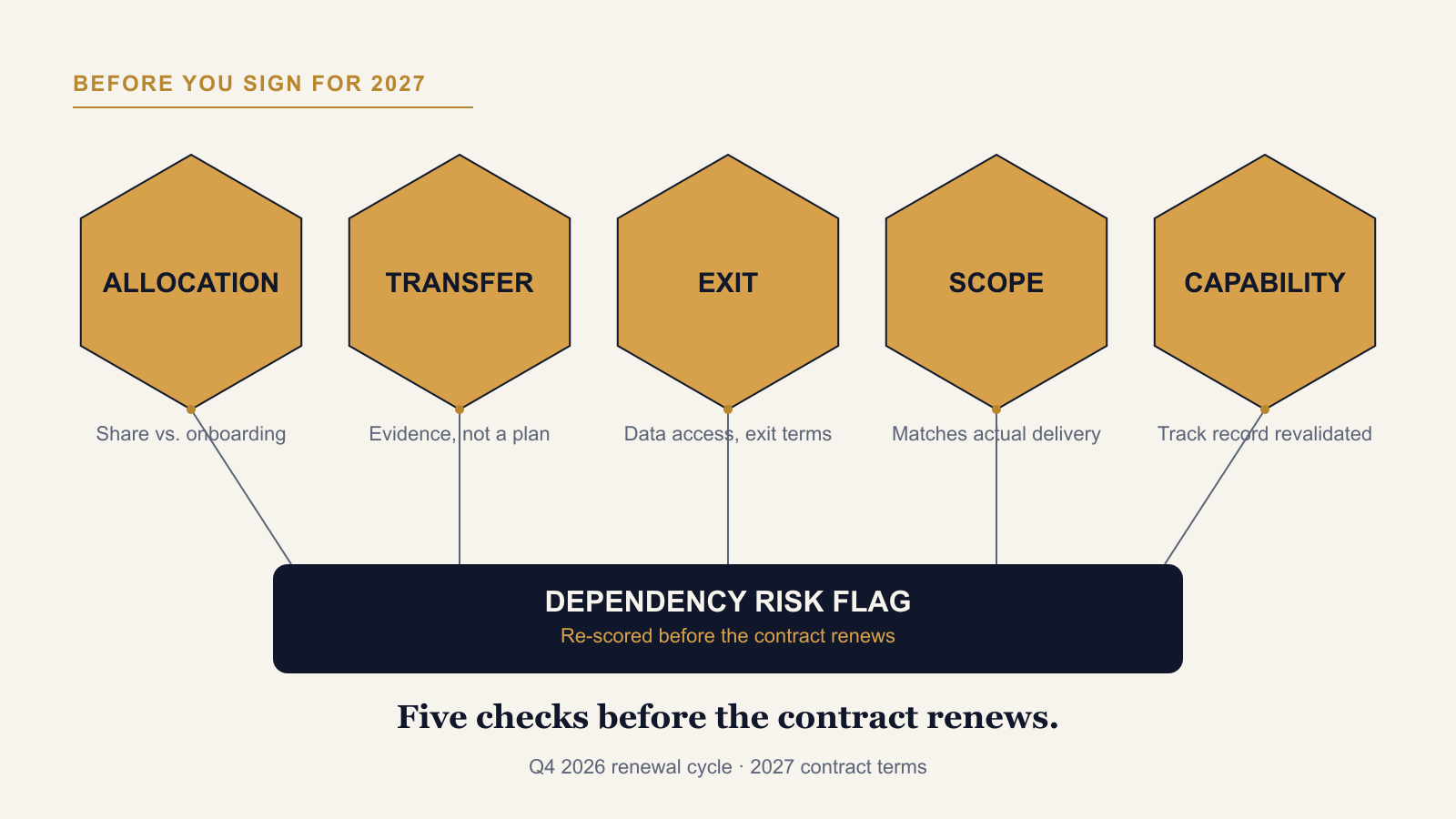
Before renewing an AI vendor contract for another year, check five things beyond the number on the renewal quote: how much of the programme the vendor now delivers against how much it delivered at onboarding, whether knowledge transfer has produced evidence — not just a plan — that the internal team can operate what was built, whether exit provisions and data portability still hold if the arrangement ended tomorrow, whether the original statement of work's scope and change-control terms still match what is actually being delivered, and whether the vendor's capability claims from the original proposal have held up over a year of delivery. Renewal is the one point in the relationship where governance gets a second look before the terms lock in for 2027 — skip it, and the next structured check is whenever the relationship is already in trouble.
Why the Renewal Moment Is a Governance Checkpoint, Not Just a Commercial One
Most organizations treat a vendor renewal as a procurement exercise: confirm the term, confirm the rate, sign. That treats the renewal decision as a repeat of the onboarding decision, when it is actually a different decision made under different conditions — a year or more of delivery has happened since the original contract was signed, and the vendor's share of the programme, the state of knowledge transfer, and the organization's actual exposure if the relationship ended have all likely moved, whether or not anyone re-checked them. Our earlier piece on the governance blind spot covers why dependency concentration goes unnoticed between individual system reviews; the renewal cycle is the one calendar-forced moment where re-checking it is unavoidable, because the contract has to be signed either way. The checklist below is what to look at in that specific window, not a restatement of why the risk exists in the first place.
The Five Things to Check Before You Sign
Each of the five checks needs an answer from someone with direct visibility into the delivery, not from the renewal proposal itself.
- Allocation drift. How much of the programme does the vendor deliver now, compared with the share recorded at onboarding or the last gate review? A vendor that has quietly grown from 40% to 65% of delivery is a different risk profile than the one the original contract was scoped against, even if nothing else in the relationship has changed.
- Knowledge transfer, evidenced. Not whether a knowledge-transfer plan exists — whether it produced anything: specific sessions that happened, documentation the internal team can use without the vendor present, and a named internal person who could explain how the system works if asked today. A plan that was never actioned is not evidence.
- Exit readiness. If the relationship ended at the close of this renewal term, are deliverables portable, is the organization's data accessible without the vendor's cooperation, and does a replacement scenario already exist on paper? Renewal is the moment to confirm this before signing another term, not after a dispute makes the answer urgent.
- Scope and change control. Does the original statement of work's scope still describe what is actually being delivered, or has the engagement drifted through informal change requests that were never run through the SOW's own change-control process? Drift that was never formalized is drift the renewal should correct, not carry forward unchanged.
- Capability, revalidated. Are the specific people and the technical depth promised in the original proposal still the people and depth actually delivering, or has turnover or sub-contracting quietly changed who is doing the work?
What the Governance Check Does Not Replace
The five checks above are a governance read on dependency and delivery risk — they are deliberately silent on whether the renewal's rate card, payment milestones, or any pricing step-ups still make commercial sense. That is ordinary contract and commercial due diligence, owned by procurement and finance on their own timeline, informed by the governance evidence above but not a substitute for it. A vendor can pass every governance check here and still be priced out of the next term, or the reverse — the two questions are related but answered by different people, against different evidence.
Who Should Run This Check
The programme manager or governance lead should run it, not whoever owns the commercial relationship with the vendor. The person negotiating the renewal has an incentive to see the relationship as healthy enough to continue as-is; the five checks above need an answer from someone assessing the evidence against each criterion on its own terms, separate from that incentive.
Timing It for Q4
Q4 is when a large share of enterprise AI vendor contracts signed during the initial 2025–2026 push to stand up programmes come up for their first or second renewal, with 2027 terms being negotiated now. Running the five checks before the renewal conversation starts — not during it — means the organization enters the negotiation already knowing its own dependency position, instead of discovering it mid-conversation, at a pace the vendor controls.
The AI Vendor Governance Scorecard provides the governance side of this renewal check: 25 evidence-based criteria across five dimensions — including Knowledge Transfer & Dependency Risk and Exit Readiness — producing a weighted Vendor Risk Score and a four-tier Vendor Dependency Risk classification, formatted for steering committee presentation.
→ Available at www.viksya.com