
Most Compliance Content Says India's DPDP Act Already Applies. It Doesn't — Not Yet.
Most compliance checklists say India's Digital Personal Data Protection Act already applies. Real ones check the commencement notification before writing that sentence. The Act was enacted in 2023 — but enactment and enforcement are not the same event, and the gap between them, in this case, runs until 13 May 2027.
Executive Summary
Four facts most secondary coverage gets wrong or leaves out
- The DPDP Act, 2023 was enacted in 2023 but its substantive provisions were not brought into force until a government notification dated 13 November 2025 — over two years later.
- That notification phases the Act into force in three tranches, not one. Almost all of the obligations a Data Fiduciary actually has to act on don't bind until 13 May 2027.
- The one date that is often mistaken for a general deadline — 13 November 2026 — only activates Consent Manager registration, a narrow, licensed intermediary role, not a general compliance requirement.
- The Data Protection Board itself has existed and been operational since 13 November 2025, even though most of the law it will eventually enforce isn't binding yet.
What's actually in force right now
As of 21 September 2026, the Data Protection Board of India exists, has been constituted, and functions as a digital office with the power to summon, inquire, and hear appeals. A handful of definitional and procedural provisions are also in force. That's the extent of it. The sections a Data Fiduciary would actually have to comply with — notice requirements, valid consent, breach reporting, children's data handling, cross-border transfer restrictions, and Data Principal rights — are not yet legally binding.
An enforcement body that exists before the law it will enforce isn't unusual. Treating it as proof the law already applies is the mistake.
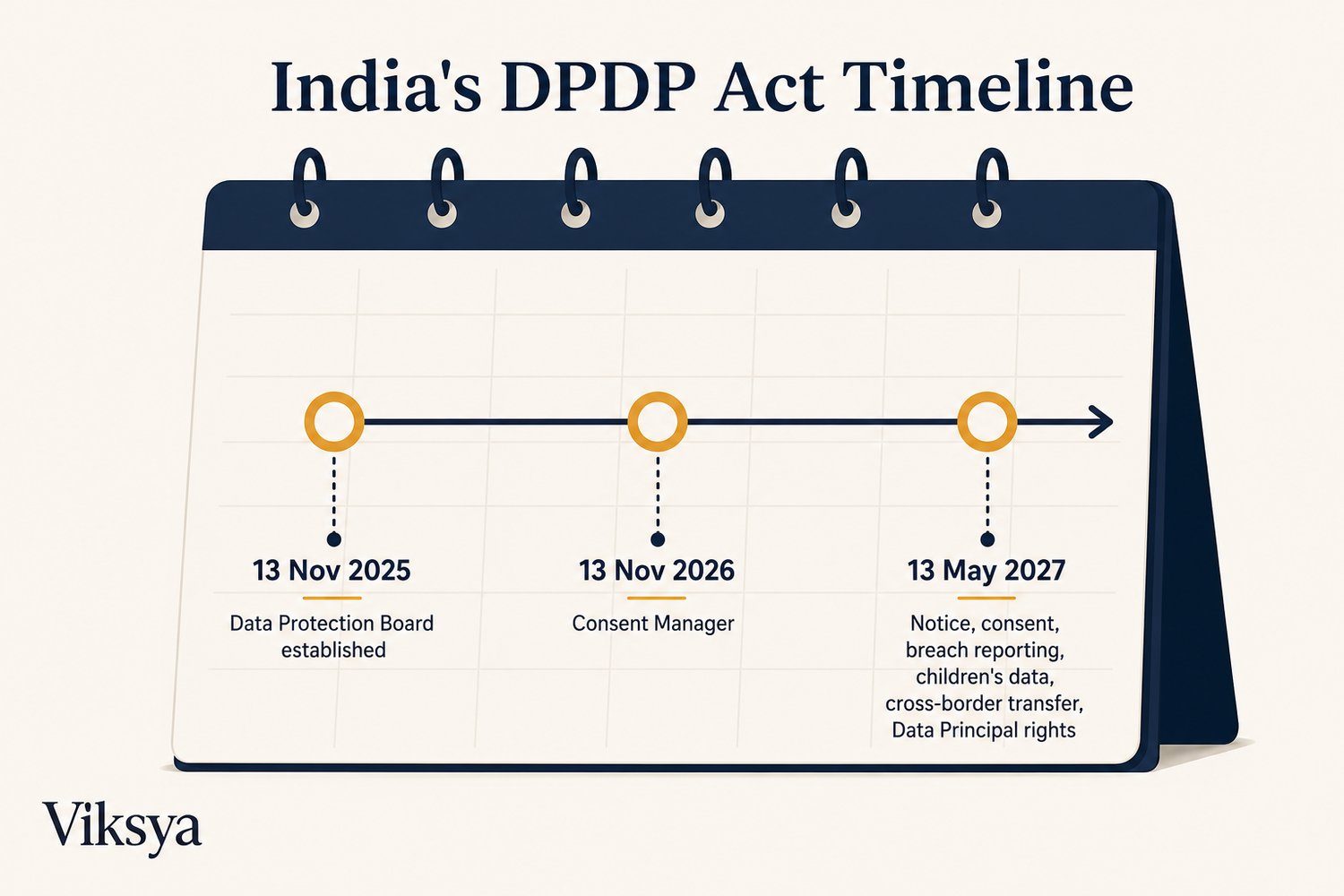
India's DPDP Act Implementation Timeline
📅 Immediate — 13 November 2025
The first phase of the Digital Personal Data Protection (DPDP) Act comes into force, including:
- Establishment of the Data Protection Board of India
- Key definitions under the Act become effective
- Procedural rules governing the Board
📅 +1 Year — 13 November 2026
The second implementation phase introduces:
- Consent Manager registration framework (under Section 6(9), Section 27(1)(d), and Rule 4)
📅 +18 Months — 13 May 2027
The remaining operational obligations come into force, including:
- Privacy notices
- Consent requirements
- Personal data breach reporting
- Processing of children's personal data
- Cross-border data transfers
- Data Principal rights
Both dates come from the same instrument: G.S.R. 843(E), the DPDP Act commencement notification dated 13 November 2025, read alongside G.S.R. 846(E), the Digital Personal Data Protection Rules, 2025, published the same day. The full text of both is on the record — see the citation at the end of this piece.
The date that gets conflated — and shouldn't be
13 November 2026 shows up in a lot of secondary commentary as though it were a general compliance deadline. It isn't. It activates one specific mechanism: registration and obligations for Consent Managers, a licensed intermediary role with its own eligibility bar — a minimum net worth of ₹2 crore, board-approved registration, and a defined set of fiduciary duties toward Data Principals. Unless your organisation is applying to operate as a Consent Manager, this date has no bearing on your compliance posture.
Not every date in a regulation is your date. This one belongs to a specific class of licensed entity, not to Data Fiduciaries generally.
Why the runway to 13 May 2027 is shorter than it sounds
13 May 2027 is the date that matters for almost every organisation processing personal data of Indian residents. As of 21 September 2026, that's about eight months out — inside the window, not years ahead of it. The obligations that activate on that date aren't things you can switch on the week before: a working breach-notification process, an identity-verification mechanism for children's data, a cross-border data flow map, and a Data Principal rights-request workflow all take real build time. The eighteen-month runway the government built in from the November 2025 notification was more than half spent by 21 September 2026. Turning that runway into a funded plan — budgeting each of the six obligations individually rather than as one rounded-up compliance line — is covered in DPDP Act and the 2027 Plan: Budgeting for the May 2027 Obligations.
LEGAL DISCLAIMER
This article provides structured, indicative guidance based on the official Gazette notifications as of the version date. It does not constitute legal advice. Regulatory interpretation evolves, and organisations subject to the India DPDP Act or the EU AI Act should obtain qualified legal counsel for binding compliance determinations.
Frequently Asked Questions
Where can I verify these dates myself?
The commencement notification (G.S.R. 843(E)) and the Digital Personal Data Protection Rules, 2025 (G.S.R. 846(E)) are both published on MeitY's official site: https://www.meity.gov.in/documents/act-and-policies/digital-personal-data-protection-rules-2025-gDOxUjMtQWa?pageTitle=Digital-Personal-Data-Protection-Rules-2025
Does this affect a system's EU AI Act risk tier?
No. The DPDP assessment runs independently of EU AI Act tier and is unaffected by the DPDP Act's own commencement timeline.
When does India's DPDP Act actually come into force?
In three phases under a commencement notification dated 13 November 2025: the Data Protection Board and procedural provisions immediately; Consent Manager registration from 13 November 2026; and the substantive Data Fiduciary obligations — notice, consent, breach reporting, children's data, cross-border transfer, and Data Principal rights — from 13 May 2027.
Does the DPDP Act already apply to companies processing personal data of Indian residents?
Only in part. The Data Protection Board exists and is operational, but the substantive obligations most organisations associate with the Act do not become legally binding until 13 May 2027.
Is 13 November 2026 a general DPDP compliance deadline?
No. That date activates Consent Manager registration only — a narrow, licensed intermediary role. It is not a general obligation for Data Fiduciaries.
GET THE TOOL
AI Regulatory Compliance Risk Register
Tracks the EU AI Act and India's DPDP Act on the same timeline the government actually set — including the DPDP Act's phased commencement dates.
▸ Regulatory Timeline tab tracks the DPDP Act's real phase-in dates, not a placeholder
▸ Compliance Gap Register flags DPDP obligations against their actual binding date
▸ Full .pdf User Guide included
→ https://viksya.com/ai-regulatory-compliance-risk-register
Source: Ministry of Electronics and Information Technology, Government of India — Digital Personal Data Protection Rules, 2025 and the DPDP Act commencement notification, both dated 13 November 2025.
Read the official notifications: https://www.meity.gov.in/documents/act-and-policies/digital-personal-data-protection-rules-2025-gDOxUjMtQWa?pageTitle=Digital-Personal-Data-Protection-Rules-2025