
Who Owns the AI Bill? Applying Governance Logic to Token Cost
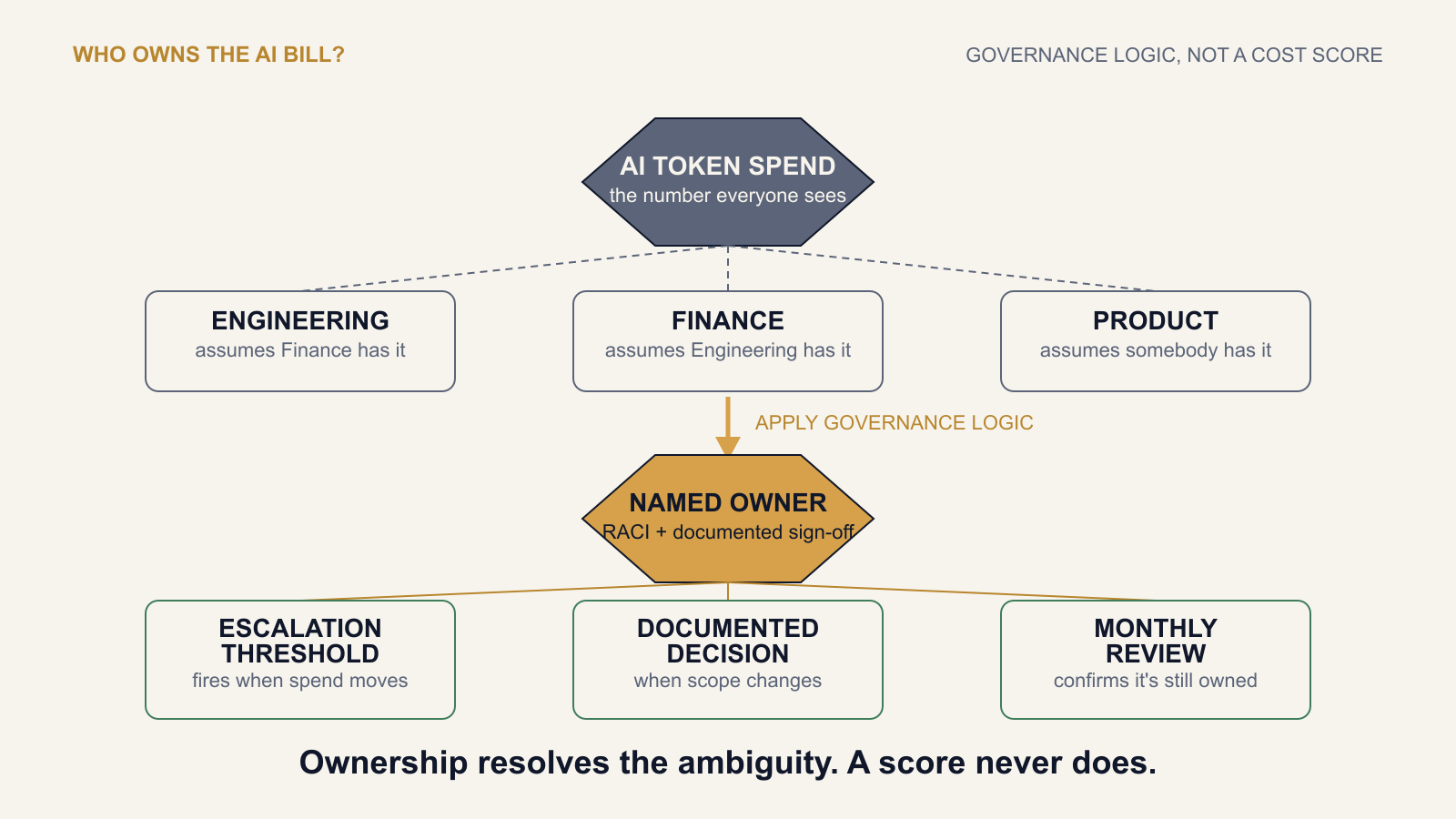
Accountability for AI spend sits with whoever is named as the owner of the decision to deploy and keep running the system generating it — not with whichever team's budget line happens to absorb the invoice. In most organizations today, that means nobody owns it: engineering assumes finance is watching the total, finance assumes engineering is controlling usage, and product assumes somebody, somewhere, has it covered. The fix is not a sharper cost dashboard. It is the same governance logic organizations already use to decide who is accountable for a model's deployment and oversight — a named owner, a documented decision, an escalation threshold — applied to the specific question of who answers for what that model costs to run.
Why Nobody Ends Up Owning the Bill
Token and inference cost is unusual among operating expenses because it is generated continuously, by configuration choices nobody revisits after launch: which model tier a workflow calls, how long its prompts and context windows run, how many retries a failure triggers, how many times a day a process re-runs. Those choices are made by engineers building the system, bounded by a budget finance approved once at a very different usage level, and multiplied by how widely product rolls the feature out. Three functions each touch one piece of the cause. None of them is positioned to see the whole number, and none of them was formally told the number was theirs to answer for. That is not a staffing gap. It is an accountability gap, and it looks exactly like the gap that shows up around AI model governance more broadly, before anyone names an owner for it.
A Dashboard Confirms the Number. It Doesn't Confirm Who Answers for It.
A cloud billing console or an LLM provider's usage page will tell an organization, accurately, what was spent last month. What it will not tell anyone is whether that figure was expected, whether somebody reviewed it, or whether the team that caused a spike even knows it happened. That is the same distinction Viksya has made about AI governance more broadly: a monitoring dashboard tells you what a system is doing; it does not, by itself, tell you whether anyone is still governing it (see Most AI Governance Is a Dashboard. Real AI Governance Is a Decision.). That piece is about deployment readiness and ongoing oversight generally — whether the human review process designed at go-live is still being followed. The spend question is the same structural gap, narrowed to one line item: a number can be perfectly visible on a screen and still have no owner standing behind it.
Borrowing the Governance Pattern, Not a Cost Score
To be specific about what this does and does not mean: no claim here is that governance tooling calculates, scores, or tracks token cost. The dollar or token figure still comes from the cloud provider's or LLM vendor's own billing console — that is not a problem governance logic is built to solve. What governance logic does supply, because organizations already use it to decide who is accountable for a model's deployment and oversight, is the accountability structure that sits around a number once it exists: a named owner, not a shared assumption. A documented decision at the point usage or scope changes, not a silent default. An escalation threshold that triggers a specific review, not a vague instruction to "keep an eye on it." A recurring checkpoint that confirms the ownership is still active, the same way a monthly governance review confirms a human review process is still being followed months after a model went live.
A Worked Illustration
Picture an organization running three AI-assisted workflows in production — a customer-support agent, an internal document-search tool, and a sales-proposal generator — each built by a different team, each calling a different model tier. Six months after launch, the combined token bill has roughly tripled, and nobody can say exactly why: the support agent's retry logic was never tuned down after a rocky early week, document search was pointed at a larger context window during a demo and never reverted, and the proposal generator was rolled out to twice as many sales reps as the original pilot. No single decision was unreasonable. Nobody was accountable for seeing all three at once, because no one had been named as the owner of the combined number — the same way, before a deployment gate exists, no one is formally accountable for whether a model's human oversight mechanisms are still functioning six months after go-live. Naming an owner for AI spend would not have prevented any one of those three choices on its own. It would have meant somebody was positioned, and expected, to ask the question before the total had tripled.
What Accountability for AI Spend Actually Looks Like
Applied concretely, the same governance logic used for deployment and oversight decisions breaks into four parts:
- A named owner, specific enough to be asked a direct question about the number — not "the engineering team" or "whoever's on call," the same way a governance review names a specific owner for reviewing monitoring alerts rather than leaving it to "the team."
- A documented decision at the point a model tier, context window, retry policy, or rollout scope changes materially — the same discipline a governance review applies to a retraining decision, recorded rather than left to a chat thread.
- An escalation threshold tied to a specific move in spend, not a general instruction to watch it — so a tripling bill triggers a review automatically instead of waiting to be noticed at quarter close.
- A periodic review that reconfirms the ownership is still active and the threshold still makes sense, on the same monthly cadence organizations already use to confirm a model's other governance controls haven't quietly eroded.
None of this requires new software bolted onto a billing dashboard. It requires treating "who is accountable for AI spend" as a governance question with the same four-part answer organizations already give to "who is accountable for this model's deployment and oversight" — because it is the same question, asked about a different line on the page.
The AI Production Governance Toolkit provides a 19-criterion pre-deployment gate across five weighted dimensions and a 15-indicator monthly governance review across four categories that assign a named owner, a documented RACI, and a recurring review cadence to AI systems in production — the same governance pattern this piece applies to who answers for what those systems cost to run.
→ Available at www.viksya.com