
Why Enterprise AI Programs Fail — And It's Rarely the Technology
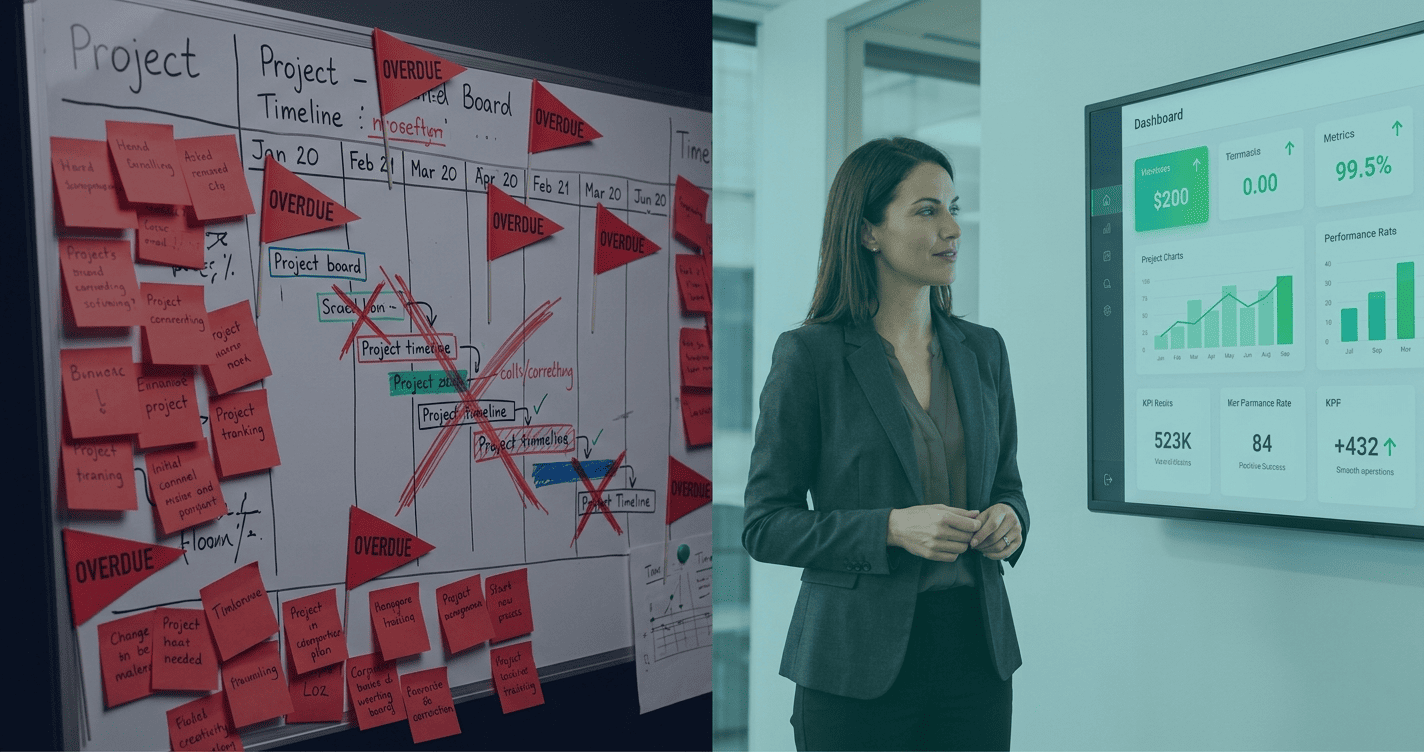
There's a version of this story every enterprise has either lived or heard.
Budget approved. Consultancy engaged. Three use cases identified. Big launch event. Twelve months later: one use case barely in production, two in limbo, and a business unit still running on spreadsheets because nobody managed the change.
The technology worked. The organisation wasn't ready.
This is not a niche failure mode. It is the dominant pattern in enterprise AI adoption — across industries, geographies, and organisation sizes. And in most cases, the warning signs were present at the start. They just weren't assessed.
The Assumption That Kills Programs Early
Most AI programs begin with a strategic narrative and a technology roadmap. What they rarely begin with is an honest, structured answer to the question: are we actually ready to execute this?
That question is harder than it sounds. Because readiness is not the same as intent, and it is not the same as maturity.
AI maturity models — the kind published by Gartner and McKinsey — tell you where your organisation sits on a long-term capability curve. That's useful for benchmarking. It tells you how sophisticated your AI practice is relative to peers.
AI transformation readiness is a different question entirely. It asks: given where we are today, can we execute this specific program, at this scale, on this timeline? It is contextual, current-state, and program-specific.
An organisation with moderate AI maturity can be fully ready for a well-scoped program. An organisation with high AI maturity on paper can be completely unready for its next AI investment — because its data governance collapsed, its sponsor changed, or its change capacity is at zero.
Maturity is where you've been. Readiness is whether you can move now.
The Six Dimensions That Determine Whether a Program Scales or Stalls
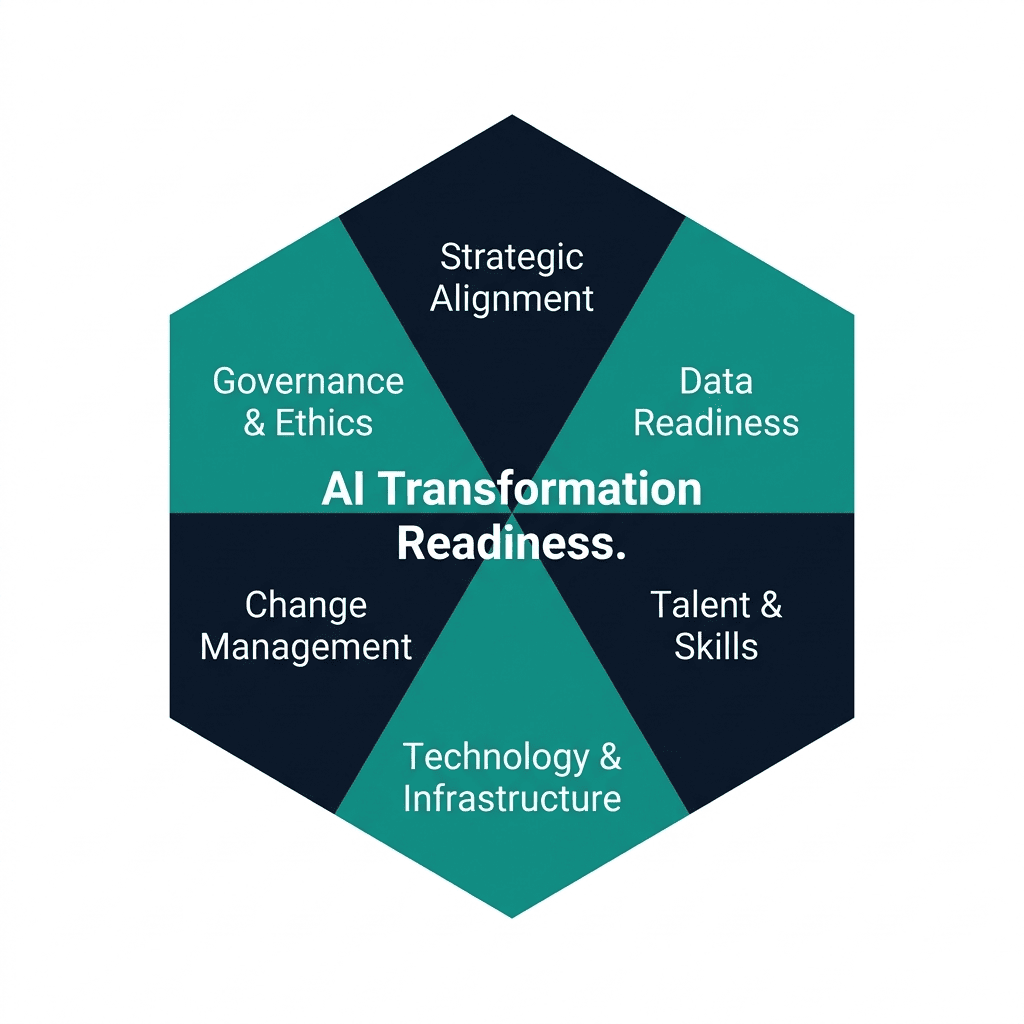
After working through AI program failures and recoveries across enterprise contexts, six dimensions consistently separate programs that deliver from programs that stall.
1. Strategic Alignment and Leadership Commitment
Board approval is not the same as executive commitment. The critical signal: can your executive sponsor name the three highest-priority AI use cases and explain why they were chosen? If not, the alignment is performative — and the program will hit a wall the first time it needs a business unit to change how it works.
2. Data Readiness and Quality
No organisation has perfect data. The real issue is when imperfect data becomes visible. Programs that discover data quality problems six months in — after significant investment — face a different kind of crisis than programs that surface the same problems upfront. The readiness question is not 'is our data perfect?' It's 'do we know exactly what we have, where it lives, and whether it's usable for the use cases we've prioritised?'
3. Talent and Skills Availability
Three types of capability are needed: technical practitioners who can build AI systems, AI-fluent product managers who can translate between business problems and AI solutions, and AI-literate leaders who can govern and challenge AI decisions without needing a technical background. Most organisations have some of the first, almost none of the second, and very few of the third. Programs that skip the product management layer consistently produce technically correct models that nobody uses.
4. Technology and Infrastructure
Cloud infrastructure for AI workloads is not standard cloud infrastructure. GPU compute, MLOps tooling, API connectivity to existing business systems — these need to be validated before the first model goes into build. Legacy technical debt is the silent killer: many programs discover mid-stream that the business system they want to connect AI to is a 15-year-old application with no API and a codebase nobody has touched in years.
5. Change Management and Culture
AI transformation changes how people work, which decisions are made by humans, and which are informed by models. It surfaces anxieties about job security that leaders consistently underestimate. The programs that treat change management as something to 'do at the end' consistently fail to achieve adoption levels that justify the investment. Change management is not a workstream that follows the technical build. It runs in parallel from day one.
6. Governance, Risk, and Ethics
The EU AI Act and India's Digital Personal Data Protection Act have moved AI governance from a best-practice conversation to a regulatory requirement. High-risk AI applications face binding obligations around validation, monitoring, and documentation. Organisations that build governance as an afterthought face two risks: regulatory exposure from non-compliant deployment, and reputational exposure from failures that proper pre-deployment testing would have caught.
Where Most Programs Actually Start
The honest pattern: most enterprise AI programs enter execution with three dimensions in reasonable shape — typically strategy, technology, and talent — and three dimensions significantly underprepared — typically data, change management, and governance.
That's not a reason to delay. It is a reason to be deliberate about which gaps are blockers and which are manageable risks.
Not every dimension needs peak readiness before a program starts. A dimension scoring 3 out of 5 — in progress, with active remediation underway — is acceptable for most programs. A dimension scoring 1 or 2 — not started, or awareness only — is a genuine blocker that will surface as a crisis later.
The value of a structured readiness assessment is to make those gaps visible before they become expensive.
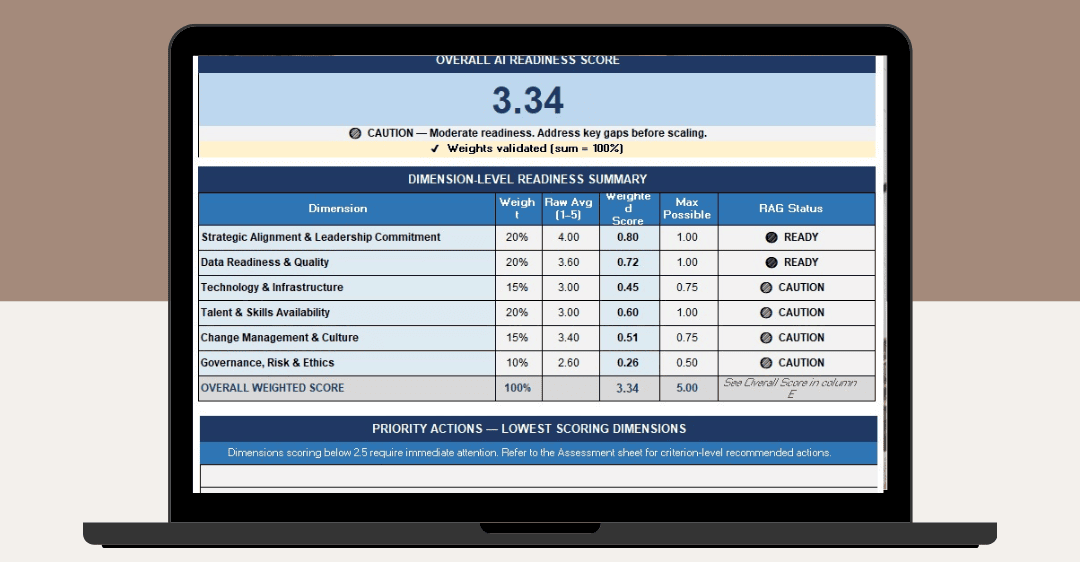
The AI Transformation Readiness Scoring Model is a structured Excel-based tool that scores your program across all six dimensions, with 30 weighted criteria, evidence prompts, and an executive RAG dashboard. Built for Programme Managers, CIOs, and Consultants who need a credible, defensible baseline — not a one-day workshop.
→ Available at www.viksya.com