
Why Most AI Business Cases Collapse Under Finance Scrutiny — And the Cost Model Behind Every One That Doesn't

Enterprise AI programs are not underfunded because finance teams don't believe in AI. They're underfunded because the business cases arriving at their desks are incomplete — and experienced CFOs know it.
There is a specific moment in almost every AI transformation program when the credibility of the entire investment case is decided. It is not the board presentation. It is not the vendor demo. It is the thirty minutes after the programme leader leaves the room and the finance director goes through the numbers alone.
That review has one job: find the gaps. And in most AI business cases, the gaps are not hard to find.
Missing cost categories. Benefit figures that arrived fully-formed with no quantification methodology behind them. A single-point development cost estimate with no range. No separation between the capital budget ask and the ongoing operational commitment. The programme leader believes the case is complete. Finance has a different view.
The result is predictable: funding delayed, scope reduced, or a conditional approval tied to assumptions the programme team never agreed to. None of these outcomes were inevitable. They were the product of a business case built without a complete cost model.
This post breaks down the four cost categories that consistently go missing from AI investment cases — and explains why a complete, structured cost model is the single most effective thing a programme leader can do to walk into a finance review with confidence.
Why AI Cost Modelling Is Different From Standard IT Investment Appraisal
Every programme leader who has come through a cloud migration or ERP implementation knows how to build a technology cost model. You count licences, add integration effort, estimate infrastructure, factor in training, and produce a number. The number might be wrong at the margins, but the structure is right.
AI programs break that structure in three specific ways.
First, the development cost is non-linear. Traditional software development has a knowable scope — a feature either meets its acceptance criteria or it does not. AI model development does not work that way. You discover what the model can and cannot do by building it. Data distributions surprise you. Feature engineering takes longer than expected. The model performs well on training data and poorly on production data. Each of those discoveries can send you back to an earlier development stage. The cost of that is real, and it belongs in the model — but it requires a different estimation approach than a fixed-scope build.
Second, the run cost is significant and permanent. A deployed AI model is not the end state — it is the beginning of an ongoing cost curve. Models degrade over time as the data they were trained on no longer reflects current reality. They need to be monitored, retrained, and periodically rebuilt. That cost does not stop when the programme closes. It transfers to the operational budget and stays there. Most AI business cases present this either not at all, or blended into the programme investment figure in a way that obscures what the ongoing commitment actually is.
Third, the people costs are systematically underestimated. Change management, training, adoption campaigns, internal programme management allocation — these are frequently treated as line items to be cut when the initial budget is under pressure, rather than as structural requirements for the investment to return any value at all.
The consequence of getting any of these wrong is not a slightly optimistic forecast. It is a business case that finance does not trust, or one that produces accurate returns at programme close and an accountability crisis twelve months into operations.
A business case that understates costs will be right in its direction but wrong in its magnitude. When actuals diverge from forecast, the credibility damage falls on the entire programme leadership team — not just the finance model. Completeness on the cost side is not pessimism. It is professionalism.
The Four Cost Categories Most AI Business Cases Get Wrong
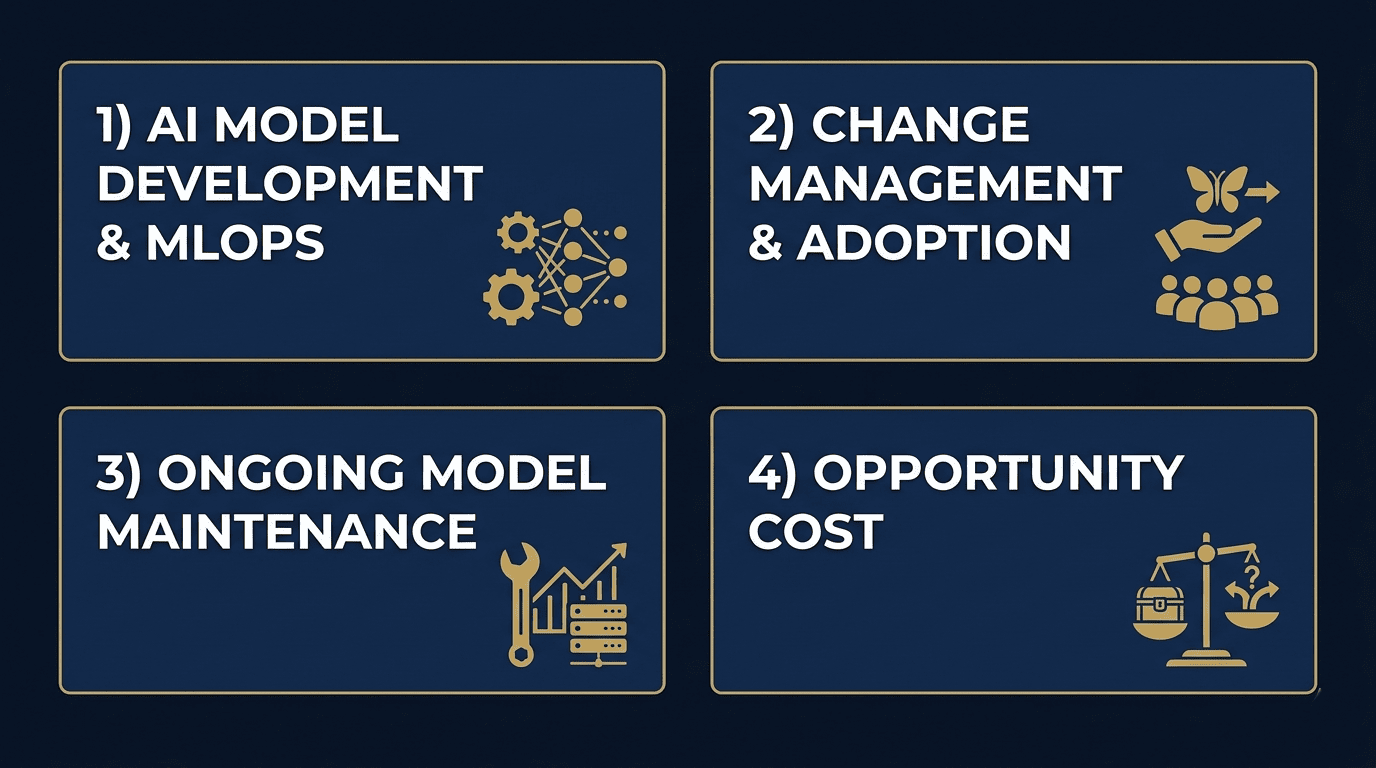
1. AI Model Development and MLOps Infrastructure
The most common failure here is not that programme teams underestimate what development costs — it is that they estimate it as a single number when it should be a range.
AI model development cost is inherently uncertain. Data quality issues, feature engineering rework, performance failures at UAT, and the need for additional training cycles all affect the final figure in ways that cannot be fully known upfront. A development cost that is estimated at $40,000 in the base case could reasonably run to $60,000 if one additional training and tuning cycle is required — a 50% variance that is well within the normal range of AI delivery experience, not an exceptional scenario.
The right approach is to present development cost as a low-base-high range, with each estimate driven by documented assumptions. Low estimate reflects efficient delivery with clean data and no major model performance issues. Base estimate reflects a realistic single development cycle with expected rework. High estimate reflects one additional full training cycle — the cost of the AI program discovering at UAT that its first model does not meet the performance threshold required for business use.
MLOps infrastructure — the tooling required for model versioning, deployment pipelines, monitoring dashboards, and retraining workflows — is the other consistent gap. Programmes that build AI models without a managed model lifecycle process are accumulating technical debt from the first sprint. The cost of MLOps infrastructure belongs in the capital budget, not as an afterthought once the model is in production.
2. Change Management and Adoption Investment
Change management is the budget line that gets cut first when the initial cost estimate comes in over target — and the programme workstream whose absence is most directly responsible for AI failing to generate the returns it promised.
AI transformation changes how people work in ways that standard software implementation does not. It changes which decisions are made by humans and which are informed or automated by models. It creates genuine anxieties about job security that leaders consistently underestimate. It requires business units to trust outputs from systems they do not fully understand. None of that happens without structured investment.
A complete change management cost model covers four components: a formal change programme with dedicated resource, structured training for all impacted users, an adoption communications plan with active executive visibility, and an AI champions network that provides peer-to-peer support at the frontline. The cost of each of these is real and should appear as a line item in the business case, not as a percentage buffer at the bottom of the page.
A change management budget of 15% of the total implementation cost is a reasonable starting point for most AI programmes. For programmes with large-scale adoption requirements, complex organisational structures, or significant process redesign, that figure should be higher.
3. Ongoing Model Maintenance and Monitoring
This is the cost that does not appear as an invoice during programme delivery and therefore rarely makes it into the capital investment model — but it is very real, and it starts the moment the model goes live.
AI models degrade. The technical term is 'model drift' — the phenomenon where the data distribution the model was trained on gradually diverges from the data it encounters in production, causing performance to decline over time. Managing this requires active monitoring infrastructure, a defined retraining cadence, and the engineering capacity to execute retraining cycles on an ongoing basis.
The cost of model monitoring and retraining is an operational cost — it belongs in the run budget, not the capital investment. But it needs to appear somewhere in the business case, because a CFO who approves an AI programme without understanding the ongoing operational commitment will be surprised by it in Year 2. That surprise is avoidable, and it is the programme leader's job to prevent it.
Separating the capital ask from the run cost explicitly in the business case — showing CAPEX and OPEX as distinct figures — is one of the most straightforward ways to demonstrate financial sophistication to a finance audience. It is also how AI budgets actually need to be approved, since CAPEX and OPEX sit in different budget categories and go through different approval processes. A related OPEX line that scales directly with usage rather than with time — the per-call token run-cost of serving the model in production — deserves its own explicit treatment in the business case; see Token Run-Cost: The Line Missing From Most AI Business Cases.
4. Opportunity Cost and Internal Resource Diversion
Every hour a senior data engineer spends on the AI programme is an hour not spent on other priorities. Every week a business analyst is dedicated to the AI use case is a week of capacity diverted from their BAU workload. These costs do not appear on any invoice, which is why they are almost universally absent from AI business cases.
The absence does not make them less real. Opportunity cost is a genuine financial impact, and it is the category that most frequently creates tension between programme teams and the business units they depend on for delivery. When the cost is not modelled upfront, it surfaces mid-programme as a resourcing conflict — which is significantly more disruptive than acknowledging it at the start.
Including opportunity cost in the business case requires the programme team to be honest about how much internal resource the programme actually needs, over what period, and what the fully-loaded cost of that resource is. It is not a comfortable conversation. It is a necessary one.
What a Complete AI Cost Model Actually Looks Like
A cost model that covers all four categories above has five components.
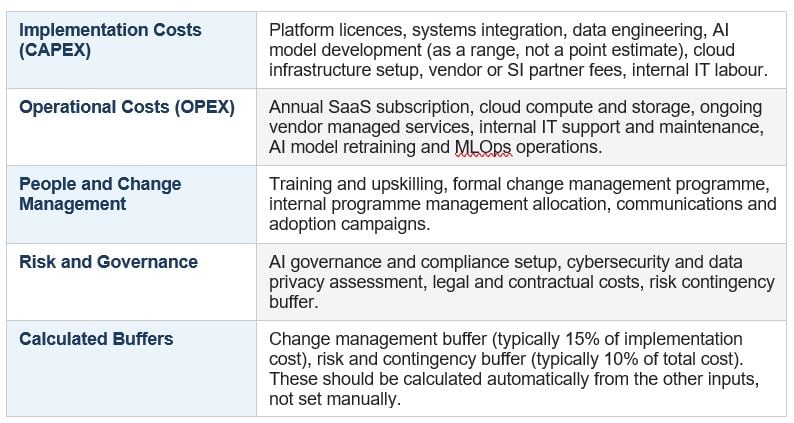
The total investment figure that emerges from a model structured this way will be higher than what most programmes initially budget. That is not a problem — it is the point. A higher, complete figure presented to finance with full transparency is significantly more credible than a lower, incomplete figure that falls apart under scrutiny.
The question finance is actually asking is not 'is this number small enough to approve?' It is 'do I trust this number?' A complete cost model, built from first principles with documented assumptions, answers that question.
Presenting Cost Alongside Benefits: The Structure Finance Expects
Cost modelling in isolation is not a business case. The cost model is the denominator of the ROI calculation — it only creates a decision-useful output when it sits alongside a structured benefits model and a set of standard financial metrics.
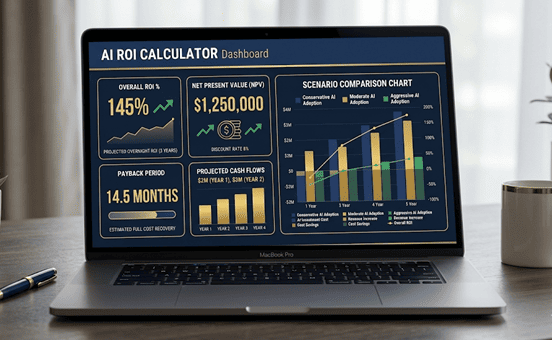
The financial metrics a CFO will ask for are consistent across organisations: Net Present Value (NPV), which discounts future cash flows to today's value; Return on Investment (ROI %), calculated over a minimum three-year horizon; Payback Period, the number of months until cumulative benefits equal total investment; and Internal Rate of Return (IRR), which allows comparison with other investment options competing for the same capital.
Each of these metrics needs to be calculated using the same benefit assumptions, the same ramp curve — reflecting the realistic time from deployment to full adoption — and the same cost figures from the complete cost model. A business case where the NPV and the cost summary use different numbers will not survive a finance review.
The AI ROI Calculator available on Viksya covers all of this in a single structured Excel toolkit. The cost model includes all five components above with automated buffer calculations. Benefits are modelled across five categories — productivity gains, cost avoidance, revenue uplift, risk reduction, and strategic value. NPV, IRR, ROI %, and payback period are auto-calculated from your inputs. Scenario modelling across Conservative, Base, and Aggressive cases is built in, as is a sensitivity analysis that lets you stress-test your ROI against your most uncertain assumptions.
It is designed for programme managers, CIOs, finance business partners, and consultants who need to build a credible AI investment case without starting from a blank spreadsheet.
A Note on AI Non-Linearity: The Cost Gap Nobody Puts in the Business Case
There is one more cost dimension that separates an AI business case from a standard technology investment case, and it is the one most commonly missing entirely.
AI model development cost is not linear. Unlike software development — where velocity stabilises after a few sprints and forecasting becomes reasonably reliable — AI model development has a fundamental discovery element. You cannot fully specify the output upfront. You find out what the model can and cannot do by building it. And sometimes, what you find is that the first model does not meet the performance threshold required for business use, and a second full development cycle is needed.
The cost of that additional cycle is real. It is AI-specific. And it is absent from almost every AI business case currently being presented to finance teams.
Modelling it is straightforward: take the estimated cost of one additional full model development and tuning cycle, and include it explicitly in the Conservative scenario of the business case. Label it 'AI non-linearity adjustment'. Show finance what the programme looks like if it happens. If the Conservative ROI is still positive with that adjustment included, the programme has genuine financial resilience. If it is not, that is important information — and it is far better to surface it before programme approval than after.
A CFO who receives a business case that explicitly models the cost of an additional development cycle is looking at a programme leader who understands how AI delivery actually works. That credibility is worth more than any individual number in the model.
The Bottom Line
An AI business case that cannot survive a finance review will not get funded — or will get funded on faith and later face an accountability crisis when costs exceed forecast and returns arrive later than promised.
The four cost gaps above — AI model development cost modelled as a range, change management budgeted properly, ongoing model maintenance separated as OPEX, and opportunity cost included — are not difficult to address. They require honesty about what the programme actually costs and discipline in how those costs are documented.
That discipline is the difference between a programme leadership team that finance trusts and one that spends its entire execution phase defending its numbers.
Build the cost model properly. Not to make the number bigger — but to make it right.
A complete cost model is one piece of the case, not the whole of it. For the rest of the process — aligning on the problem before the numbers get built, assembling the remaining pieces in order, and handling finance's response after submission — see How to Build an AI Business Case Finance Will Approve.
TOOL REFERENCED IN THIS ARTICLE
AI ROI Calculator — Executive Excel Toolkit : Available at Viksya.com
• Complete cost model across all five cost categories, with automated buffer calculations
• AI non-linearity modelling — development cost presented as a Low / Base / High range
• Explicit CAPEX vs OPEX separation for finance-ready presentation
• Auto-calculated NPV, IRR, ROI %, and Payback Period
• Conservative / Base / Aggressive scenario modelling with AI non-linearity adjustment
• Print-ready Executive Summary tab for CFO and board presentation
→ Available at viksya.com | Excel — instant download
Frequently Asked Questions
What is included in an AI program cost model?
A complete AI program cost model covers five categories: implementation costs (platform licences, integration, data engineering, model development, cloud setup, vendor fees, internal IT labour), operational costs (annual SaaS subscriptions, cloud compute, ongoing vendor services, IT support, model retraining and MLOps), people and change management costs (training, change programme, programme management allocation, communications), risk and governance costs (compliance setup, cybersecurity assessment, legal), and calculated buffers for change management and risk contingency.
Why does AI model development cost need to be presented as a range?
AI model development is non-linear. Unlike standard software development, AI models are built through iterative cycles of training, evaluation, and tuning. Poor data distribution, feature engineering rework, or a performance failure at user acceptance testing can require an additional full development cycle. Presenting a single-point estimate without confidence bounds either understates the realistic cost or signals to finance that the programme team has not accounted for AI-specific delivery risk.
What is the difference between CAPEX and OPEX in an AI business case?
In an AI business case, CAPEX covers the one-time capital investment: implementation costs, model development, integration, and infrastructure setup. OPEX covers the ongoing operational costs: annual platform subscriptions, cloud compute, model monitoring infrastructure, retraining costs, and ongoing vendor services. These need to be presented separately because they sit in different budget categories and go through different approval processes. Blending them produces a single total that obscures the permanent operational commitment the organisation is making beyond programme close.
How much should AI change management cost as a percentage of the total programme?
A common starting point is 15% of total implementation cost as a change management budget. For programmes with large-scale adoption requirements, significant process redesign, or complex multi-business-unit deployment, the appropriate figure is higher. Change management is the programme workstream most directly responsible for whether AI adoption actually happens — underfunding it is one of the most reliable ways to produce a technically successful deployment that generates no business value.
Does the AI ROI Calculator on Viksya cover Agentic AI programs?
Yes. The calculator covers traditional ML programs, Generative AI initiatives, and Agentic AI deployments. The Program Configuration tab allows selection of AI program type, and the Benefits Model includes productivity value modelling appropriate for knowledge worker augmentation use cases. The What-If Scenarios tab includes an AI non-linearity adjustment specifically designed to model the additional risk premium in agentic systems that take autonomous actions at scale.