AI Readiness Assessment Questions Leadership Should Be Able to Answer
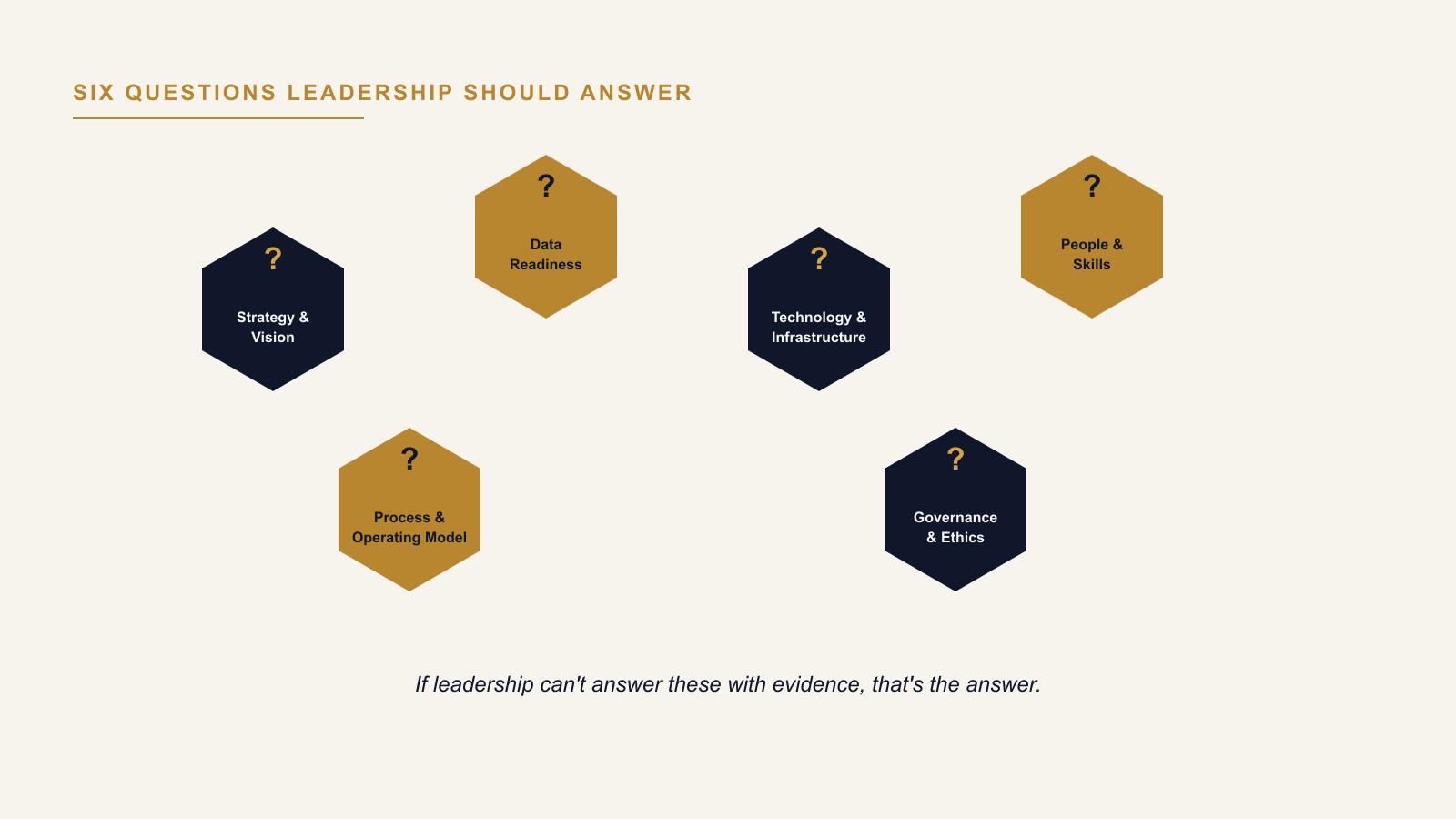
The AI readiness assessment questions leadership should be able to answer — without pulling up a spreadsheet — are six, one per dimension, each demanding a specific piece of evidence rather than an opinion. If a sponsor or steering committee member can't answer these with something concrete, that gap in their own answer is itself a readiness signal, before the full thirty-criteria assessment ever runs.
These are not the full scored checklist — for the complete evidence-based criteria across all thirty, see AI Readiness Checklist: The Criteria to Score Before You Commit Budget. These six are a shorter, sharper leadership-level test: can the people accountable for the programme answer them today, from memory, with a named artifact behind each answer.
1. Strategy & Vision — "What specific business objective is this AI programme meant to serve, and who owns that outcome?"
A good answer names a number and a person. A red-flag answer is "we want to explore AI" or "the CEO is excited about it" — enthusiasm is not a mandate, and a programme without a named accountable owner has no one who can say, six months in, whether it's actually working.
2. Data Readiness — "What evidence do we have that the data our first use case needs is usable today, not eventually?"
A good answer cites a data catalogue entry or a profiling result. A red-flag answer is "the data's been there for years" — true, and irrelevant to whether it's clean, labeled consistently, and legally usable for AI training.
3. Technology & Infrastructure — "Is the compute and MLOps capability to run this in production sized, costed, and actually provisioned?"
A good answer points to a specific environment and an owner for keeping it running. A red-flag answer is "it'll scale when we need it to" — an assumption, not a provisioned environment.
4. People & Skills — "Who, specifically, can build and validate this model, and is that person on staff or still being hired?"
A good answer names a person or a contract already signed. A red-flag answer is "we're planning to hire for this" with no req open and no close date — skilled people take longer to hire than budget takes to approve, and a programme timeline that assumes otherwise is already behind.
5. Process & Operating Model — "Who outside IT has signed off on the change this system will make to how people work?"
A good answer names the business unit lead and the date they signed off. A red-flag answer is "IT and the business are aligned" with no business-side name attached — alignment that was never actually confirmed in writing tends to dissolve the moment the system changes someone's job.
6. Governance & Ethics — "Is there a written AI policy covering this use case, and who owns it independently of the build team?"
A good answer names a document and an owner who isn't building the model. A red-flag answer is "general IT policy covers it" — general IT policy was not written with model risk, explainability, or AI-specific regulation in mind, and assuming it covers AI use is exactly the gap that surfaces, expensively, after launch.
Running This as a Fifteen-Minute Pre-Check
These six work best asked in one sitting, before the full assessment is ever commissioned — a leadership team, a sponsor, or a steering committee answering each one out loud, in front of each other, with no advance preparation. The point isn't to catch anyone out. It's to surface, cheaply and early, which of the six dimensions already has a confident, evidence-backed answer and which doesn't — so the full thirty-criteria assessment that follows can focus data-gathering effort on the dimensions this quick pass couldn't answer, instead of treating all six as equally unknown.
What "I Think So" Actually Means
A leadership team that can answer all six with a named artifact has a genuine basis for confidence. A team that answers most of them with "I think so" or "probably" has just located, in under five minutes, where the full assessment needs to focus first — which is a more useful outcome than a reassuring but unverified "yes" to all six.
The AI Transformation Readiness Assessment provides the full evidence-based version of these six questions: 30 scored criteria across the six dimensions above, each with the specific evidence prompt a credible answer requires.
→ Available at www.viksya.com