
AI Readiness Checklist: The Criteria to Score Before You Commit Budget
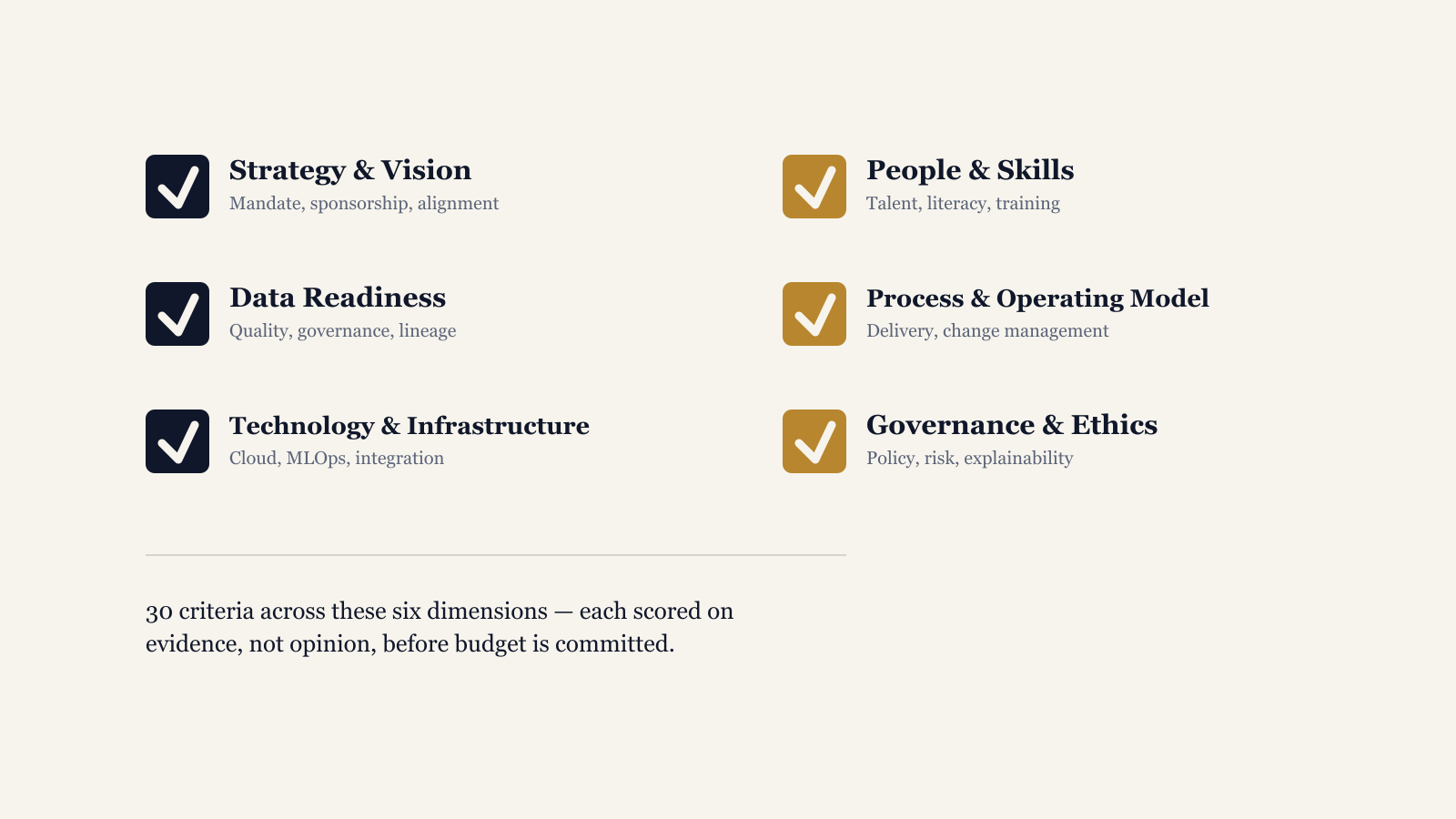
An AI readiness checklist is the set of evidence-based criteria an organization scores before committing budget to an AI transformation programme — not a list of intentions, a list of what can currently be proven. Below is the checklist across the six dimensions a credible AI readiness assessment covers. Each item states the evidence it requires, not just a box to tick.
Two rules make a checklist like this useful rather than decorative. First, every item is scored on evidence that already exists, not a plan to produce it — a roadmap slide is not evidence. Second, a missing item is a gap to close before launch, not a footnote to revisit later. Score honestly and the checklist tells you exactly where the programme is exposed.
Strategy & Vision
- A named executive sponsor accountable for the AI programme’s outcomes, not just its budget line.
- A written AI mandate connecting the programme to a specific business objective — not “explore AI,” a stated outcome with a number attached.
- Evidence the business units affected have been consulted, not just informed, before the programme was scoped.
- A committed multi-year investment horizon, not a single-year pilot budget with no stated path beyond it.
- Agreement across leadership on what “success” means for the first wave, documented and shared — not assumed to be common knowledge.
Data Readiness
- A data catalogue covering the datasets the first-wave use cases will actually depend on — not an enterprise-wide catalogue initiative still in progress.
- Documented data quality metrics for those datasets, with known gaps named, not assumed clean.
- A clear data access and ownership model — who can approve use of a given dataset, and how long that approval takes in practice.
- Evidence of data lineage for anything that will feed a model making a consequential decision.
- A working data pipeline from source to a usable, queryable state — not a one-off export someone ran for a proof of concept.
Technology & Infrastructure
- A cloud or compute environment that can actually host the planned workload, sized and costed, not assumed to “scale when needed.”
- Basic MLOps capability — versioning, monitoring, and a rollback path for a model in production, not a manual process run by one engineer.
- An integration architecture that connects a model’s output to the system that will actually act on it.
- Security and access controls reviewed for the specific data and systems the first-wave use cases touch.
- A named owner for keeping the infrastructure running once the initial build team moves on.
People & Skills
- At least one person on staff, or under contract, who can build and validate the kind of model the first wave requires — not a generalist expected to learn on the job under deadline.
- A baseline AI literacy level among the teams who will use the output, confirmed, not assumed.
- A training plan for the people whose roles change once the system is live.
- A hiring or partner pipeline for the specific skills gaps the assessment surfaces, not a general intention to “hire more data people.”
- Clarity on who owns the model once it’s in production — the build team, a dedicated ML operations function, or no one yet.
Process & Operating Model
- A delivery methodology the team will actually follow, not a framework named in a kickoff deck and abandoned by sprint three.
- A documented change management plan for the business process the AI system will alter, with an owner.
- Cross-functional alignment confirmed in writing — the business unit, IT, legal, and compliance all agree on scope, not just IT.
- A defined escalation path for when the system produces an output someone disagrees with.
- A realistic timeline that accounts for the organization’s actual change-absorption capacity, not an aspirational one.
Governance & Ethics
- A written AI policy covering acceptable use, even a short one — not an assumption that general IT policy already covers it.
- Risk controls appropriate to what the system actually does — a chatbot and a credit-decisioning model do not need the same controls, and conflating them wastes effort in one direction and leaves exposure in the other.
- A documented regulatory position for the jurisdictions the system operates in, including whether the EU AI Act or a similar regime applies.
- An explainability approach suited to the decision’s stakes — a black-box model making a low-stakes recommendation is a different governance problem than one making a high-stakes one.
- A named owner for AI governance who is not the same person building the models — evaluating your own work is not independent review.
Using This Checklist
Thirty items, six dimensions, each scored against evidence rather than intention. A programme that can check every box has a genuine readiness baseline. One that can’t has a prioritised list of exactly what to fix before the budget conversation, which is a better position to be in than discovering the same gaps six months into delivery.
This checklist tells you what to score. For the process of actually running that scoring exercise — who should be in the room, how to avoid self-serving optimism, and how to turn thirty scores into one defensible verdict — see How to Run an AI Readiness Assessment That Actually Means Something.
The AI Transformation Readiness Assessment provides this checklist as a scored Excel workbook — all 30 criteria across the six dimensions above, with evidence prompts for each, an auto-calculated RAG dashboard, and a gap register ranked by severity.
→ Available at www.viksya.com