
How to Run an AI Readiness Assessment That Actually Means Something

Most AI readiness assessments produce one of two outcomes: a score that tells leadership what they already know, or a score that tells them what they want to hear.
Neither is useful.
A readiness assessment done properly gives programme leadership an objective, evidence-based view of where the gaps are — before they become expensive — and a clear basis for go/no-go decisions. Done poorly, it's a slide in a steering committee deck that nobody references again.
Here's what makes the difference.
If you're looking for what an AI readiness assessment actually is and measures before diving into execution, start with What Is an AI Readiness Assessment and What Does It Measure. If you're still deciding whether to commit budget at all, see How to Tell Whether Your Organization Is Ready to Invest in AI.
First: Who Needs to Be in the Room
AI readiness is not a technology assessment. That's the most common mistake.
Limiting the assessment to the IT architecture team produces a view of one dimension — infrastructure — and leaves five others unexamined. A credible assessment requires input from Data and Analytics (data readiness), HR and L&D (talent), Legal and Compliance (governance), Business unit leads (change readiness and adoption risk), and the PMO (strategic alignment and program capacity).
If those stakeholders are not contributing to the scoring, the output reflects IT's view of whether IT is ready. That's a different question.
Second: Score on Evidence, Not Aspiration
This is where most self-assessments break down.
A score of 4 out of 5 means solid capability exists today — not that it's planned, budgeted, or on a roadmap. The instinct to score optimistically is understandable. The consequence is a readiness score that misleads the steering committee and delays the surfacing of real blockers.
Useful scoring criteria are evidence-based. For each dimension, the question is not 'do we have this capability?' It is 'what evidence exists that this capability is operational?' A data quality score requires a data catalogue with documented quality metrics — not a plan to build one. A change management score requires a completed change impact assessment — not an intention to complete one.
Evidence-based scoring is uncomfortable. It is also the only kind that protects the program.
Third: Separate Blockers from Manageable Risks
Not all gaps are equal, and treating them as equal produces the wrong prioritisation.
A useful framework: dimensions scoring below 2.5 out of 5 are active blockers — areas where remediation needs to be underway before execution proceeds, not in parallel with it. Dimensions scoring between 2.5 and 3.5 are manageable risks — acknowledged gaps that can be addressed during the program with structured workstreams and active tracking. Dimensions scoring above 3.5 are stable — continue to monitor, but not a primary focus.
This separation gives programme leadership something actionable: a short list of genuine blockers, a longer list of risks with owners, and a defensible record of what was assessed and when. That same blocker threshold is what turns a readiness score into a funding decision, not just a diagnostic — see Using AI Readiness as a Funding Gate in the 2027 Budget for how to build it into the annual budget cycle.
Fourth: Present It as a Trend, Not a Snapshot
A single readiness score has limited value to a steering committee. A readiness trend — tracked quarterly across a 12-month program — has significant value.
It shows whether gap remediation is working. It flags emerging risks before they escalate. It gives executives a visible, objective indicator of program health that sits alongside cost, schedule, and scope.
The practical implication: run the assessment at baseline (before execution), repeat it at program kick-off, and re-run it quarterly. The questions stay the same. The scores change. The trend is the insight.
The Four-Stage Process
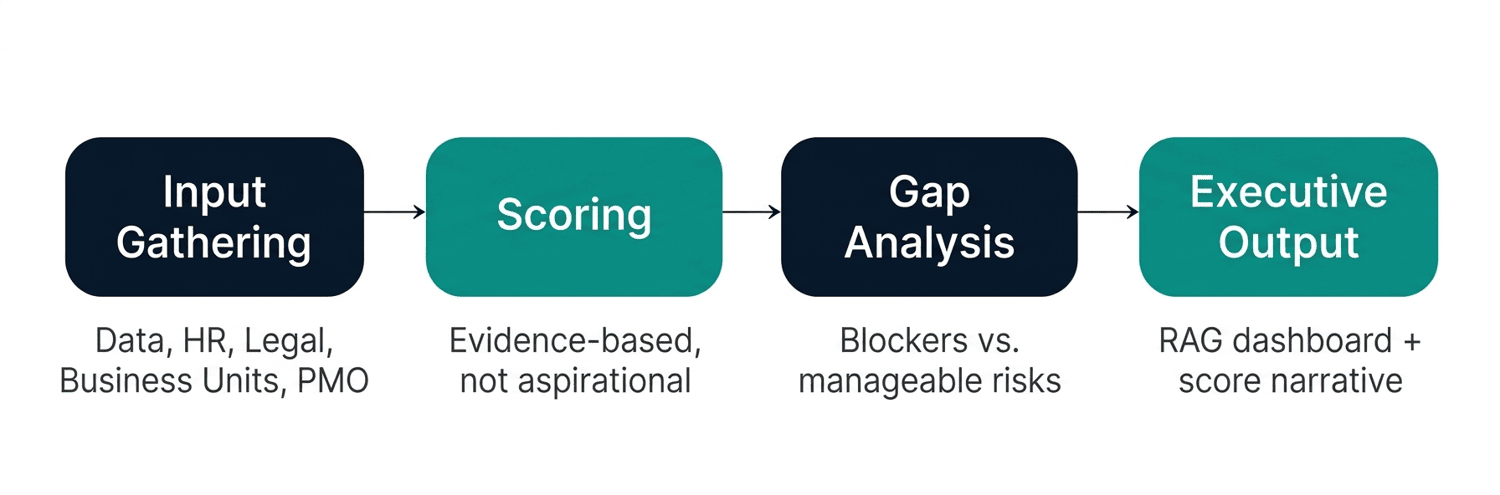
Structurally, a focused readiness assessment can be completed in a working week. The four stages:
- Input gathering — structured questionnaires and document review across Data, HR, Legal, Business units, and PMO. This is not a series of workshops; it's targeted evidence collection.
- Scoring — each of the six dimensions scored against weighted criteria, using the evidence gathered in stage one. Scores are documented with supporting rationale, not just a number.
- Gap analysis — blockers separated from manageable risks, with recommended actions and owners assigned to each gap.
- Executive output — a RAG dashboard per dimension, an overall readiness score, and a summary narrative that gives leadership the basis for informed decision-making.
The output is not a recommendation to proceed or halt. It is the evidence that allows programme leadership to make that decision with clarity rather than optimism.
What a Useful Readiness Score Looks Like
A readiness score of 3.1 out of 5, with two dimensions in green, three in amber, and one in red, is more useful than a score of 4.2 across the board — because the former reflects reality and the latter doesn't.
The goal of a readiness assessment is not a high score. It is an accurate score, with a plan behind every gap.
Readiness is not the absence of gaps. It is the presence of a plan.
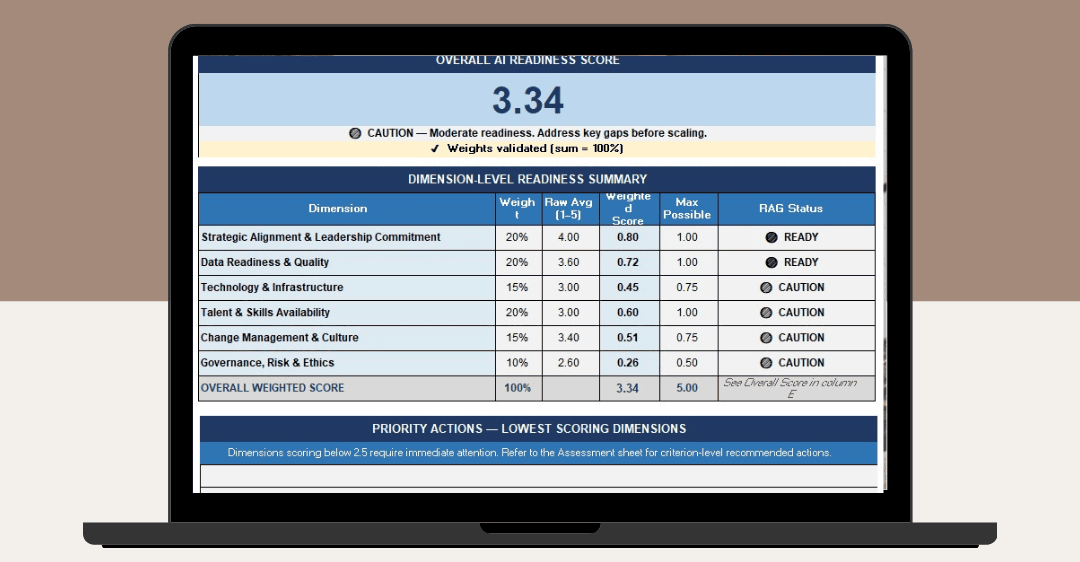
The AI Transformation Readiness Scoring Model provides the structured framework for this process — 30 scored criteria across six dimensions, evidence prompts for each, recommended actions, and an auto-calculated executive dashboard. Designed to run a credible assessment in under 90 minutes.
→ Available at www.viksya.com