
What Is an AI Readiness Assessment and What Does It Measure
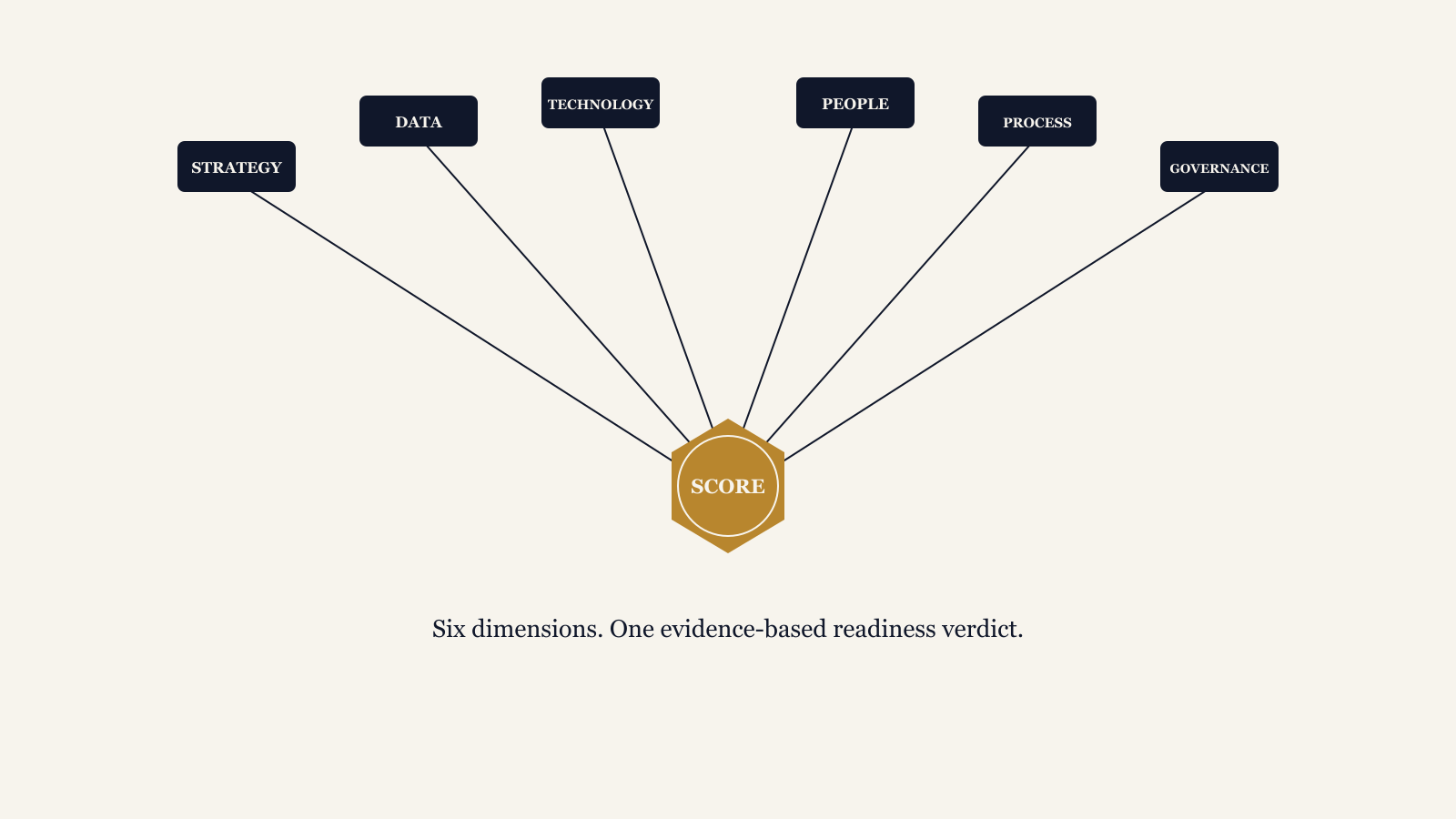
An AI readiness assessment is a structured evaluation of whether an organization is positioned to invest in an AI transformation initiative before committing budget, scored across dimensions such as strategy, data, technology, people, process, and governance. It replaces opinion — "we feel ready" or "we feel behind" — with an evidence-based score that a steering committee can actually act on. The term gets used loosely in practice, sometimes to mean a single conversation with IT about infrastructure, sometimes to mean a full external audit. What follows is the specific, narrower definition a credible assessment actually uses.
What It Measures
A credible assessment scores six dimensions independently rather than producing one blended impression: Strategy & Vision, Data Readiness, Technology & Infrastructure, People & Skills, Process & Operating Model, and Governance & Ethics. Each dimension is broken into specific, evidence-based criteria — not "do you have good data," but a scored checklist against what's actually demonstrable today, not what's planned. Scoring each dimension separately, rather than folding everything into one average, is what makes the result useful: a strong technology score can't quietly cover for a weak data score, the way it would in a single blended number. For what each dimension covers, see The Six Dimensions of AI Readiness; for the full criteria list, see AI Readiness Checklist.
How It Differs From a Generic Maturity Model
A generic digital maturity model measures general organizational capability — useful, but not built for this decision. An AI readiness assessment is scoped specifically to AI investment, weighted toward the gaps that most commonly stall AI programmes: data governance, model risk controls, and AI-specific skills. The difference matters in practice: an organization can score well on general digital maturity and still be unready for a specific AI investment, because the general model never asked about model risk controls or AI-specific talent at all. A company with excellent enterprise software adoption and a mature IT service desk can still have no documented data lineage and no named owner for AI governance — gaps a general maturity model has no mechanism to surface, because it was never built to look for them.
What the Output Looks Like
Not a single adjective. A useful assessment produces a per-dimension score, an overall weighted score, and a plain-language verdict — typically Ready, Caution, or Not Ready — so the number doesn't need separate interpretation. The most useful assessments also separate blockers (dimensions scoring low enough to need remediation before execution) from manageable risks (gaps that can be tracked and closed in parallel), rather than treating every gap as equally urgent. That separation is what turns the output from a score into something a steering committee can actually act on: a short list of things that must be fixed before launch, and a longer list of things to track with an owner while delivery continues.
When Organizations Run One
Before committing budget to an AI transformation programme, and again at key checkpoints — programme kick-off, then quarterly — so the readiness score becomes a trend leadership can track, not a one-time snapshot that goes stale the moment real delivery work starts. A single assessment answers "are we ready right now." A tracked trend answers a more useful question: is the gap-remediation work actually working, or are the same dimensions still scoring low two quarters later. Programmes that only assess once, at the start, lose the ability to answer that second question entirely.
It's typically run by three kinds of people, for three different reasons: programme and transformation leads building the evidence base before committing budget they're accountable for; CIOs and CTOs who need a scored, dimensional view to bring to a board or steering committee, not a consultant's opinion; and consultants or system integrators who want a structured, repeatable instrument instead of running an ad-hoc discovery workshop with every new client.
Already clear on what an assessment is and ready to run one well? See How to Run an AI Readiness Assessment That Actually Means Something for who should be in the room, how to avoid optimistic scoring, and how to present the result to a steering committee.
The AI Transformation Readiness Assessment provides this as a structured, scored instrument: 30 criteria across six dimensions, delivered as a scored Excel workbook with an auto-calculated RAG dashboard and gap register.
→ Available at www.viksya.com