
The Six Dimensions of AI Readiness: Strategy, Data, Technology, People, Process, and Governance
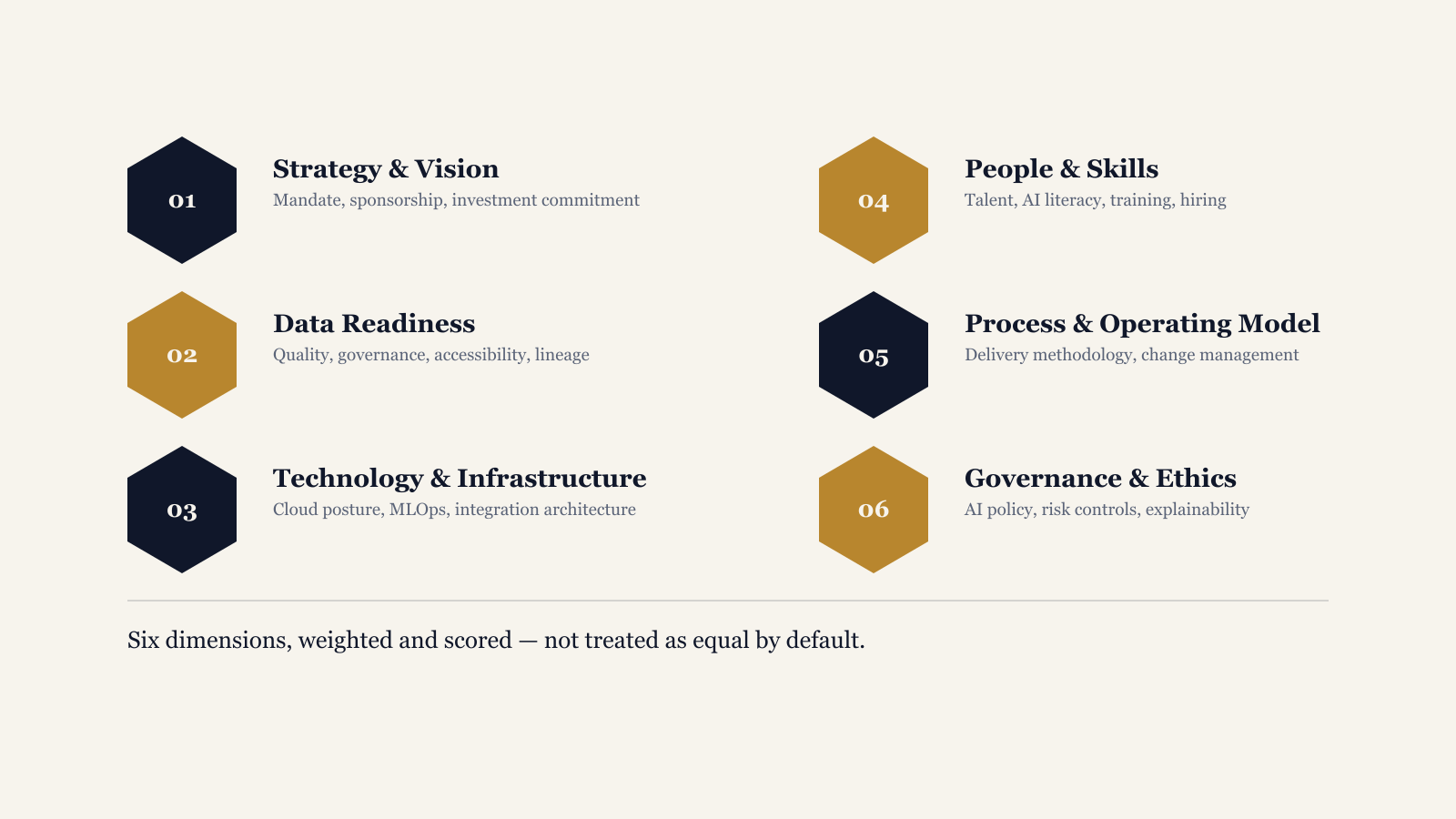
AI readiness is assessed across six dimensions: Strategy & Vision, Data Readiness, Technology & Infrastructure, People & Skills, Process & Operating Model, and Governance & Ethics. Each one captures a distinct way an AI programme can fail that the others don’t catch — which is why a credible assessment scores all six separately rather than producing one blended number.
Strategy & Vision
Whether there is an executive mandate, a named sponsor, and a stated business objective the AI programme is actually meant to serve. Programmes that score low here usually have enthusiasm but no accountable owner and no definition of what success looks like — which means nobody can say, six months in, whether the programme is working.
Data Readiness
Whether the data the planned use cases depend on is accessible, governed, and of known quality. This is the dimension that most often gets assumed rather than verified, and the one most likely to quietly cap how far a programme can go — a model is never better than the data it's trained and run on, and “we have a lot of data” is not the same claim as “we have the data this use case needs, in a usable state.”
Technology & Infrastructure
Whether the compute, cloud posture, MLOps tooling, and integration architecture actually exist to host and run what's being proposed. This is the dimension IT-only readiness assessments overweight — it matters, but a strong infrastructure score next to weak data and governance scores does not add up to a ready organization.
People & Skills
Whether the organization has, or has a credible path to, the talent that can build, validate, and operate what it's proposing to build — and whether the teams who will use the output have the AI literacy to use it correctly. A programme can be fully funded and technically sound and still stall here, because skilled people take longer to hire than budget takes to approve.
Process & Operating Model
Whether there's a delivery methodology the team will actually follow and a change management plan for whatever business process the AI system will alter. This dimension is where otherwise well-resourced programmes lose momentum — the model works, but nobody planned for how the people whose job changes will actually adopt it.
Governance & Ethics
Whether there's a written AI policy, risk controls sized to what the system actually does, and a regulatory position for the jurisdictions it operates in. This dimension carries the most asymmetric downside: a gap here doesn't slow a programme down the way a data or skills gap does, it creates exposure that surfaces later, often after launch, when it's much more expensive to fix.
Why the Six Aren't Scored Equally
A generic maturity model averages dimensions like these into one number, which quietly assumes a weak governance score and a weak data score cost the organization the same amount. They don't — a governance gap tends to surface as regulatory or legal exposure months after launch, while a data gap tends to surface immediately, as a model that simply doesn't perform. A credible AI readiness assessment lets each dimension carry its own weight, set deliberately rather than defaulted to equal, and checks that those weights actually sum to 100% before producing a verdict — because an unweighted average of six very different risks isn't a readiness score, it's an illusion of precision.
In practice, the dimensions that score lowest are rarely the ones an organization expects going in. Technology and infrastructure gaps tend to be visible and already on someone's roadmap; data readiness and governance gaps tend to be invisible until someone is specifically asked to produce evidence for them, which is exactly why they're worth scoring independently rather than assumed.
For the specific, evidence-based criteria scored within each of these six dimensions, see AI Readiness Checklist: The Criteria to Score Before You Commit Budget.
The AI Transformation Readiness Assessment provides all six dimensions above as a scored instrument: 30 underlying criteria, rolled up into the six dimension scores shown here, each dimension weighted by an auto-calculated dashboard that checks your weights sum to 100% and returns a plain-language verdict — Ready, Caution, or Not Ready.
→ Available at www.viksya.com