
Using AI Readiness as a Funding Gate in the 2027 Budget
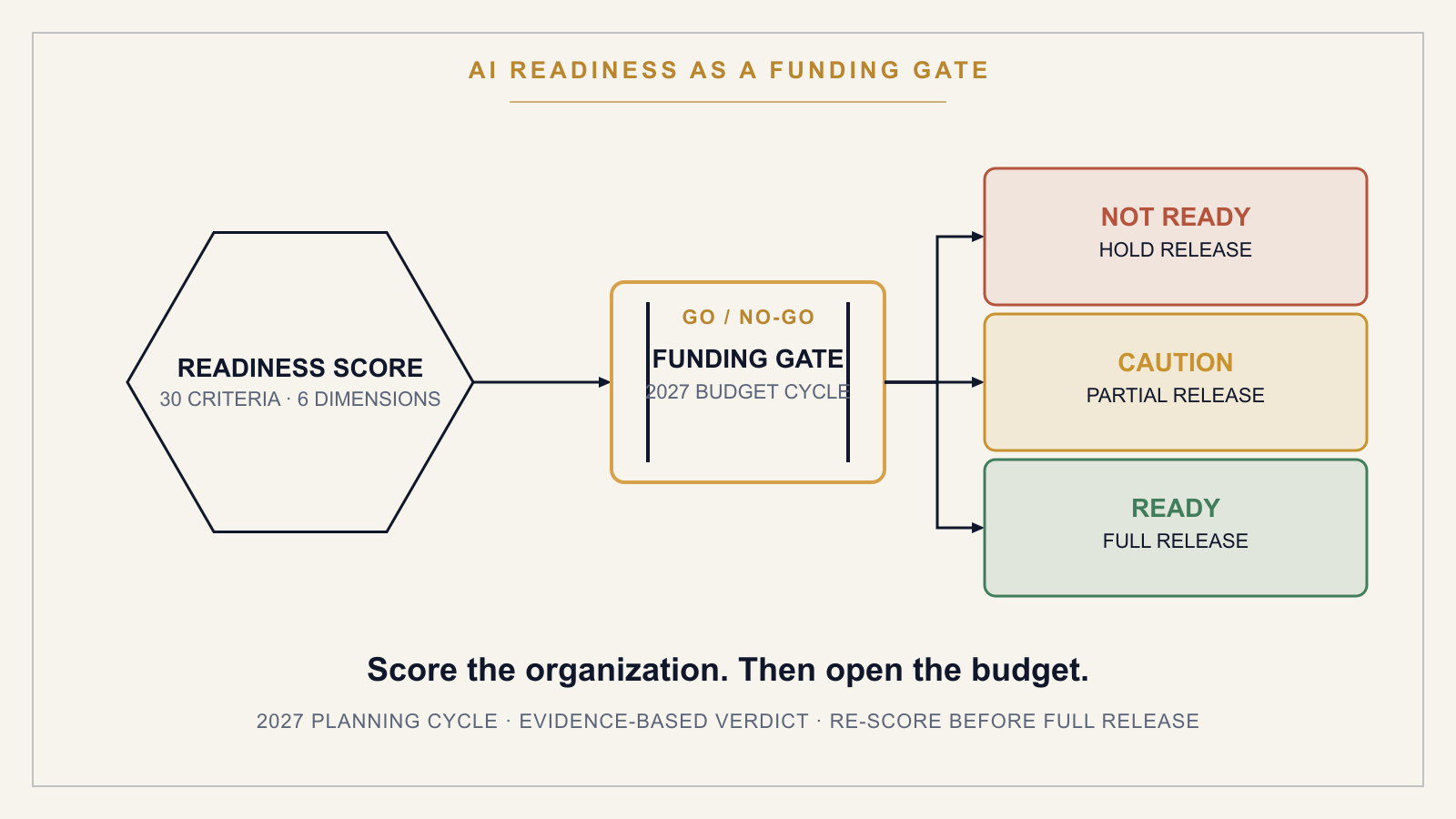
Using AI readiness as a funding gate in the 2027 budget means setting a minimum readiness verdict as a precondition for releasing AI investment funds during the annual planning cycle, not after a programme is already underway. A score that lands in the Not Ready band holds the budget. A Caution verdict releases a smaller, remediation-scoped allocation instead of the full request. A Ready verdict releases the full request as submitted. The gate sits at the planning-cycle decision point — before any individual programme has been selected, and before that programme's own delivery milestones begin.
This is a different checkpoint from the one covered in How to Run an AI Readiness Assessment That Actually Means Something, which addresses how to run the assessment well: who needs to be in the room, scoring on evidence rather than aspiration, and separating blockers from manageable risks. This post assumes that assessment has already produced a score and takes up a narrower question: what the organization does with that score at the exact moment the annual budget is being set.
It is also a different checkpoint from the one in Staged AI Investment Gates, which structures a programme's own delivery budget into three tranches tied to model performance milestones, once that programme already has funding and is underway. A readiness-score funding gate — an AI investment gate scoped to organizational readiness rather than model performance — operates earlier and at a different level of the organization: it decides whether AI budget opens at all for the planning cycle, before any specific programme has been chosen or has reached that post's Gate 1.
Why AI Readiness Comes Before the Budget, Not Alongside It
A readiness score run during the same meeting where the budget is approved is not evidence — it is theatre. The score needs to exist, dated and documented, before the budget submission is drafted, so the finance and PMO reviewers approving the request are reading a verdict rather than a promise that one will be produced later. For organizations working to a standard fiscal calendar, that means the assessment behind the 2027 budget runs during the Q4 2026 planning season, early enough that a Not Ready or Caution result still leaves time to adjust the request before it is submitted, not after it has already been approved.
Setting the Threshold
Tying AI readiness score funding decisions to bands that already exist in the assessment keeps the threshold defensible rather than improvised each planning season. How to Run an AI Readiness Assessment lays out the scoring bands used across the model's thirty criteria. The same bands translate directly into a funding decision:
- Below 2.5 on any dimension — an active blocker. Full budget release is held until that dimension is remediated, regardless of how strong the rest of the score looks.
- 2.5 to 3.5, with no blocker-band dimension — a manageable risk. The gate releases a reduced, remediation-scoped allocation rather than the full request.
- Above 3.5 across the board, with an overall Ready verdict — the gate releases the full request as submitted.
Set in writing before the budget cycle starts, these thresholds become a standing policy the PMO and finance can point to, rather than a judgment call improvised fresh every planning season.
What a Held or Partial Release Looks Like in Practice
Picture an organization heading into its 2027 planning cycle with an overall verdict of Caution, driven by a Data Readiness dimension scoring 2.1 — a blocker on its own, even though the other five dimensions score comfortably above 3.5. Rather than releasing the full AI programme budget requested for the year, the gate releases a smaller, named allocation scoped specifically to data remediation: closing the governance and lineage gaps the dimension score identifies, with an owner assigned and a re-score date set ahead of the next quarterly review. The remainder of the requested budget stays held until the re-score clears the blocker band. Nothing about the rest of the programme plan changes — only the timing and size of what gets funded first.
Building the Gate Into the Budget Request Itself
A funding gate only works if the score is part of the budget submission, not a separate exercise the steering committee reviews on its own schedule. In practice, that means:
- The budget request includes the dated RAG Dashboard output and the one-page Executive Summary from the readiness assessment, not a verbal assurance that readiness was checked.
- The finance or PMO owner reviewing the request can see the overall verdict — Ready, Caution, or Not Ready — and the per-dimension breakdown behind it, before approving any allocation.
- A re-score date is set as a condition of any partial release, so a Caution-band allocation has a defined point at which the remainder either releases or gets re-evaluated.
This is a small amount of additional process layered onto a budget cycle that already requires a business case, a cost estimate, and an ROI projection. What it adds is a check that those other documents are being built against an organization actually positioned to deliver — rather than discovering, mid-programme, that the data governance or talent gaps the readiness assessment would have surfaced were there all along.
Why This Belongs in the Annual Cycle, Not Just the Steering Committee
A readiness score reviewed only at the steering-committee level, after budget has already been approved, can inform how a programme runs but cannot change whether it was funded in the first place. Moving the same score into the budget approval step itself, ahead of the 2027 planning cycle, is what turns it from a diagnostic into an actual gate — the difference between a number the organization is aware of and a number that decides what gets funded.
The AI Transformation Readiness Assessment provides the scored baseline this gate runs on — thirty criteria across six dimensions, delivered as an Excel workbook with an auto-calculated RAG Dashboard, a one-page Executive Summary, and a Ready / Caution / Not Ready verdict that can be exported straight into a budget submission.
→ Available at www.viksya.com