How to Tell Whether Your Organization Is Ready to Invest in AI
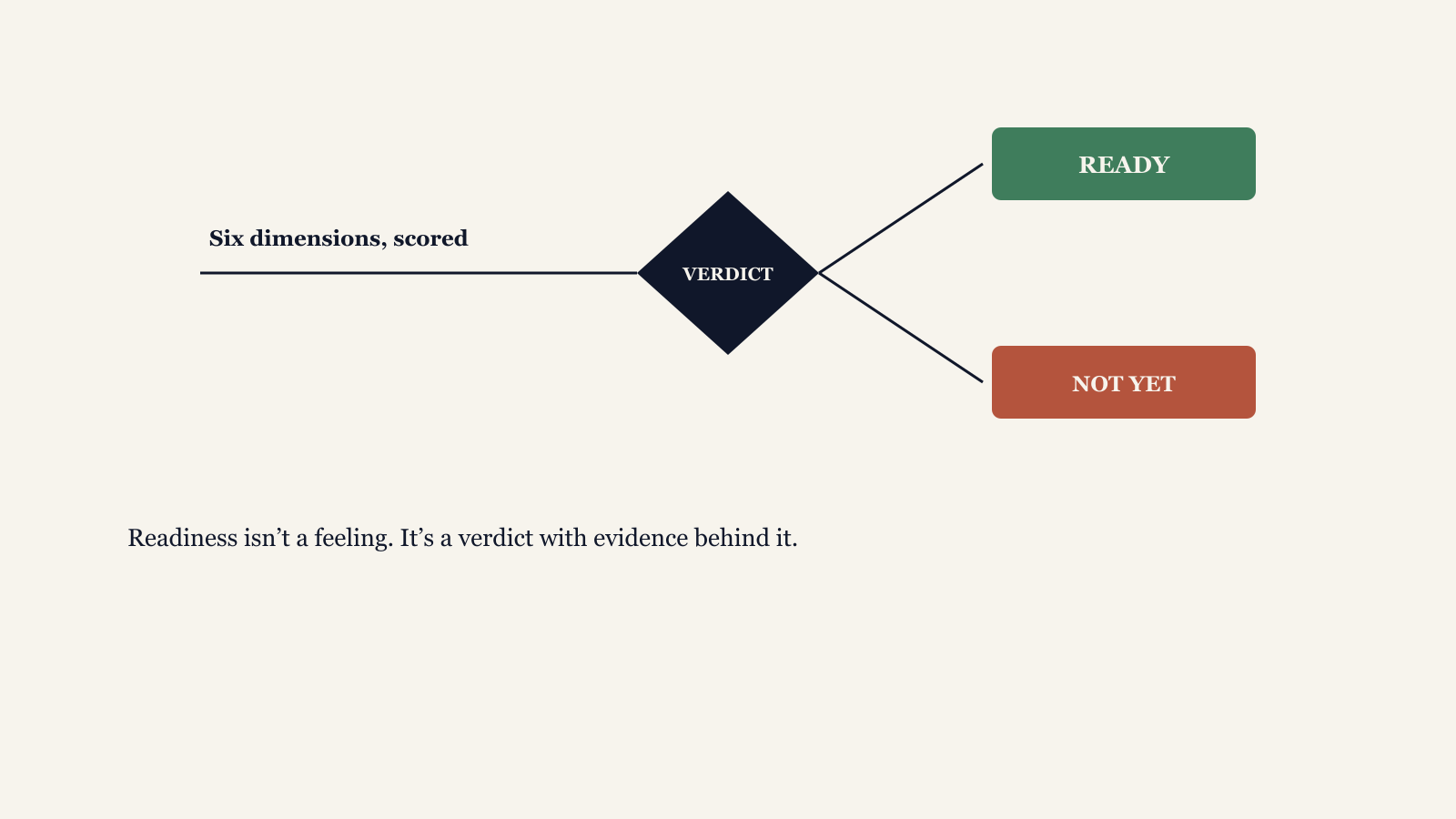
An organization is ready to invest in AI transformation when it can produce evidence — not confidence — across six dimensions: strategy, data, technology, people, process, and governance. Short of running the full scored assessment, a handful of recognizable warning signs will tell you quickly whether that evidence actually exists, or whether "we're ready" is still an opinion. This question tends to surface earlier than most people expect — usually in the budget conversation itself, when someone on the finance side asks what the readiness picture actually looks like and the honest answer is that nobody has checked.
Signals You're Not Ready Yet
None of these alone is disqualifying. Three or more together usually mean the organization is still at the strategy stage, not the investment stage. The point of checking them isn't to produce a verdict on the spot — it's to catch the obvious, expensive mistakes before they reach a budget committee, where a vague "we're ready" gets far more scrutiny applied to it after the money is committed than before.
- The AI mandate exists only as a slide. There's executive enthusiasm, but no named sponsor accountable for outcomes and no specific business objective the programme is meant to serve.
- Nobody can describe the data honestly. "We have a lot of data" is a different claim from "we have a documented catalogue with known quality metrics for the datasets this specific use case needs." If the honest answer is the former, the data dimension isn't ready.
- There's no plan for who owns a model once it's live. Build teams exist. Operations teams for what happens after launch often don't.
- Nobody has asked the regulatory question. Not "we'll figure out compliance later" — an actual answer to whether something like the EU AI Act applies to what's being proposed.
- The budget conversation keeps getting deferred. If finance keeps asking for more detail before committing, that's often a readiness gap wearing a budgeting-process costume.
- The same two or three people answer every readiness question. If strategy, data, and governance are all being answered by one enthusiastic sponsor rather than the people who'd actually have to produce the evidence, the picture is optimistic by construction, not because anyone's lying.
Why a Gut Check Isn't Enough
These signals are useful for catching obvious problems early, and that's all they're built for. They can tell you "we are clearly not ready" when the mandate is a slide and nobody owns the data. They cannot tell you "we are ready," because readiness isn't the absence of obvious red flags — it's a specific, weighted score across all six dimensions, with evidence behind each one. An organization with no obvious red flags can still have a real gap in, say, model risk governance that only a structured assessment would surface, because nobody thought to ask the question informally. That asymmetry is the whole reason an informal check and a formal assessment answer different questions: one is built to catch what's obviously broken, the other is built to catch what looks fine until someone actually asks for evidence.
What a Real Answer Looks Like
A structured AI readiness assessment doesn't return a single yes or no. It returns a verdict — Ready, Caution, or Not Ready — built from a weighted score across the six dimensions, with the specific gaps named rather than implied. "Caution" is itself a useful, actionable answer: it means proceed, but with specific, named risks tracked and owned, not an all-clear and not a halt. That's a materially better outcome for a budget conversation than either extreme — a flat "yes" that turns out to have hidden a governance gap six months in, or a flat "no" that stalls a programme leadership already believes in, for reasons nobody can point to specifically.
For what the assessment actually measures, see What Is an AI Readiness Assessment and What Does It Measure. Ready to run the formal version properly? See How to Run an AI Readiness Assessment That Actually Means Something.
The AI Transformation Readiness Assessment provides exactly this as a structured, scored exercise — 30 criteria across six dimensions, delivered as an Excel workbook with an auto-calculated dashboard that returns a plain-language verdict: Ready, Caution, or Not Ready.
→ Available at www.viksya.com