
AI Readiness vs AI Maturity: Which One Decides an Investment
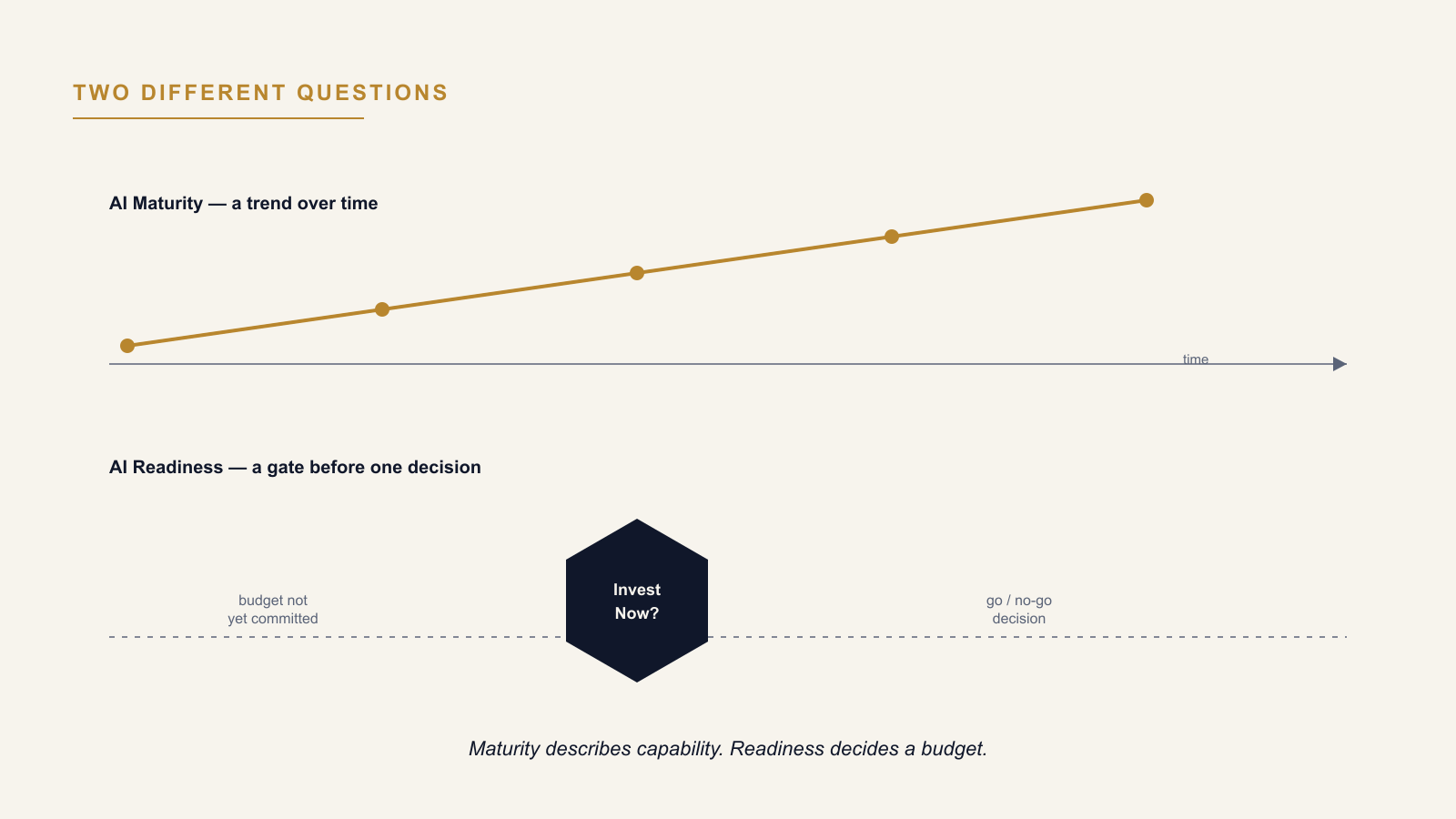
AI readiness and AI maturity answer different questions and neither substitutes for the other. AI maturity describes how advanced an organization's general AI capability is, tracked as a trend over time. AI readiness is a scored, evidence-based verdict on whether this organization, right now, is positioned to commit budget to a specific AI investment. Maturity is descriptive. Readiness is decision-grade. Confusing the two produces a programme that scores well on one and still fails on the other — and a steering committee that asks for a maturity score when what it actually needs, before signing off a budget line, is a readiness verdict.
What Each One Actually Measures
A maturity model measures general capability — how far along an organization is on digital transformation broadly, often scored against a standard set of stages (ad hoc, developing, defined, managed, optimized) that apply across technology initiatives, not AI specifically. An AI readiness assessment is scoped narrowly to one decision: is this organization ready to invest in a specific AI transformation initiative before committing budget, scored across Strategy & Vision, Data Readiness, Technology & Infrastructure, People & Skills, Process & Operating Model, and Governance & Ethics. For the full definition, see What Is an AI Readiness Assessment and What Does It Measure.
Why a Strong Maturity Score Doesn't Answer the Readiness Question
An organization can score well on general digital maturity — excellent enterprise software adoption, a mature IT service desk, strong cloud fundamentals — and still be unready for a specific AI investment, because a generic maturity model was never built to ask about data lineage for a specific use case, AI-specific talent, or model risk controls. It measures the wrong things for this decision, not fewer of the right ones.
A Worked Illustration
Picture two organizations, both scoring "Managed" on a standard digital maturity scale — solid cloud adoption, an established IT service desk, mature software delivery practices. One of them has a documented data catalogue for the dataset its first AI use case depends on, a named AI governance owner, and two data scientists already on staff. The other has neither a data catalogue entry nor a governance owner, and is still interviewing for its first AI hire. Both score identically on general maturity. Only one of them would score "Ready" on an AI readiness assessment — the maturity number never asked the questions that would have told them apart.
A Different Pair of Questions, Side by Side
Put plainly: a maturity model asks "how capable are we, in general, compared to where we were last year." A readiness assessment asks "are we specifically positioned to fund this initiative, right now, with evidence to back that up." The first question has no wrong time to ask it — it's a standing benchmark. The second has a very specific wrong time to ask it: after the budget has already been approved.
Scope, Timing, Output, Audience
The two differ on four practical points. Scope: maturity covers general organizational capability; readiness covers the six dimensions a specific AI investment actually depends on. Timing: maturity is assessed periodically as an ongoing benchmark; readiness is assessed immediately before a go/no-go budget decision. Output: maturity produces a stage or a level on a general scale; readiness produces a weighted score and a plain-language verdict — Ready, Caution, or Not Ready — with blockers separated from manageable risks. Audience: a maturity score informs a long-range roadmap conversation; a readiness score informs the specific people who have to defend a budget request to a steering committee this quarter.
When to Use Each
Use a maturity model to benchmark general capability over time and plan where to invest in foundational capability next year. Use a readiness assessment immediately before committing budget to a specific AI initiative, and again at programme kick-off, then quarterly, so the readiness trend shows whether gap remediation is actually working rather than producing a one-time snapshot that goes stale the moment delivery starts. The two are complementary, run on different cadences, for different audiences — neither is a substitute for the other, and an organization with a strong maturity trend can still walk into a specific investment decision with an unready data estate the maturity model never asked about.
The AI Transformation Readiness Assessment provides the readiness-specific instrument this distinction points to: 30 criteria across six dimensions, scored on evidence and weighted to your own risk profile, producing a decision-grade verdict rather than a general maturity stage.
→ Available at www.viksya.com