
Most AI ROI Metrics Measure Usage. Real AI ROI Metrics Measure the Business Case.
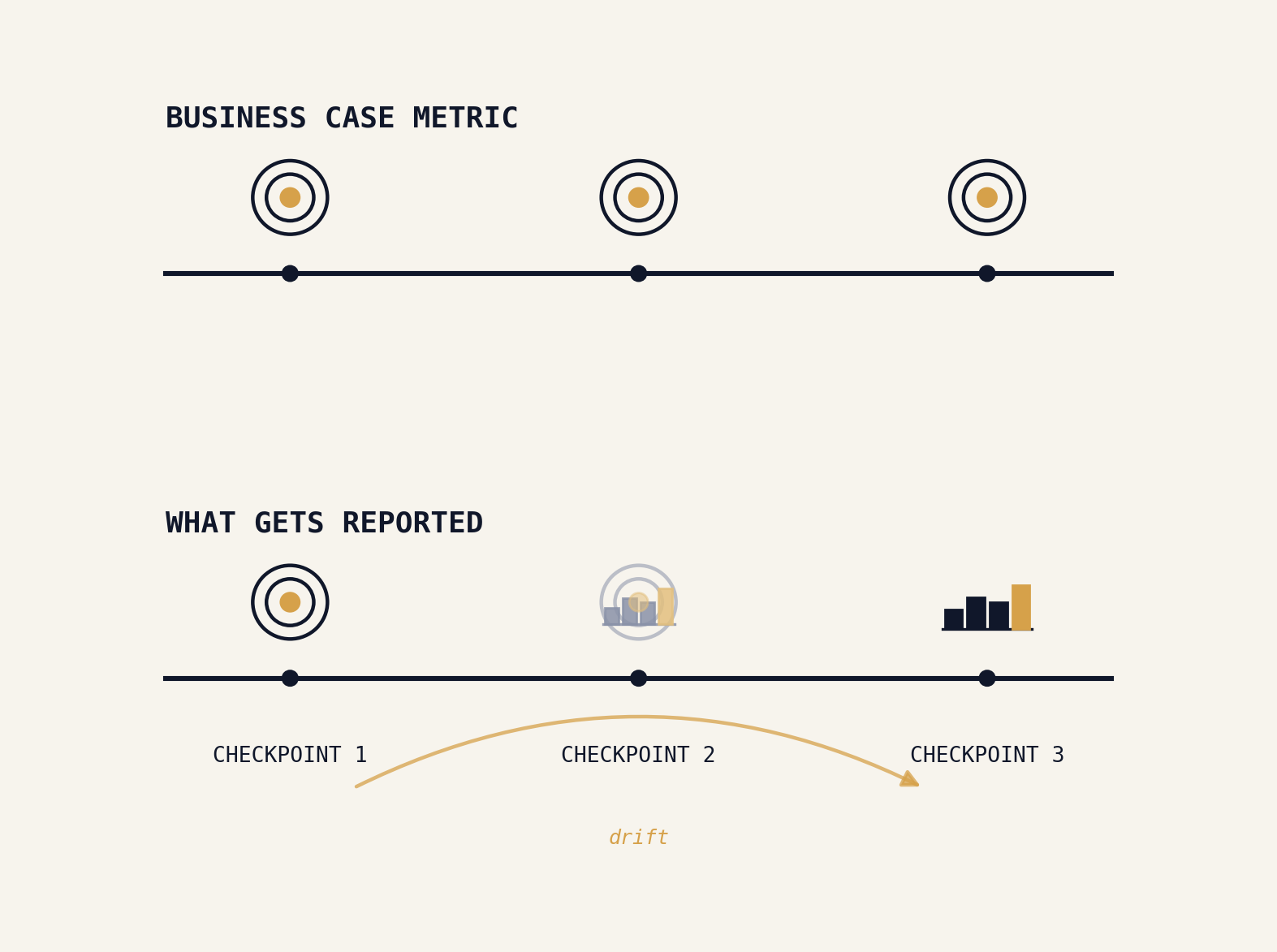
Once an AI program launches, the metric an organisation tracks has a way of quietly changing. The business case was built on a financial or operational outcome — cost per unit, cycle time, error rate, revenue per rep, an NPV or payback calculation. A few quarters later, the steering committee slide shows seats activated, queries run, and an adoption percentage. Nobody approved that swap. It happens because usage data is free and outcome data is work. The fix isn't a better dashboard — it's carrying the same metric from the business case through every post-launch checkpoint, on the same cadence the funding gates already require.
We keep seeing the same pattern in programme reviews. A use case gets funded against a specific number: cases resolved per agent per day, a defect escape rate, days to close. The business case document has it in writing, usually next to the NPV or payback calculation built to justify the spend. The programme launches. By the third or fourth steering committee update, the number on the slide isn't the number in the business case anymore. It has become an adoption number — how many people logged in, how many prompts went out, what share of the target user base counts as "active."
That's not a reporting shortcut, and most people in the room know it even when nobody says so. "Is the tool being used" and "did the case we funded come true" are different questions, and a rising usage number can sit directly on top of a business case that isn't paying off. A team can run thousands of queries a month, ship no faster, resolve no more cases, and cut no cost — and the usage chart will still read as a success.
Picture a customer-service deployment funded on a projected reduction in average handling time. A year in, agent adoption sits above 90%, and everyone treats that as validation. But nobody has gone back and re-run the average-handling-time calculation the case was actually funded on. The tool is being used. Whether the case came true is still an open question — and the fact that nobody has asked it in months is itself the finding.
The reason this happens is mechanical, not careless. Usage metrics are instrumented by the tool itself the moment it's switched on, at zero marginal effort. Outcome metrics require someone to have captured a baseline before launch, held the definition steady, and gone back to re-measure it on the same terms — which is exactly the discipline a staged funding model is supposed to enforce, and exactly the discipline that erodes once attention moves to the next wave.
This is why we build staged investment gates around the outcome metric, not the usage metric: the number a programme has to clear to unlock its next tranche should be the same one finance signed off on, checked on the same cadence — not a proxy the tool's own dashboard happened to make convenient. It's the same discipline our AI ROI Calculator asks for at the business-case stage, applied where most programmes quietly stop applying it: after launch, not just before it. An AI ROI number is not a one-time artifact you produce to get funded. It's the instrument you're supposed to keep reading.
If your last steering committee update showed a usage or adoption number where the original business case had a financial or operational one, that swap already happened. Worth checking who approved it — and whether anyone did.