
How to Present an AI Use Case Shortlist to an Executive Committee

Structure, Scoring, and Sequencing — The Complete Governance Presentation
Most AI programme teams walk into their executive committee with a slide deck. Executive committees make better decisions from a scored framework. The difference is not presentational — it is the difference between asking for approval and giving a committee everything it needs to govern.
The executive committee meeting to review and approve an AI use case shortlist is one of the highest-leverage moments in a programme's lifecycle. The decisions made in that room determine Wave 1 composition, resource allocation, change management investment, and the programme's credibility baseline with the people who control its budget.
Most programme teams underinvest in the preparation for this meeting. They build slides. They rehearse the narrative. They prepare for the obvious questions. What they frequently do not prepare is the scored, structured output that allows the committee to make genuine governance decisions rather than react to a polished presentation.
There is a meaningful difference between the two. A slide deck asks the committee to trust the programme team's judgement. A scored framework gives the committee the evidence to form its own. The former creates dependency. The latter creates governance.
This article — the final in Viksya's six-part series on AI use case prioritisation — addresses the question that the preceding five articles were building toward: once you have scored your use cases correctly, how do you present the output to the people who need to approve it?
EXECUTIVE SUMMARY
Four things that separate a governance presentation from a programme pitch:
- The scored output is the presentation — not a summary of it. The ranked table, wave assignments, and portfolio balance results go to the committee in full, not condensed into a headline recommendation.
- Downgrade rationale is presented proactively — not defended reactively. Every deferred use case has a specific score and evidence, presented before the committee asks.
- Decisions are named explicitly — the committee leaves having confirmed specific wave assignments, resource approvals, and deviation acceptances. Not having had a discussion.
- The governance record is the output — a dated, scored file that documents every decision, deviation, and downgrade rationale. Retrospective accountability requires a prospective record.
What Executive Committees Actually Need From This Meeting
The most common mistake in AI use case shortlist presentations is optimising for the wrong audience response. Programme teams often prepare for enthusiasm — building a compelling narrative about the programme's potential, the value of the selected use cases, and the technology choices involved. What executive committees actually need is something different.
They need to be able to govern. That means they need the information to confirm that the shortlist is defensible, that the risks are visible and managed, that the sequencing reflects deliberate strategy rather than advocacy, and that the decisions being asked of them are specific and bounded.
What Executive Committees Need vs. What They Typically Receive
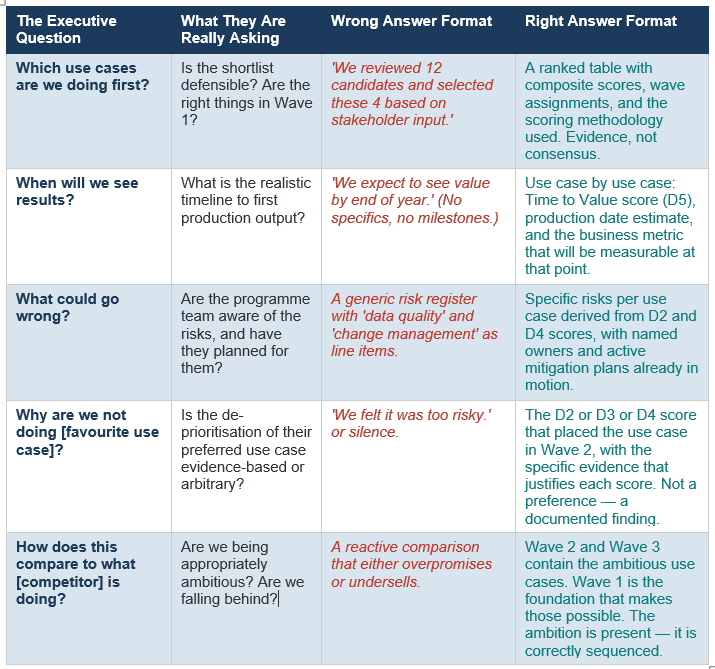
Source: Viksya Editorial. Based on recurring patterns in enterprise AI programme governance. The 'right answer format' column describes the output of a structured scoring framework rather than a consensus shortlisting process.
The table above is worth reading carefully. In each row, the difference between the wrong and right answer format is not about more or better content — it is about evidence versus assertion. An executive committee presented with evidence can govern. An executive committee presented with assertions is being asked to trust.
Trust is a reasonable basis for small decisions. For Wave 1 AI programme commitments — involving significant budget, organisational change, and reputational exposure — governance is the right standard. Evidence-based governance is what a scored framework delivers.
THE GOVERNING STANDARD
An executive committee that receives a scored framework output does not need to trust the programme team's judgement about which use cases to pursue. They need to challenge the evidence behind specific scores. That is a categorically more useful governance conversation — and it produces better-defended decisions.
The Presentation Structure: Six Sections, Twenty-Five Minutes
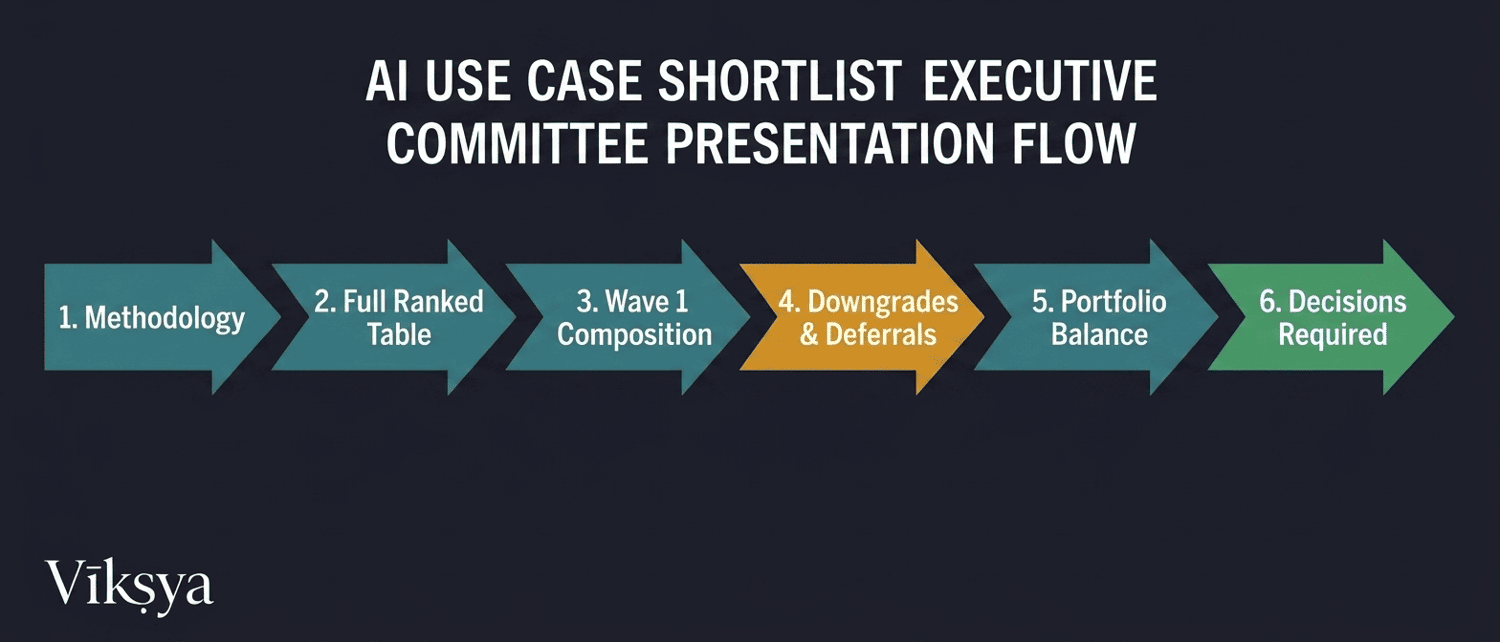
A well-structured AI use case shortlist presentation to an executive committee should take no more than twenty-five minutes — including time for the committee to challenge specific scores and make the required decisions. The structure below has been designed to give the committee the full picture in the correct sequence, with each section building on the one before it.
AI Use Case Shortlist Presentation — Recommended Structure for Executive Committee Review
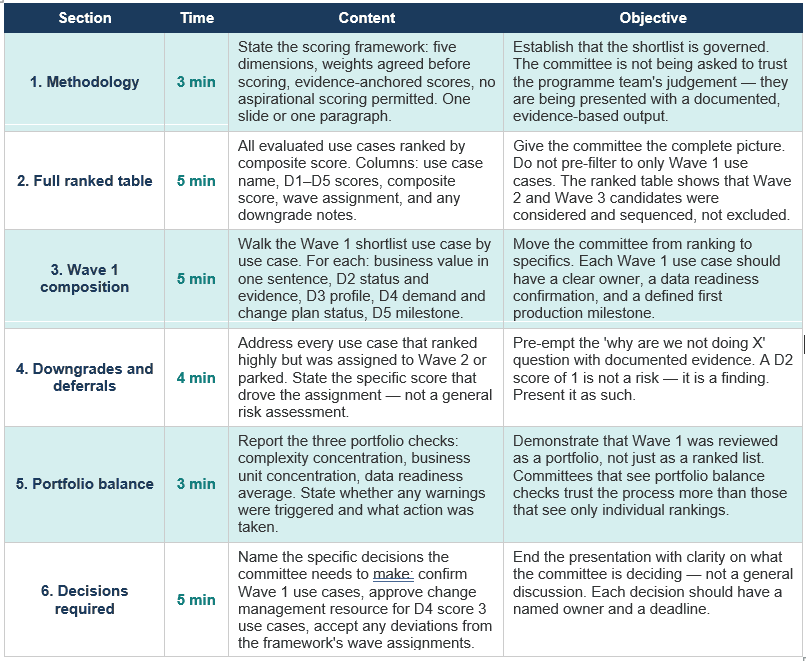
Source: Viksya Editorial. Total time: 25 minutes plus committee discussion. Section 6 (Decisions Required) should be prepared in advance with named decision items — do not leave this to emerge from the discussion.
The sequencing is deliberate. Starting with methodology establishes that the output is governed before any specific use case is discussed. This prevents the HIPPO effect — where a senior stakeholder's preference for a specific use case dominates the session before the scoring has been contextualised. By the time the ranked table is presented, the committee has agreed to evaluate what they see against the framework, not against their prior preferences.
Ending with explicit decisions is equally deliberate. The most common failure mode in executive committee reviews is a productive discussion that produces no binding decisions. Every wave assignment should leave the meeting confirmed, challenged and re-scored, or explicitly deferred. Every change management resource request should leave approved or escalated. The presentation ends when the decision table is complete — not when the time runs out.
The Language of Downgrade Rationale
The most politically sensitive moment in an AI use case shortlist presentation is when the programme team presents a use case that a senior stakeholder expected to see in Wave 1 — and explains why it is in Wave 2 or parked instead.
The language used in that moment determines whether the committee experiences the deferral as a governance decision or a political setback. The difference is not spin — it is precision. A downgrade rationale that cites a specific score, with the evidence behind it, is a documented finding. A downgrade rationale that says 'we felt it was too risky' is an opinion that can be challenged and overridden.
Downgrade Language That Works
The following language patterns are grounded in the scoring framework and resistant to HIPPO override:
- 'Use case [X] received a D2 score of 1. The dataset required for this use case has not been profiled by a data engineer — the compliance review has not been initiated and significant unknown variables remain. A D2 score of 1 triggers an automatic Wave 2 assignment in our framework. We have a data preparation workstream starting in [week]. When that assessment produces a score of 2 or above, the use case moves to Wave 2 eligibility.'
- 'Use case [Y] scored 2 on Technical Complexity (D3). The model architecture required involves [specific novel element]. The team has not built this architecture before, there are no established benchmarks for this use case type in our domain, and the infrastructure required does not yet exist. A D3 score of 2 in combination with a D4 score of 2 places this use case in the defer category. We have an architecture spike planned for Wave 1 parallel — it will de-risk the Wave 2 build.'
- 'Use case [Z] scored 2 on Change Management Demand (D4). The affected population is [size], the process change is [description], and [union/regulatory body] has not yet been consulted. Deploying this use case without a change management plan calibrated to a D4 score of 2 is the most reliable way to produce an adoption failure. We are recommending Wave 2 with change management engagement starting [date] in parallel to Wave 1.'
THE DOWNGRADE RULE
Every deferred use case should have exactly one primary reason for deferral — the specific score on the specific dimension that drove the wave assignment. Not a list of concerns. Not a general risk assessment. One score, one finding, one remediation path. That precision is what makes the rationale resistant to override.
What makes these language patterns effective is not that they are more persuasive — it is that they are more specific. A committee member who wants to challenge 'the data is fine' now has to challenge a documented finding from a data engineer's profiling exercise, not a risk assessment produced by the programme team. The scored framework has transferred the burden of proof from the programme team to the challenger.
That is not obstruction. It is governance. A deferred use case that has a genuine evidence basis for its data readiness — and that evidence was not available at the scoring session — should be rescored. The framework accommodates that. What it does not accommodate is a D2 score of 1 being overridden by a business unit owner asserting that the data is fine without providing the evidence to support it.
The Challenge-Response Guide: Handling Committee Pushback
Executive committees will challenge the shortlist. That is not a problem — it is the point. A committee that does not challenge the scoring has not governed; it has rubber-stamped. The programme team's role is to respond to challenges with evidence, not to defend the shortlist with preference.
The five challenge patterns below cover the majority of pushback scenarios encountered in AI use case shortlist presentations. Each has a documented evidence-based response derived from the scoring framework.
Committee Challenge-Response Guide — Five Common Pushback Scenarios
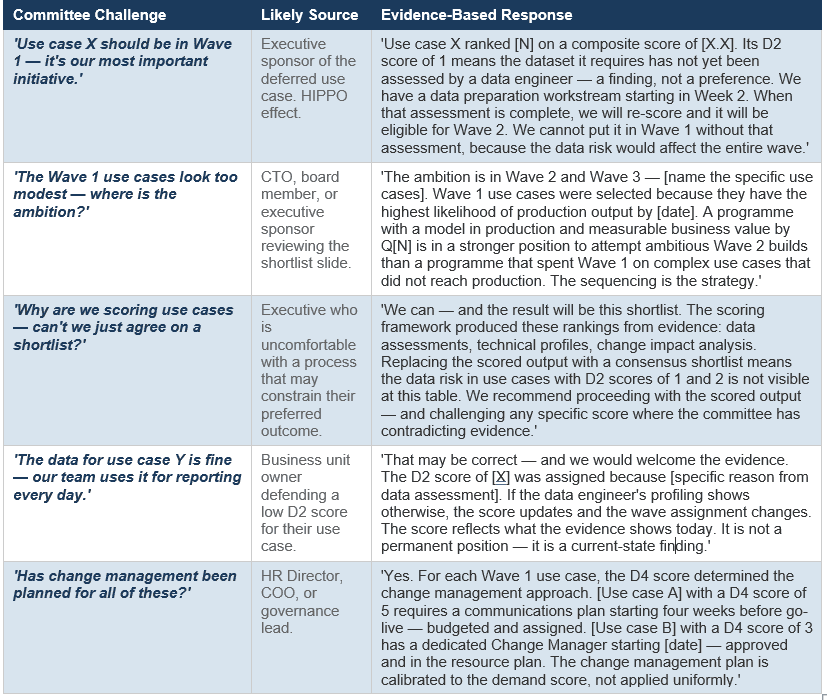
Source: Viksya Editorial. Challenge responses are most effective when the programme team can point to a specific score and the evidence that justifies it — not to the framework's recommendation in the abstract.
The common thread across all five responses is the same: redirect from preference to evidence. The committee's preferred use case can still enter Wave 1 — if the evidence supports a higher D2 score than the current assessment shows. The programme's sequencing can be more ambitious — if the committee accepts the delivery risk and logs it as a governance decision. The scoring methodology can be set aside — if the committee is prepared to make a consensus shortlist decision without the protections the framework provides.
In each case, the programme team is not defending a position. It is presenting options — each with its evidence, its risk, and its accountability structure. That is how a governance conversation should work. That is not how most AI programme presentations work. The difference is worth the preparation.
The committee does not need to agree with every score. It needs to understand what would have to be true for a score to change — and decide whether the evidence for that change exists. That is a governance conversation. Everything else is a pitch.
When the Committee Overrides the Framework
Executive committees will sometimes override the framework's wave assignment for a specific use case. This is their prerogative — and it is not always wrong. Business context, regulatory timing, competitive pressure, and strategic alignment can all create legitimate reasons to proceed with a use case that the scoring framework would defer.
The programme team's role in this situation is not to resist the override. It is to ensure that the override is documented, the risk is understood, and the accountability is clear.
The Override Protocol
- Name the score being overridden. 'The committee is accepting a Wave 1 assignment for use case [X] despite a D2 score of [Y].' This is not a formality — it is a factual record of what is being decided.
- State the risk explicitly. 'The risk accepted is that if the data assessment produces an unresolvable finding, the use case will need to be restructured mid-Wave 1, affecting the timeline for [adjacent use cases].' The committee should hear this before approving — not read it in a post-mortem.
- Name the accountability owner. 'The business unit sponsor accepts that if the data assessment produces findings that require use case restructuring, the programme timeline impact will be managed within their function's resource.' Accountability without ambiguity.
- Record the override in the governance document. A dated note: use case name, score overridden, risk stated, approving executive, and date. This is the single most important governance record from the meeting. It is also the one most commonly omitted.
An override documented this way is a legitimate governance decision. An override that happens because the programme team did not present the score, the evidence, or the risk is a governance failure — and when the predictable problem surfaces six months later, the programme team will be held accountable for a decision they tried to flag but failed to document.
The Governance Record: What to Save and Why
The executive committee presentation is not just a decision point. It is a governance record moment. The output of the meeting — confirmed wave assignments, approved resource, accepted overrides, outstanding decisions — should be documented in a dated file that becomes part of the programme's governance history.
The governance record is not a meeting minute. It is a structured document that captures the scoring baseline, the decisions made against it, and the deviations accepted. It serves the programme in three ways: it protects the programme team when decisions made with good evidence produce unexpected outcomes; it provides the baseline for re-assessment at the next gate; and it creates accountability for the changes in use case status that occur between gates.
Governance Record — What to Save After Every Executive Committee Review
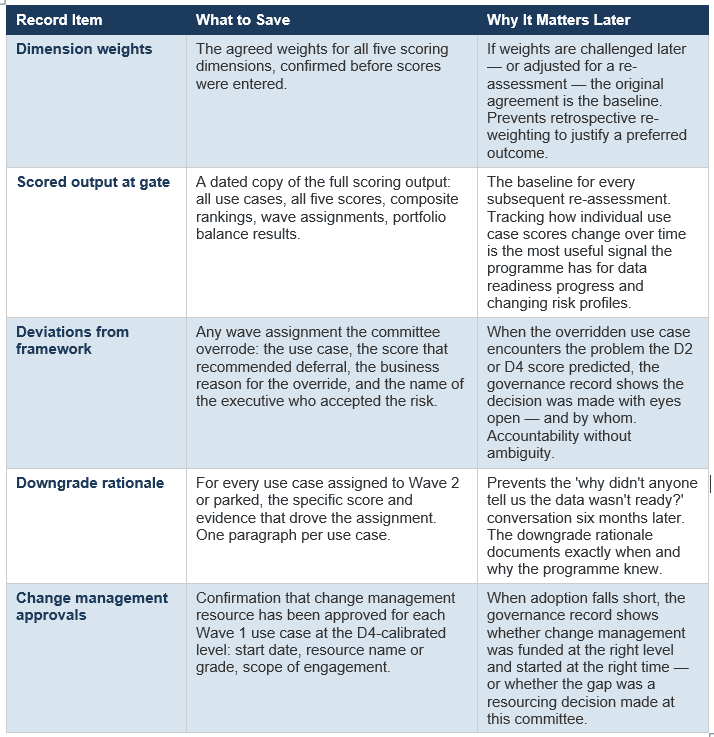
Source: Viksya Editorial. Save a dated copy of the scoring file at each governance gate. The naming convention: AI_UseCasePrioritisation_[ProgrammeName]_[YYYYMMDD].xlsx
The deviations from framework row is the most important row in the governance record — and the most commonly omitted. When a use case that was deferred by the framework is promoted to Wave 1 by executive decision, and subsequently encounters the problem the score predicted, the programme team needs to be able to show that they flagged the risk before the decision was made. Without the governance record, that demonstration is impossible. With it, the accountability is clear, the decision-making process is documented, and the programme team is protected.
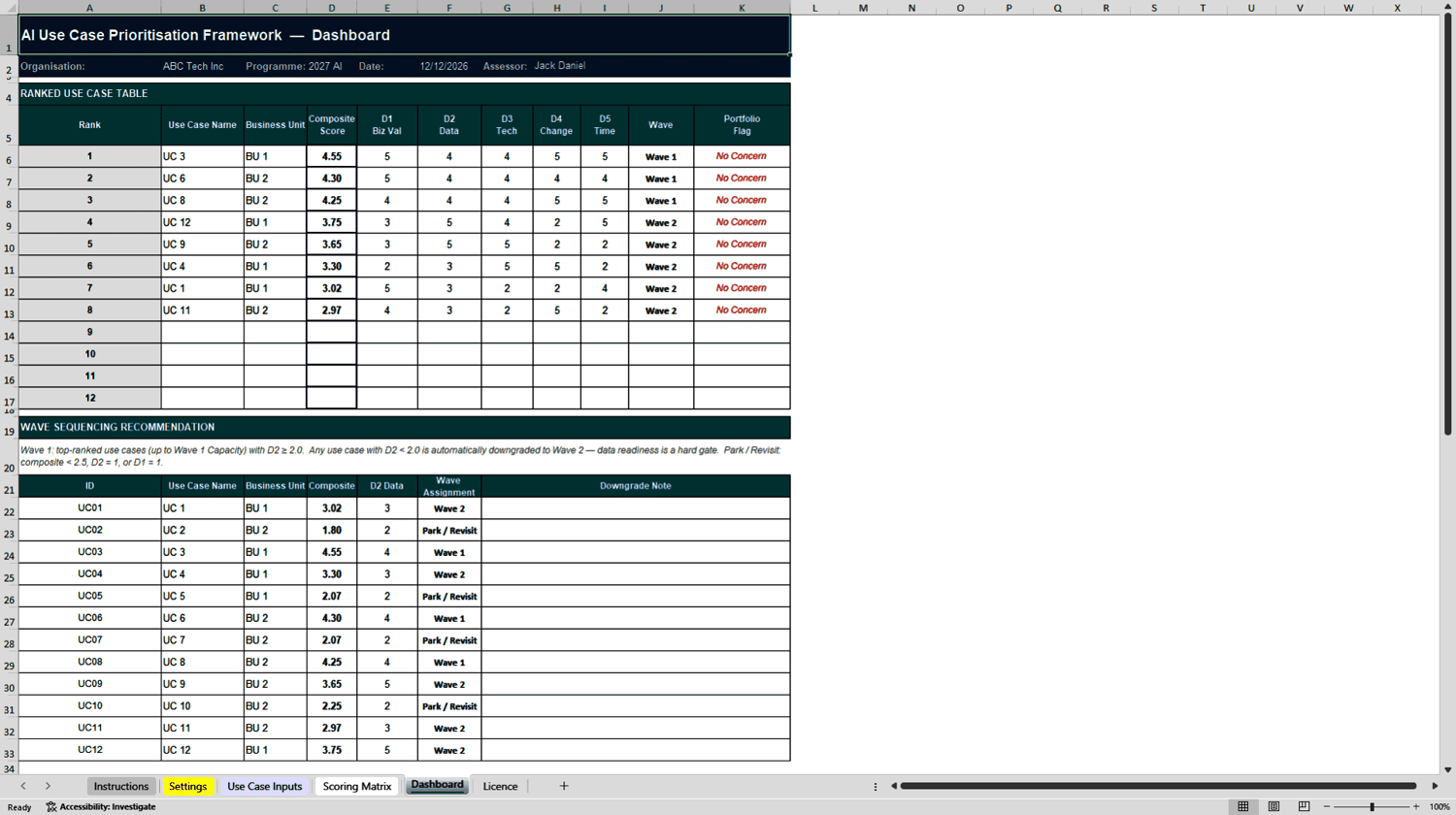
Viksya AI Use Case Prioritisation Framework Dashboard — ranked shortlist with composite scores, wave assignments, and downgrade notes for executive committee presentation
The Full Series: Six Principles for Structured AI Use Case Prioritisation
This article is the sixth and final in Viksya's series on AI use case prioritisation. Together, the six articles constitute a complete methodology — from the failure modes of gut-feel selection through to the governance standards required to present and defend a scored shortlist to an executive committee.
The table below summarises the core principle from each article. The principles are sequential — each one addresses a failure mode that the preceding article identified, and each one builds toward the governance conversation this final article describes.
AI Use Case Prioritisation Series — Six Articles, Six Principles
Structured scoring replaces seniority and advocacy with evidence. The selection process determines the shortlist quality — not the quality of individual use cases.
2 Data Feasibility as a Hard Gate
A D2 score below 2.0 blocks Wave 1 assignment regardless of any other score. Data unreadiness discovered at selection costs one data engineer for five days. Discovered at Sprint 4, it costs months.
3 Business Value vs. Technical Complexity
The 2×2 matrix makes trade-offs visible before commitment. Prime Candidates are rarer than they appear. Quick Wins are undervalued. The Avoid quadrant must be named to be avoided.
4 Why the First Use Case Should Be Boring
Wave 1 is not the transformation. It is the foundation. Boring in Wave 1 earns the credibility, the MLOps proof, and the steering committee confidence that makes ambitious Wave 2 possible.
5 Change Management Demand As A Scoring Dimension
Adoption is value-conditional. D4 scores the human cost of adoption. Override rate is the leading signal of change management failure — and it is predictable at selection.
6 Presenting to an Executive Committee
The committee does not need a slide deck. It needs a scored output, clear wave assignments, explicit downgrade rationale, and specific decisions to make. Give them that — and make the decisions easy.
This article.
The six principles are not a checklist. They are a system. Applying principle 1 (structured scoring) without principle 2 (data feasibility hard gate) produces a ranked list with data-unready use cases in Wave 1. Applying principle 3 (value vs. complexity matrix) without principle 5 (change management demand) produces a technically balanced portfolio with unmanaged adoption risk. The principles are interdependent — and the governance presentation in principle 6 is only defensible if the preceding five have been applied with evidence.
What Good Governance Actually Looks Like
Most AI programmes governance fails not because the programme team made bad decisions, but because they made undocumented ones. The use case that entered Wave 1 despite a low D2 score was approved by someone — but there is no record of who, on what basis, and with what acknowledged risk. When the data problem surfaces at Sprint 3, the programme team has no evidence that they flagged it and were overridden. The accountability gap is not a moral failing — it is a governance process failure.
The structured approach described in this series — scoring evidence-based, presenting the full ranked output, documenting downgrades explicitly, recording overrides with named accountability — closes that gap. Not perfectly. Governance is never perfect. But it moves the programme from a situation where failures are surprising and accountability is contested, to one where failures are predictable and accountability is pre-agreed.
That is the standard worth building toward. Not because it makes the programme look better — though it does. Because it makes the programme actually run better. Decisions made with evidence, against a documented framework, by executives who understand what they are approving, produce better outcomes than decisions made on instinct, in the moment, without a record.
The executive committee presentation is not the end of use case selection. It is the beginning of programme accountability. The scored framework, the governance record, and the documented decisions are what make that accountability meaningful — for the committee, for the programme team, and for the organisation that invested in both.
AI Use Case Prioritisation Framework — viksya.com
The presentation structure described in this article is built from the outputs of the AI Use Case Prioritisation Framework. The ranked table, wave assignments, portfolio balance checks, and downgrade rationale are all produced automatically from the scoring inputs. The framework scores up to 12 candidate use cases across five dimensions, outputs a Dashboard ready for steering committee review, and generates the governance record that makes every deferred use case auditable.
Built for Programme Managers, CIOs, Strategy Leads, and Management Consultants. Excel-based. No code. Instant download.
→ Download the AI Use Case Prioritisation Framework
Frequently Asked Questions
How should an AI use case shortlist be presented to an executive committee?
An AI use case shortlist should be presented to an executive committee as a scored framework output, not as a slide deck recommendation. The presentation should cover: the scoring methodology and agreed weights; the full ranked table of all evaluated use cases with dimension scores and wave assignments; a use case by use case walk of the Wave 1 shortlist; explicit downgrade rationale for every deferred use case citing the specific score; portfolio balance results; and the specific decisions the committee needs to make. The committee should leave having confirmed wave assignments, approved change management resource, and logged any overrides with documented rationale. Total time: approximately 25 minutes.
What is a governance record in AI programme management?
A governance record in AI programme management is a dated, structured document that captures the scoring baseline at a programme gate, the decisions made against that baseline by the executive committee, and any deviations from the framework's recommendations — including the specific score overridden, the risk accepted, and the name of the executive who approved the override. In AI use case prioritisation, the governance record includes the agreed dimension weights, the scored output at each gate, downgrade rationale per deferred use case, and change management resource approvals. The governance record is the foundation of retrospective accountability when use cases encounter the problems their scores predicted.
How do you handle executive pushback on a deferred AI use case?
Executive pushback on a deferred AI use case should be handled by presenting the specific score that drove the wave assignment and the evidence behind it — not by defending the deferral as a risk preference. A use case deferred due to a D2 score of 1 was deferred because the data has not been assessed by a data engineer. If the committee believes the data is ready, the response is: 'We would welcome the evidence. If a data engineer's profiling shows readiness at a score of 2 or above, the wave assignment updates.' The burden of proof transfers to the challenger — which is the appropriate governance dynamic when the original score was evidence-based.
What should be documented when an executive committee overrides a scoring framework recommendation?
When an executive committee overrides a scoring framework wave assignment, the governance record should document: the name of the use case overridden; the specific dimension score that was overriding; the risk that the override accepts; the name and role of the executive approving the override; and the date of the decision. This documentation protects the programme team when the overridden use case encounters the problem the score predicted, and creates accountability for the decision at the appropriate level. Without this record, the programme team carries accountability for a decision that was made above them.
How often should an AI use case prioritisation framework be re-run?
An AI use case prioritisation framework should be re-run at each major programme gate — typically before Wave 1 starts, at Wave 1 mid-point, and before Wave 2 planning. Re-running the framework tracks how individual use case scores change as data preparation workstreams progress, as technical architecture spikes clarify complexity profiles, and as change management engagement updates the resistance assessment. The most valuable output of a re-assessment is not the new ranking — it is the change in individual scores relative to the previous gate, which shows which use cases are becoming more or less ready for the next wave.
Explore the Full Viksya Insights Library
→ AI Vendor Governance Scorecard — structured governance for vendor-led AI programmes
→ AI Production Governance Toolkit — structured go/no-go before every model deployment
→ AI Transformation Readiness Assessment — six dimensions of organisational AI readiness
→ AI Regulatory Compliance Risk Register — 30 compliance requirements for enterprise AI programmes