
How to Assess Data Readiness Before an AI Programme
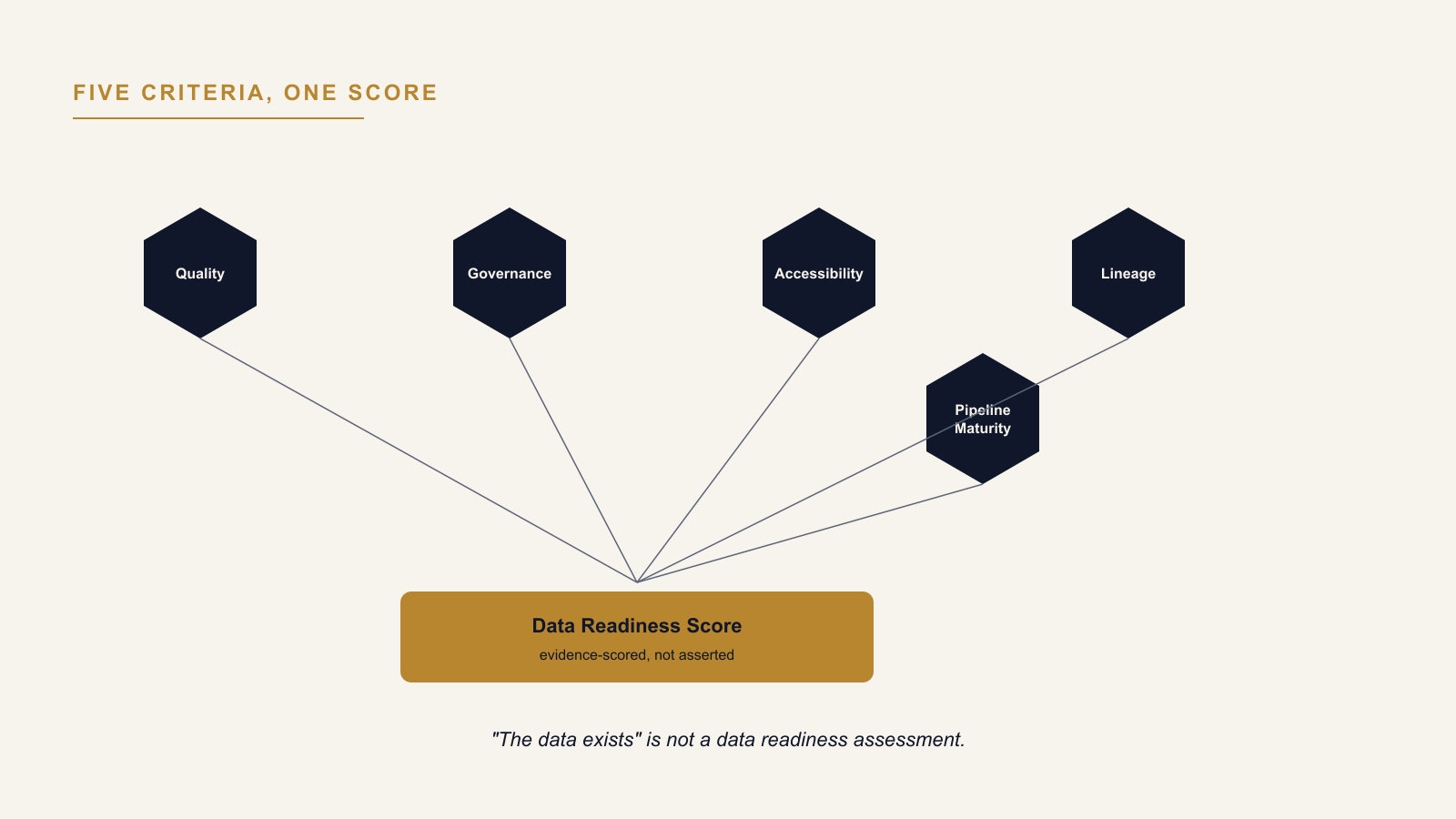
Assessing data readiness before an AI programme means scoring your data estate — specifically, the data the planned first-wave use cases will depend on — against five evidence-based criteria: quality, governance, accessibility, lineage, and pipeline maturity, before a single use case is shortlisted. It is a baseline exercise at the programme level, distinct from gating an individual use case once one has already been selected. Here is how the two relate, and how to run the baseline.
Programme-Level Readiness vs. Per-Use-Case Feasibility
These are two related but different checks, run at two different points. Data readiness, covered here, asks a broader question before use cases are even chosen: is the organization's data estate, in general, in a state where AI use cases are viable at all. Data feasibility, covered in Data Feasibility as a Hard Gate, asks a narrower question once specific use cases are on the table: does this particular use case's data clear the bar to enter Wave 1 delivery, with any score below 2.0 blocking it regardless of its business value. Running the broader readiness check first means the narrower per-use-case gate isn't discovering systemic data problems one use case at a time — it's confirming a baseline that's already been established.
The Five Criteria, Scored on Evidence
Each of the five criteria needs an answer from someone with direct technical access to the data, not a business unit assertion that "the data exists."
- Quality — documented null rates and known data-quality issues in the specific fields the planned use cases depend on, not an assumption that the data is "mostly clean."
- Governance — a clear ownership and access-approval model: who can approve a given dataset's use, and how long that approval actually takes in practice.
- Accessibility — whether the data can actually be reached by the systems and people who need it, not just whether it exists somewhere in the estate.
- Lineage — a traceable record of where the data came from and how it's been transformed, essential for anything feeding a model that makes a consequential decision.
- Pipeline maturity — a working, repeatable pipeline from source to a usable, queryable state, not a one-off export someone ran for a prior analysis.
Who Should Run This
A data engineer, not the business unit owner and not the programme manager. When a business unit owner confirms the data "exists," they are typically confirming that historical records sit in a system they can access — which says nothing about null rates, label consistency across source systems, or whether the volume of genuinely usable records is sufficient. That distinction matters enough that it's worth restating plainly: data that has served monthly reporting for years can still be inadequate for model training, because reporting tolerates gaps and manual overrides that model training does not.
Scoring and What a Low Result Means
Score each of the five criteria on the same 1–5 evidence scale the rest of the readiness assessment uses, and average them into the Data Readiness dimension score. A result below 2.5 is a blocker — not a reason to cancel the AI programme, but a reason to resource a focused data-preparation effort before committing to specific use cases, with a named owner and a re-score date. For what to do once a dimension comes back low, see What to Do When Your AI Readiness Score Comes Back Low.
Why This Check Comes Before Use Case Selection, Not After
As the profiling-effort estimates in Data Feasibility as a Hard Gate lay out for the per-use-case version of this work, a first-pass profiling exercise against a well-structured dataset runs one to two days of a data engineer's time; a complex, multi-source dataset, closer to a week. The same order of magnitude applies at the programme level, scored once across the datasets the first-wave use cases share, rather than repeated per use case. Either way, it is a fraction of the cost of discovering the same gap after a use case has been selected, a sprint plan is running, and budget is already committed — the point at which the same discovery becomes a programme restructure rather than a scoping adjustment.
What This Baseline Changes Downstream
Running the organization-level check first doesn't make the per-use-case gate redundant later; it changes what that gate finds. A program that enters use case selection with a known, already-scored Data Readiness baseline is screening individual use cases against data that's already been profiled once, at the estate level — so a use case failing the Data Feasibility gate is failing on something specific to that use case, not rediscovering a systemic null-rate or governance problem the organization could have found months earlier for a fraction of the cost.
The AI Transformation Readiness Assessment provides this as one of six scored dimensions: the five Data Readiness criteria above, scored on the same evidence-based scale as the other twenty-five criteria, rolled into a weighted overall score with an auto-calculated dashboard.
→ Available at www.viksya.com