
What to Do When Your AI Readiness Score Comes Back Low
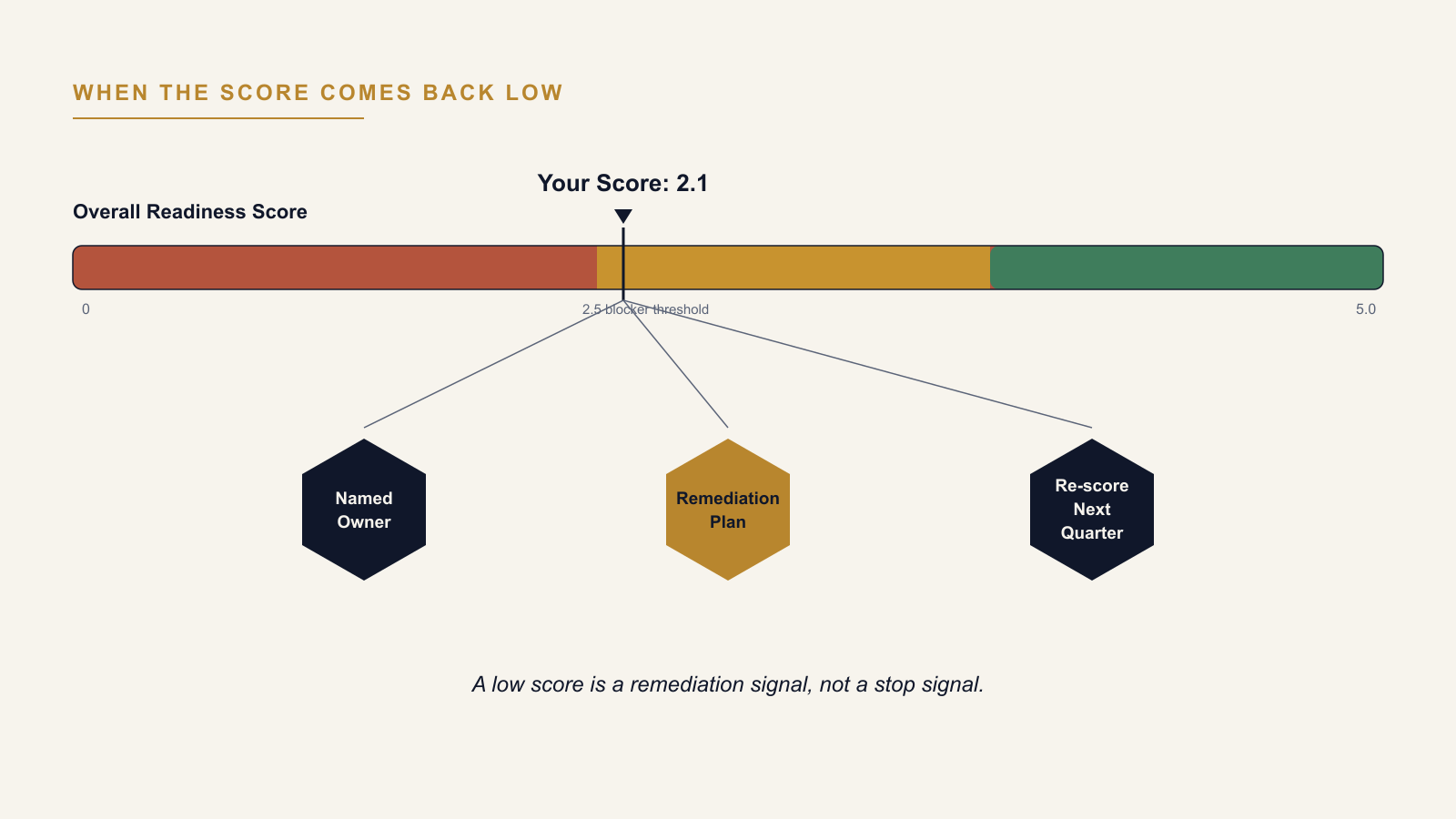
A low AI readiness score means one or more of the six dimensions a credible assessment scores — Strategy & Vision, Data Readiness, Technology & Infrastructure, People & Skills, Process & Operating Model, Governance & Ethics — came back below the threshold where remediation needs to start before execution proceeds, not run quietly alongside it. It is not a verdict against investing in AI. It is a specific, named gap that needs an owner, a plan, and a re-score date before the budget conversation continues. Here is what to actually do once that number is in front of you.
Separate the Blocker From the Noise
A low overall number rarely means every dimension is weak. Dimensions are weighted rather than averaged — see How to Score AI Readiness With Weighted Criteria for the arithmetic — so one heavily weighted dimension scoring low can pull an otherwise reasonable average down on its own. Pull the per-dimension RAG breakdown before reacting to the headline number. Treating a 2.9 overall score as six uniformly mediocre dimensions, when it is actually five dimensions sitting at 3.4–3.9 and one sitting at 1.1, sends the remediation effort at the wrong target entirely. Fix the one dimension that is actually broken, not the five that are already fine.
Use the Published Thresholds, Not a Gut Feel
A useful reading of any dimension score applies the same fixed bands every time, rather than deciding case by case how worried to be: dimensions scoring below 2.5 out of 5 are active blockers, where remediation needs to be underway before execution proceeds. Dimensions between 2.5 and 3.5 are manageable risks, worth a named owner and a tracked plan but not a reason to halt. Dimensions above 3.5 are stable. A dimension landing at 2.4 and one landing at 1.1 are both "low," but they are not the same problem, and a remediation plan that treats them identically wastes effort on the 2.4 while the 1.1 stays unaddressed. For the full reasoning behind these bands, see How to Run an AI Readiness Assessment That Actually Means Something.
Name an Owner Who Didn't Score It
The most common mistake after a low score is assigning remediation to whoever runs the dimension that scored low — often the same person whose optimistic self-assessment contributed to the gap being underestimated in the first place. Evaluating your own work is not independent review, and fixing your own unexamined gap tends to produce the same blind spots that let it go unscored for this long. Wherever practical, the remediation owner and the original scorer should not be the same person.
Write a Remediation Plan With a Date, Not an Intention
A gap without a named owner and a fixed re-score date tends to stay a gap, revisited only when someone happens to notice it again. A usable remediation plan states the specific evidence that needs to exist for the dimension to clear the blocker threshold, who is accountable for producing it, and the date the dimension will be re-scored — not "improve data governance," a sentence that could mean anything and therefore commits to nothing.
Re-score on the Same Cadence as Everything Else
Treat a fix as done only when a re-score says so, not when a status update claims it. A readiness score has the most value as a tracked trend — baseline, programme kick-off, then quarterly — and a dimension that was remediated off-cycle should still wait for the next scheduled re-score rather than being marked clear on the strength of the team's own confidence.
A Worked Example
Picture an organization whose overall readiness score came back at 2.9. Five dimensions sit between 3.2 and 3.9 and one — Data Readiness — sits at 1.8, comfortably inside blocker territory. The correct response is not a general "improve AI readiness" initiative. It is a remediation plan scoped to Data Readiness alone: a named data engineering lead (not the business sponsor who originally scored it) is accountable for closing the null-rate gaps in the three feature fields the first-wave use case depends on and producing a data catalogue entry with documented quality metrics, with a re-score scheduled for the next quarterly checkpoint. Three months later, Data Readiness re-scores at 3.1 — out of blocker territory — and the overall score moves to roughly 3.4, without anything else in the organization changing at all.
For what each of the six dimensions actually measures, see The Six Dimensions of AI Readiness. For the specific criteria the Data Readiness dimension scores against, see How to Assess Data Readiness Before an AI Programme. For who should be doing the scoring in the first place, see Who Should Score the AI Readiness Assessment and Why Self-Scoring Fails.
The AI Transformation Readiness Assessment provides the Gap Analysis and Action Planner tabs this process runs on: a ranked list of gaps by dimension and severity, and priority actions per dimension with owner and timeline fields already built in.
→ Available at www.viksya.com