
How to Score AI Readiness With Weighted Criteria
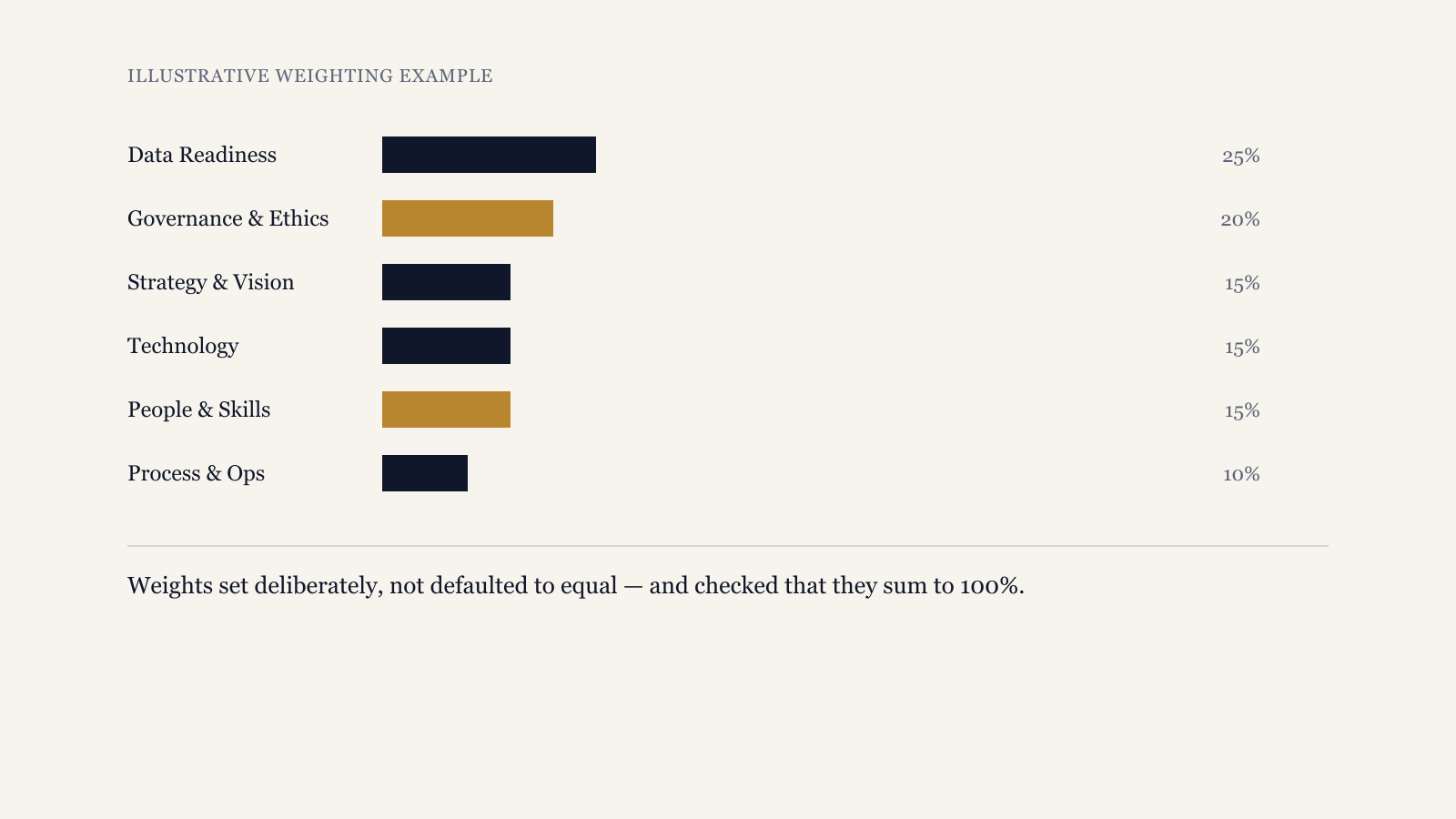
Scoring AI readiness with weighted criteria means: score each criterion on a 1-5 evidence-based scale, average those scores into a per-dimension score, multiply each dimension's score by a deliberately chosen weight, and sum the results into one overall score — after confirming the weights themselves add up to 100%. Here is each step, and what to watch for at each one.
Step 1: Score Each Criterion on Evidence, Not Aspiration
A score of 4 out of 5 means solid capability exists today, demonstrated by evidence — not that it's planned, budgeted, or on a roadmap. A data quality score of 4 requires a data catalogue with documented quality metrics, not a plan to build one. Score optimistically here and every later step inherits the error: the averaging in Step 2 and the weighting in Step 3 are both just arithmetic on whatever number this step produces, and arithmetic can't correct an input that was wrong to begin with. This is also where most self-assessments quietly fail — not because anyone is being dishonest, but because the instinct to round a criterion up when it's "mostly there" feels harmless at the level of one score, and only becomes visible as a problem once thirty of them have been rounded the same way.
Step 2: Average Into a Per-Dimension Score
Each dimension is made up of several criteria — five, in the Viksya model's six-dimension structure. The dimension's score is the average of its criteria, which is why one strong criterion can't carry four weak ones: a dimension with four criteria scored 2 and one scored 5 still averages to 2.6, not a flattering blend.
Step 3: Weight the Dimensions — Don't Average Them
This is the step a generic maturity model skips. Averaging six dimension scores treats a weak governance score and a weak data score as equally costly to the organization. They aren't. Weighting lets each dimension carry the influence its actual risk profile warrants — a regulated financial services firm might weight Governance & Ethics heavily; a data-mature retailer with a thin AI mandate might weight Strategy & Vision heavily instead. There's no universal correct weighting. There is a wrong one: equal weighting by default, chosen because nobody made a deliberate decision.
Step 4: Do the Arithmetic
Multiply each dimension's average score by its weight, then sum across all six dimensions. An illustrative example, with illustrative weights (not a fixed default — yours should reflect your own risk profile):
- Data Readiness: score 2.8 × weight 25% = 0.700
- Governance & Ethics: score 3.4 × weight 20% = 0.680
- Strategy & Vision: score 4.1 × weight 15% = 0.615
- Technology & Infrastructure: score 3.6 × weight 15% = 0.540
- People & Skills: score 2.9 × weight 15% = 0.435
- Process & Operating Model: score 3.2 × weight 10% = 0.320
Summed: 0.700 + 0.680 + 0.615 + 0.540 + 0.435 + 0.320 = 3.29 overall. Before trusting that number, confirm the weights themselves sum to 100% — 25 + 20 + 15 + 15 + 15 + 10 = 100. A weighting scheme that doesn't sum to 100% produces a score that looks precise and means nothing, and rounding each product to two decimal places before summing — rather than carrying full precision through to the final total — is exactly the kind of small error that makes a defensible-looking score quietly wrong.
Step 5: Read the Result Against Thresholds, Not Just the Number
A single number invites a single, often optimistic, interpretation. Reading it against fixed thresholds removes the guesswork: dimensions scoring below 2.5 are active blockers needing remediation before execution proceeds; dimensions between 2.5 and 3.5 are manageable risks to track with an owner; dimensions above 3.5 are stable. In the worked example above, Data Readiness (2.8) and People & Skills (2.9) both sit in the manageable-risk band — worth a named owner and a tracked remediation plan, not yet a reason to halt. For the full reasoning behind these thresholds and how to present them to a steering committee, see How to Run an AI Readiness Assessment That Actually Means Something.
For what each of the six dimensions actually measures, see The Six Dimensions of AI Readiness. For the specific criteria scored within each one, see AI Readiness Checklist.
The AI Transformation Readiness Assessment provides this calculation already built: enter your own dimension weights, score the 30 criteria, and the workbook checks your weights sum to 100% and returns a weighted score with a plain-language verdict.
→ Available at www.viksya.com