
Who Should Score the AI Readiness Assessment and Why Self-Scoring Fails
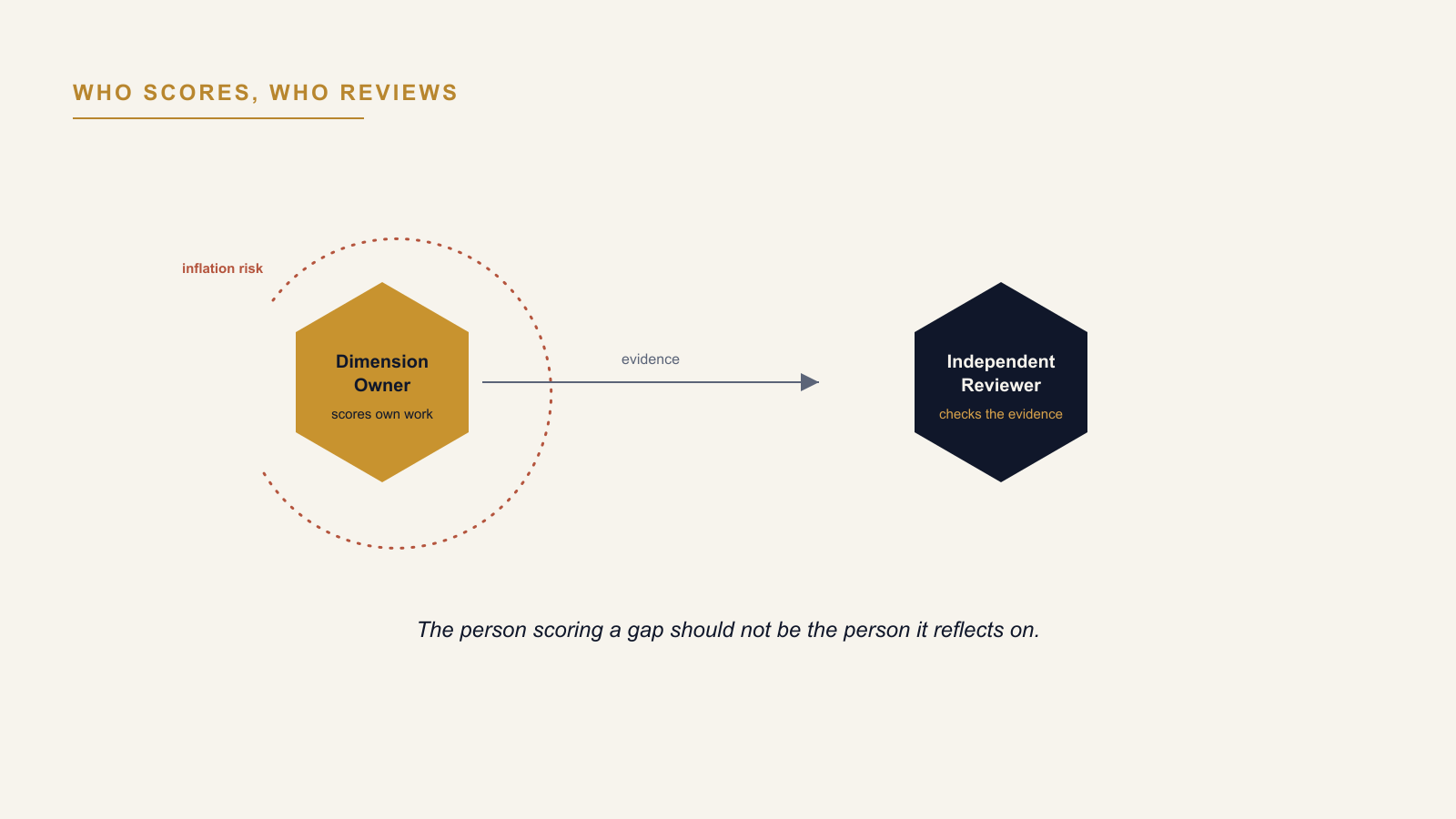
Who should be involved in an AI readiness assessment is six groups — Data & Analytics, HR & L&D, Legal & Compliance, business unit leads, the infrastructure or platform team, and the PMO — each scoring the dimension their function actually has evidence for. The harder, less obvious rule governing who's involved is this: the person scoring a dimension should not be the person that dimension's result reflects on. Self-scoring is the single most common way a readiness assessment quietly produces a number that flatters the organization instead of one that protects it.
Six Functions, Six Dimensions
A credible assessment is not a technology assessment run by IT alone — that produces a view of one dimension and leaves five unexamined. Data & Analytics scores Data Readiness. HR & L&D scores People & Skills. Legal & Compliance scores Governance & Ethics. Business unit leads score Process & Operating Model and contribute to change-readiness input. The infrastructure or platform team scores Technology & Infrastructure. The PMO scores Strategy & Vision and overall programme capacity. If any of those six isn't contributing scored evidence, the output reflects whichever function did show up, not the organization as a whole (see How to Run an AI Readiness Assessment That Actually Means Something for the full process this maps into).
Why Self-Scoring Fails
Self-scoring is not dishonest scoring. It is predictable scoring, produced by an incentive structure that has nothing to do with anyone's integrity. Scoring your own dimension low means flagging your own gap, in front of the people who approve your budget — and the instinct to round a 2 up to a 3 when "we're mostly there" feels harmless at the level of one score. It becomes a problem once every dimension owner has made the same small, individually reasonable decision, and the resulting readiness score tells the steering committee what it wants to hear instead of what's actually true.
Scorer and Reviewer Should Be Different People
The structural fix is simple to state and easy to skip under deadline pressure: whoever scores a dimension should not be the same person whose evidence is being accepted at face value. For each dimension, a workable split looks like this:
- Strategy & Vision — scored by the PMO; reviewed by an executive sponsor outside the programme team.
- Data Readiness — scored by a data engineer with direct access to the data; reviewed by Data & Analytics leadership, not the business unit requesting the use case.
- Technology & Infrastructure — scored by the infrastructure or platform team; reviewed by an architect not embedded in the programme.
- People & Skills — scored by HR & L&D against a documented skills inventory; reviewed by the hiring manager for the relevant roles.
- Process & Operating Model — scored by the business unit lead whose process changes; reviewed by the PMO against the actual change management plan, not the stated intention to have one.
- Governance & Ethics — scored by Legal & Compliance; reviewed by someone outside the build team entirely, since the team building the model evaluating its own governance posture is not independent review.
What the Reviewer Actually Checks
Not whether the score "feels right." Whether the evidence cited for it is a real artifact — a data catalogue entry, a signed-off change management plan, a documented AI policy — rather than a description of work that's planned or in progress. A score of 4 defended by "we're working on it" is a 2 with optimistic rounding, and the reviewer's job is to catch that before it reaches the dashboard, not after.
What Happens Without a Reviewer
Picture a programme where all six dimensions are scored exclusively by the person accountable for that area, with no second check. The pattern that tends to emerge isn't dramatic dishonesty — it's five dimensions landing in the 3.5–4 range, each individually defensible, and an overall score that reads as "mostly ready" right up until delivery hits the one gap nobody was positioned to catch, because the person best placed to catch it was also the person being scored. A reviewer doesn't need to re-run the assessment. They need to ask for the artifact behind each score and confirm it says what the scorer claims it says — a few hours of work that catches most of the inflation before it reaches a steering committee.
The AI Transformation Readiness Assessment provides the structured scoring input this process runs on — 30 criteria across six dimensions, each with the specific evidence a defensible score requires, so a reviewer has something concrete to check against.
→ Available at www.viksya.com