
How to Calculate AI ROI Outside the US: Currency and Language Cost Effects
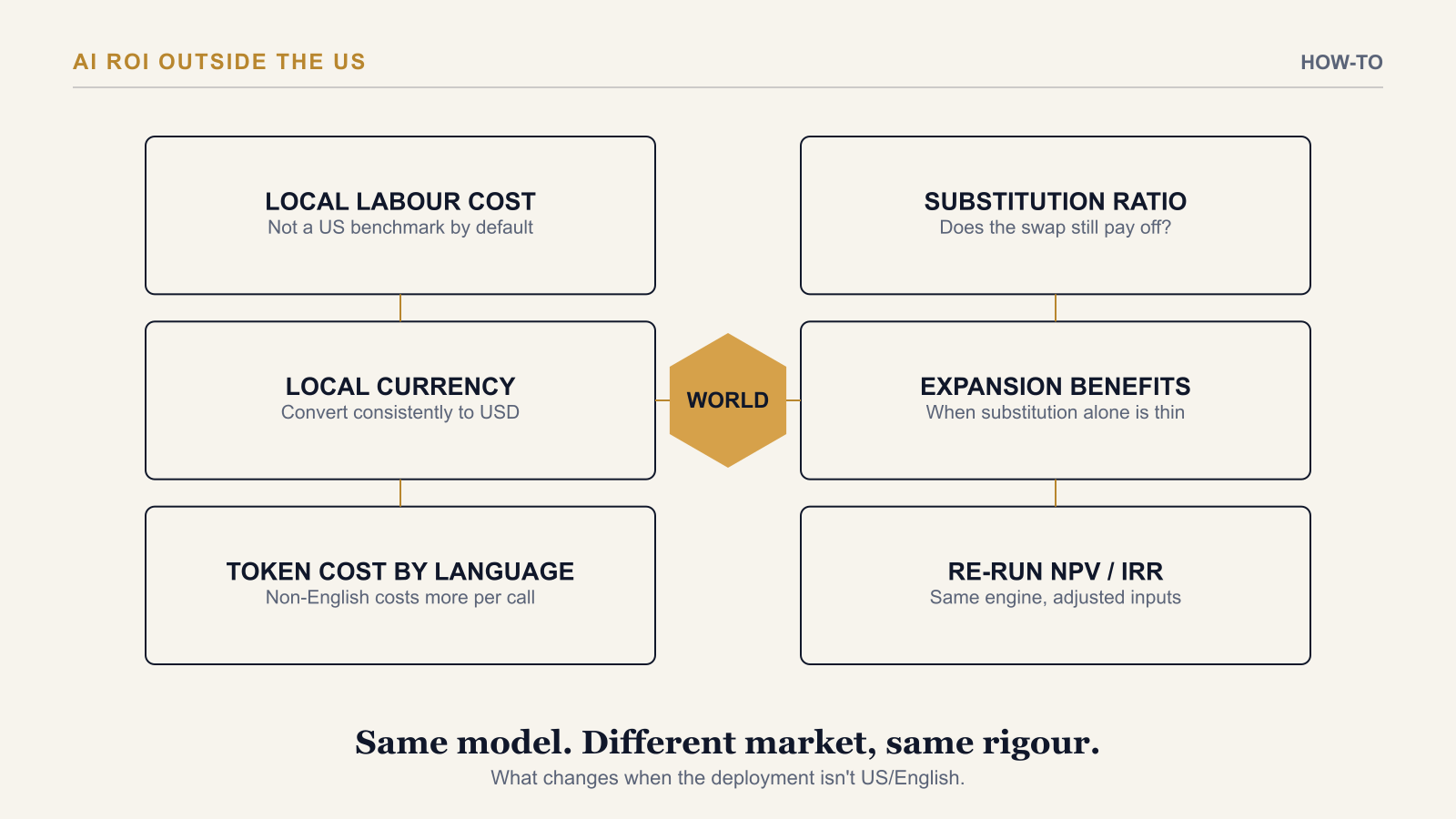
To calculate AI ROI outside the US, convert every cost and benefit into one currency, price the AI system's running cost in the language it actually operates in rather than defaulting to English economics, compare that running cost against the fully-loaded local cost of the role or process it replaces, and check whether that comparison alone justifies the investment or whether the case needs to lean on value that is only reachable because the AI system exists. The same NPV, IRR, and payback mechanics from a US business case still apply — four of the inputs feeding them change.
Step 1: Pick One Currency and Convert Consistently
Decide upfront whether the model runs in local currency or USD, state the exchange rate assumption explicitly, and convert every cost and benefit line the same way. A business case that mixes currencies silently — some costs quoted locally, some in USD, with no stated conversion — cannot be checked by a reviewer, which is reason enough on its own for finance to send it back.
Step 2: Price Local Labour Cost Accurately
Use the fully-loaded monthly cost of the role being replaced in the market where the deployment actually runs, not a US benchmark applied by default. This figure varies considerably by market, and it is the side of the cost comparison most likely to be wrong if the business case was adapted from a US template without re-checking the labour assumption underneath it.
Step 3: Price the AI System's Running Cost in the Deployment Language
AI inference cost is not language-neutral. Providers price by token volume, and non-English languages — especially those using non-Latin scripts — typically require more tokens to represent the same amount of meaning, which raises the per-interaction running cost purely as a function of the language involved. A US-context cost model applied to a non-English deployment without this adjustment will understate the AI side of the comparison.
Step 4: Compute the Comparison and Read the Signal
Divide the local labour cost by the AI running cost to get a substitution ratio, and use it to decide what kind of business case this needs to be: a strong ratio supports a labour-substitution case on its own; a ratio that compresses toward parity means substitution alone will not carry the case, and the business case needs a different primary argument. For the specific ratio bands and the standard per-language cost multipliers that feed this calculation, see Introducing the Location-Adjusted Edition: Why a USD, English-Only AI ROI Model Doesn't Travel.
Step 5: Where Substitution Is Weak, Build on Expansion Value
A compressed substitution ratio does not mean the investment case collapses — it means the case should be built on value only reachable because the AI system exists, rather than value saved by replacing a human who was already doing the work: reaching customers human capacity never covered, retention gains from serving people in their own language, and the value of continuous availability. These are a different kind of benefit from labour substitution, and they need to be named and modelled as their own category, not folded into a substitution argument that does not actually hold at a weak ratio.
Step 6: Re-Run NPV, IRR, and Payback With the Adjusted Inputs
Once currency, local labour cost, and language-adjusted running cost are set, the rest of the calculation is identical to a US business case: the same NPV, IRR, payback, and benefit-cost-ratio mechanics, run on inputs that now actually reflect the market and language the deployment runs in.
The AI Investment ROI Model — Location-Adjusted Edition runs this process automatically on top of the same NPV, IRR, payback, and BCR core as the base model — a Market Configuration tab for currency and local labour cost, a Blended Token Cost Multiplier across ten languages plus Custom, a Substitution Ratio signal, and an Expansion Benefits Module for the four value categories in Step 5.
→ Available at www.viksya.com