How to Fund AI Projects in Stages
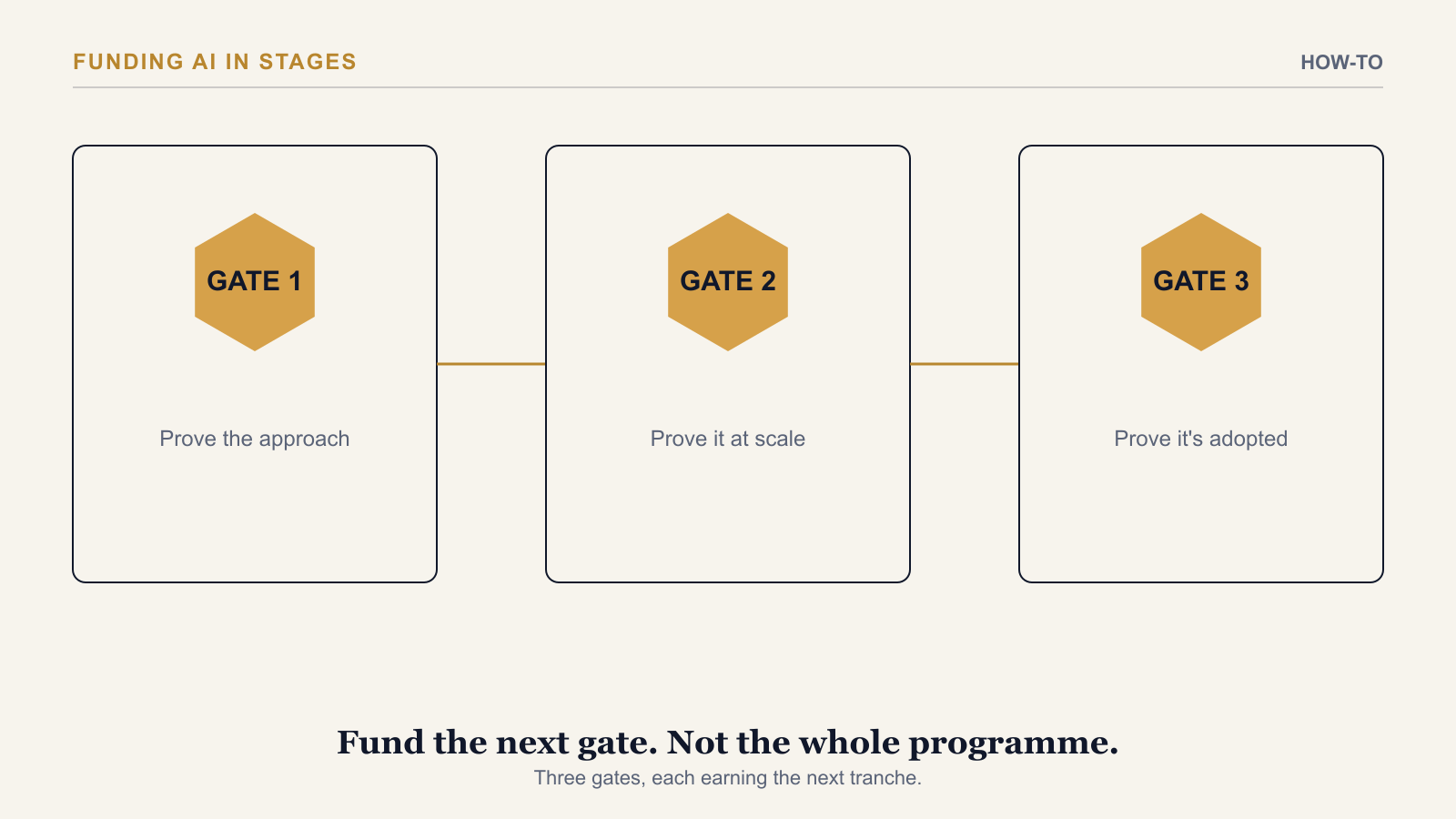
To fund an AI project in stages, split the total budget into three sequential tranches — a proof-of-concept gate, a scaled-build gate, and a production gate — each with its own go/no-go criteria agreed before the programme starts, and release the next tranche only once the current gate's criteria are met. This replaces a single lump-sum budget request, which implicitly claims a level of predictability AI delivery does not actually have.
Step 1: Scope Gate 1 as a Proof, Not a Pilot
Gate 1 should fund only what is needed to answer one question: does this AI approach work, given the data the organisation actually has? Data quality is the single most important Gate 1 criterion — issues found here are manageable; the same issues found six months and a full Gate 2 budget later are program-threatening. Ask for only the Gate 1 budget in the initial approval request, not the full programme total.
Step 2: Set Gate 2 Criteria Before Gate 1 Begins
Gate 2 funds the full build, training, and validation cycle against production-representative data, conditional on Gate 1's outcome. The key criterion is model performance at UAT, and the threshold needs to be agreed with the business unit before Gate 1 starts — not adjusted afterward to fit whatever the model actually achieved. A performance bar set after the fact is not a credible criterion.
Step 3: Make Change Readiness a Gate 3 Criterion, Not an Afterthought
Gate 3 funds production deployment and the first wave of adoption — and it is also where the organisation begins incurring the ongoing operational run cost that continues indefinitely. A model that is technically ready but deployed into a business unit that is not prepared to use its outputs will not generate the benefits the ROI case promised, so change readiness belongs in the Gate 3 criteria alongside technical performance, not as a separate conversation.
Step 4: Present All Three Gates to Finance Upfront
Show the full three-gate roadmap and budget in the initial conversation, with Gates 2 and 3 explicitly framed as conditional on the gates before them — not sprung as separate requests later. Finance responds to seeing the whole structure at once: it signals the programme team understands how AI delivery actually works, rather than hiding the full cost until it is already committed.
Step 5: Set Go Probabilities Honestly
Each gate should carry an honest go-probability, calibrated down from a baseline by the programme's actual risk factors — technology novelty, vendor dependency, organisational complexity — not set high because the team believes in the use case. The probability-weighted total this produces is a materially more credible number to bring to finance than the maximum exposure alone. For the specific formula and the probability ranges a representative programme typically uses, see Staged AI Investment Gates: The Smarter Way to Fund AI Programs.
Step 6: Treat a Failed Gate as the System Working
Stopping at Gate 1 because data quality did not hold up, or stopping at Gate 2 because the model missed its UAT threshold, is not a programme failure — it is the gate structure doing exactly what it was built to do: limiting exposure before the larger tranches of budget are committed. Presenting a stopped gate this way, rather than as a setback to explain away, is itself part of building finance's trust in the next programme that comes through the same structure.
The AI Investment ROI Model's Investment Gate Planner tab covers all three gates with configurable budget, go-probability, and criteria fields, auto-calculating the risk-adjusted expected investment and maximum exposure so the roadmap in Step 4 is ready to present without a separate spreadsheet.
→ Available at www.viksya.com