
How to Get Real AI ROI, Not Reported ROI
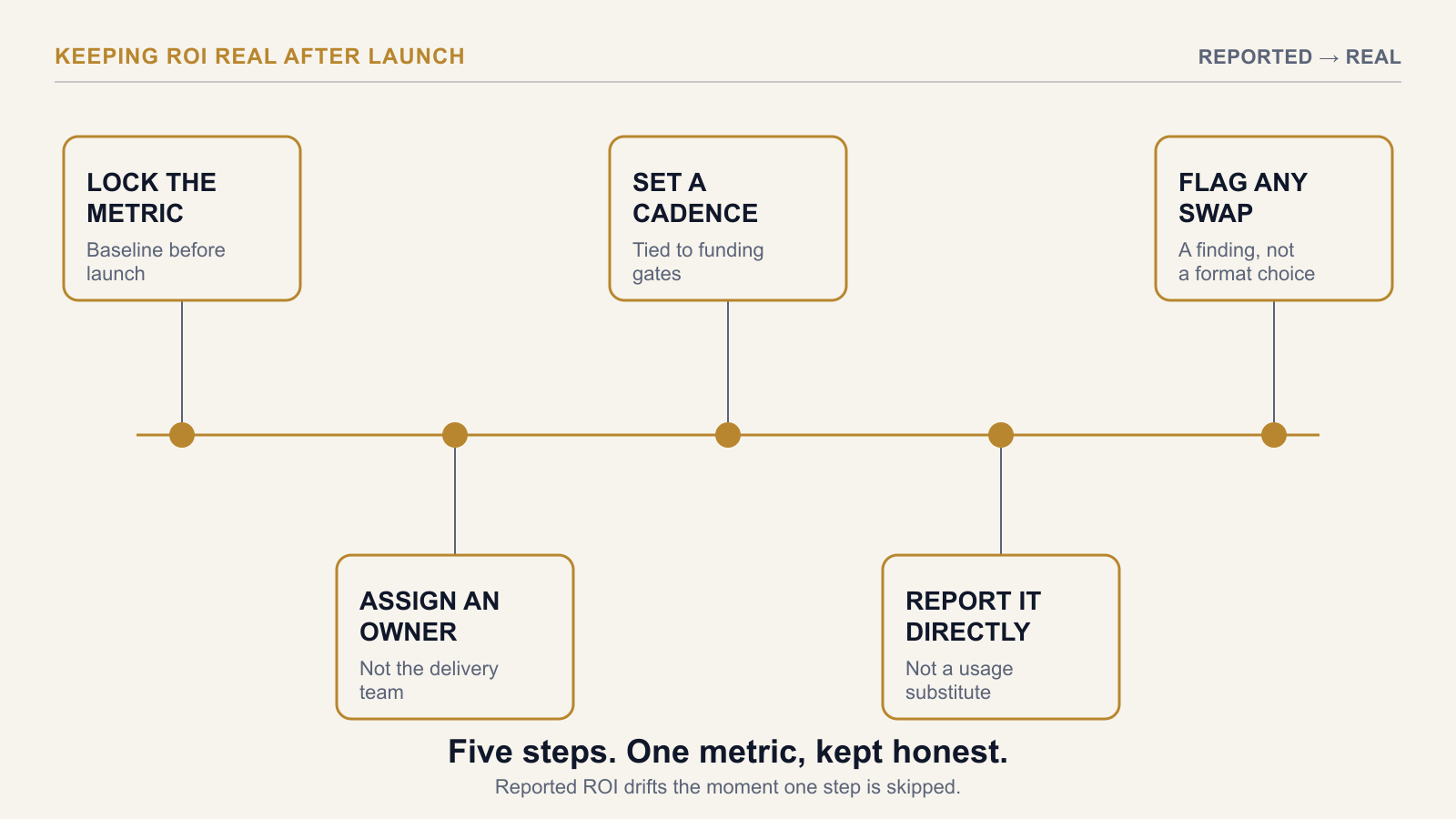
To get real AI ROI rather than reported ROI, lock the exact metric the business case was funded on before launch, assign someone other than the delivery team to re-measure it on a fixed cadence tied to the programme's funding gates, and report that same metric — not a usage or adoption figure — at every steering committee update until the programme closes. Reported ROI drifts from real ROI the moment any of those three steps gets skipped, usually quietly and usually without anyone deciding it should.
Step 1: Lock the Metric Before Launch
Write down the exact metric the business case was funded on — cost per unit, cycle time, error rate, revenue per rep, whatever it specifically was — and capture its baseline value before the AI system goes live. This sounds obvious and is the step that most often doesn't happen, because the business case document and the post-launch reporting dashboard are frequently built by different people at different times, and nobody carries the exact metric definition across that gap.
Step 2: Assign Ownership for Re-Measurement
Name a specific owner for re-measuring the locked metric — not the delivery team that built the system. A delivery team naturally reports on what the system is doing (usage, uptime, query volume), because that's what their tooling instruments automatically. Re-measuring the original business-case metric requires someone to deliberately go back and repeat a calculation that isn't anyone's default job once the system is live, which is exactly why it needs a named owner rather than an assumption that it will happen.
Step 3: Set a Re-Measurement Cadence Tied to Funding Gates
Re-measure on the same cadence the programme's funding decisions already run on — quarterly is typical — not on an ad hoc basis whenever someone remembers to check. If the programme uses staged investment gates, the locked metric should be the number reviewed at each gate, checked against the original business case, not a usage figure substituted because it was easier to pull.
Step 4: Report the Locked Metric, Not a Substitute
At every steering committee update, present the re-measured business-case metric by name, next to the original target it was funded against. If a usage or adoption number also gets shown — which is reasonable context — label it explicitly as usage context, not as evidence the case came true. The two numbers answer different questions, and a slide that blurs them lets a usage increase stand in for an outcome that was never actually re-checked.
Step 5: Treat an Unexplained Metric Swap as a Finding, Not a Formatting Choice
If a steering committee update ever shows a different metric than the one the business case was funded on, with no explanation of why, that's not a reporting style decision — it's a signal the original question stopped being asked. Flagging it and asking who approved the change, and why, is a legitimate and useful challenge at any point in the programme, not a gotcha reserved for a post-mortem.
Why This Discipline Matters More After Launch Than Before It
Building a rigorous ROI case before funding is the easier half of this discipline, because it happens once, under scrutiny, with people specifically assigned to get it right. Keeping the same metric alive for the following one to three years, through multiple steering committee cycles and team changes, is the harder half — and it's the half that determines whether the number anyone eventually reports as "the ROI" bears any relationship to what was actually funded. The most common point of failure isn't malice or even carelessness — it's a handover. The programme sponsor who knew the exact locked metric moves to a different role, the reporting owner changes teams, or the steering committee itself gets restructured partway through, and the new people in those seats inherit a dashboard without inheriting the one document that said what the dashboard was supposed to be measuring. Naming an owner for re-measurement in Step 2 is partly about day-to-day accountability and partly about making sure that handover has somewhere specific to land. For the full diagnosis of how this drift happens and why usage metrics quietly take the business case metric's place, see Most AI ROI Metrics Measure Usage. Real AI ROI Metrics Measure the Business Case.
The AI Investment ROI Model locks the same NPV, IRR, payback, and ROI % figures this protocol is built to protect — the Assumptions Log tab documents every input with its source, so the metric a programme was funded on stays traceable and re-checkable, not lost the moment the workbook that produced it gets closed.
→ Available at www.viksya.com