
How to Prioritize AI Use Cases: A Scored Approach
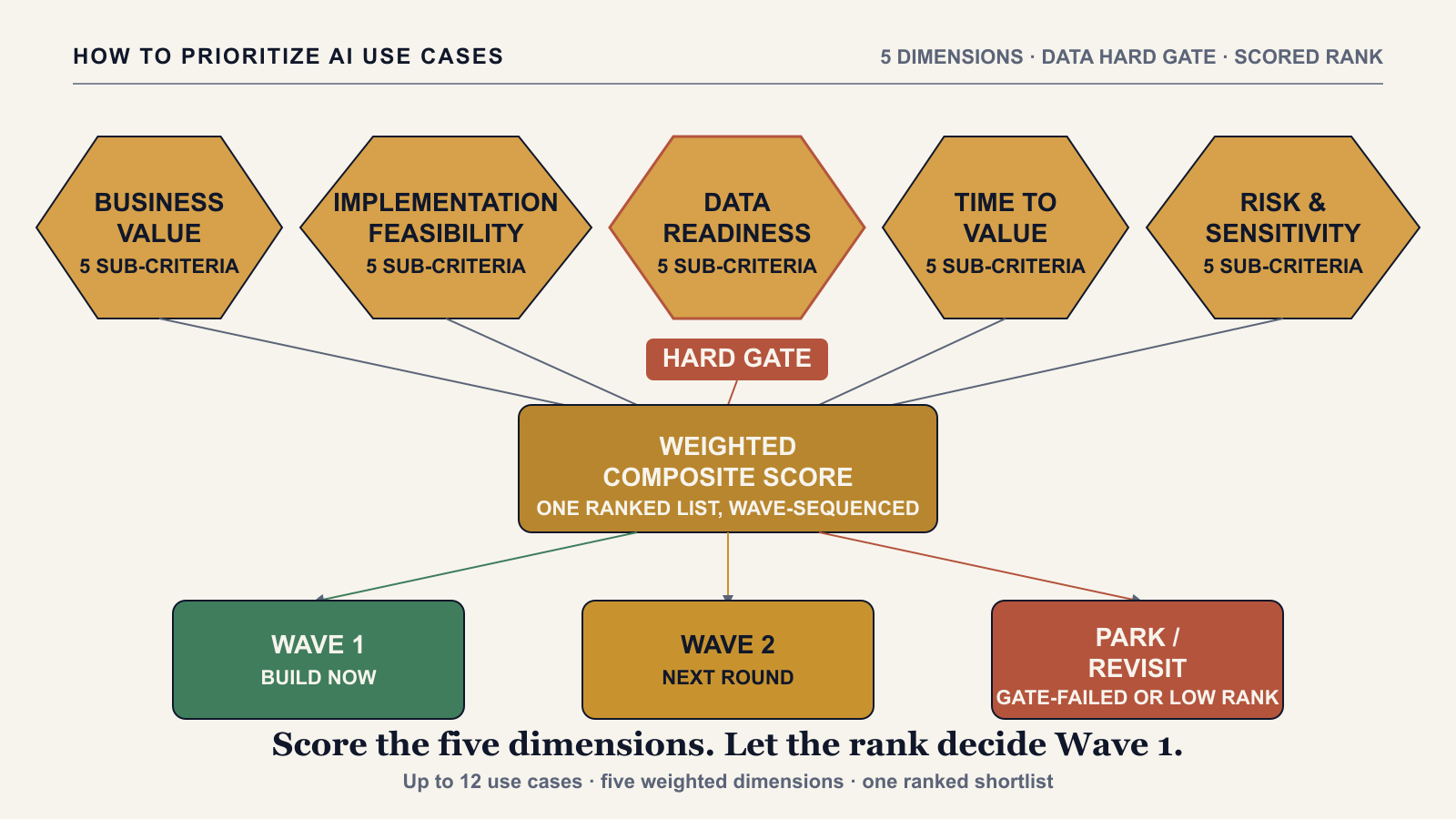
To prioritize AI use cases, score every candidate against the AI Use Case Prioritization Framework's five weighted dimensions — Business Value, Implementation Feasibility, Data Readiness, Time to Value, and Risk & Sensitivity — apply the Data Readiness hard gate before anyone gets attached to a favorite use case, and let the resulting weighted composite score decide the build sequence. The score, not the loudest voice in the room, determines what goes into Wave 1. What follows is that process laid out step by step, from building the candidate list to reading the final ranked output.
Why a Score Settles What a Workshop Can't
Most AI use case shortlists are built on enthusiasm rather than evidence. A use case makes the list because an executive sponsor likes it, because the underlying model is technically interesting, or because a competitor announced something similar. None of those are measures of whether the use case is worth building first. A scored approach replaces that debate with five consistent questions, asked of every candidate the same way, so the shortlist reflects a structured comparison instead of whoever argued most persuasively. We have written before about why plotting Business Value against Technical Complexity on a single two-axis view is a useful starting lens for seeing where ambition and difficulty collide — see AI Use Case Prioritization: Business Value vs. Technical Complexity. That view is diagnostic: it shows where the tension sits, and its own conclusion is that the matrix is an orientation tool while the composite score is the actual decision tool. Turning a shortlist into a ranked, sequenced build order means scoring all five dimensions, not two, and running them through the hard gate and the weighting below. That is the process this post covers.
Step 1: Build the Candidate List, Capped at Twelve
Before any scoring happens, write down the candidates. The framework caps the list at twelve use cases per round, which is a deliberate constraint rather than a limitation: a list longer than twelve is usually a sign that candidates haven't been pre-filtered for basic plausibility, and scoring twenty half-formed ideas produces twenty half-formed scores. Each entry needs enough description to be scored honestly — the business process it touches, the data it would depend on, and the team that would build it — not just a one-line name. A use case titled “AI for customer service” cannot be scored on data readiness or complexity; a use case titled “Deflect tier-1 billing inquiries using the existing support-ticket history” can.
Step 2: Score Every Use Case Across Five Weighted Dimensions
With the list built, score each use case across the framework's five weighted dimensions, each broken into five sub-criteria:
- Business Value — revenue impact, cost reduction potential, strategic alignment, and competitive differentiation.
- Implementation Feasibility — technical complexity, integration burden, team capability, and vendor dependency.
- Data Readiness — data availability, quality, access, and volume. This dimension also carries the hard gate described in Step 3.
- Time to Value — delivery speed, MVP scope, dependency chain, and regulatory clearance.
- Risk & Sensitivity — regulatory risk, model explainability requirements, and reputational sensitivity.
Score every use case against the same five dimensions in the same sitting, ideally in one working session rather than spread across separate conversations with different stakeholders — consistency across candidates is what makes the resulting rank defensible. A use case scored generously in isolation and one scored conservatively in a different meeting cannot be meaningfully compared later.
Step 3: Apply the Data Readiness Hard Gate
Data Readiness is not just another weighted input — it is a hard gate. A use case that fails the data-feasibility threshold on this dimension is removed from Wave 1 consideration regardless of how strongly it scores on Business Value or Time to Value. This is the step most prioritization exercises skip, and it is the one that saves programmes the most pain later: an AI use case with no viable data foundation does not get discovered to be unbuildable in a scoring workshop — it gets discovered months into delivery, after a team has already been committed to it. Running the gate before ranking anything else means an exciting, high-value use case with a genuine data problem gets flagged immediately, not after the budget and the team are already assigned to it.
Step 4: Let the Weighted Composite Produce the Rank
Once every use case has cleared or failed the Data Readiness gate, the five dimension scores combine into a single weighted composite score per use case. This is the step that turns five separate judgments into one comparable number — the mechanism that makes it possible to say one use case genuinely ranks above another, rather than relying on a felt sense of which seemed more compelling in the room. The output is a single ordered list: every surviving use case ranked highest to lowest by composite score, with the hard-gated use cases logged separately rather than silently dropped, so the group can see exactly which candidates were excluded and why.
Step 5: Read the Wave Assignment and Check Portfolio Balance
The ranked list then sorts into three buckets: Wave 1, for immediate delivery; Wave 2, for the next round; and Park/Revisit, for use cases that are not ready yet but may be worth returning to once a blocking dimension improves. Before treating the Wave 1 list as final, check portfolio balance — specifically, whether Wave 1 leans too heavily on a single business unit. A Wave 1 shortlist that is numerically strong but concentrated in one department carries rollout and political risk that the composite score alone will not surface; it shows up only when someone deliberately checks the distribution across units rather than just the ranking.
A Worked Example
Picture a mid-size insurer with eight candidate AI use cases on the table: a claims-document extraction tool, a customer chatbot, a fraud-detection model, a pricing-optimization engine, and four smaller automation ideas. Scored across the five dimensions, the claims-document extraction tool and one of the smaller automation ideas clear the Data Readiness gate comfortably and land near the top of the composite rank — both draw on structured, already-digitized data the organization has used for years. The pricing-optimization engine scores well on Business Value but fails the Data Readiness gate outright: the historical pricing data it would need is scattered across three legacy systems that were never reconciled. Rather than discovering that months into a build, the gate surfaces it at the scoring stage, and the use case is logged to Park/Revisit with the specific data gap noted, not discarded outright.
Turning the Ranked List Into a Board-Ready Shortlist
The output of this process is not just an internal ranking — it is something a programme can defend to a steering committee. A dated, scored shortlist with the hard-gate exclusions shown and the Wave 1/Wave 2 split visible answers the question a board will ask (“why these use cases, in this order”) with the scoring evidence behind it, rather than a narrative assembled after the fact to justify a decision that was really made on enthusiasm. That is the difference a scored approach makes: not a more sophisticated-looking spreadsheet, but a prioritization decision that survives being questioned.
The AI Use Case Prioritization Framework provides a structured, weighted method for scoring up to 12 candidate AI use cases across five dimensions — Business Value, Implementation Feasibility, Data Readiness, Time to Value, and Risk & Sensitivity — with a data-feasibility hard gate and an automatically sequenced Wave 1, Wave 2, and Park/Revisit shortlist, delivered as a seven-tab Excel workbook.
→ Available at www.viksya.com