
The AI ROI Formula and What Belongs in Each Term
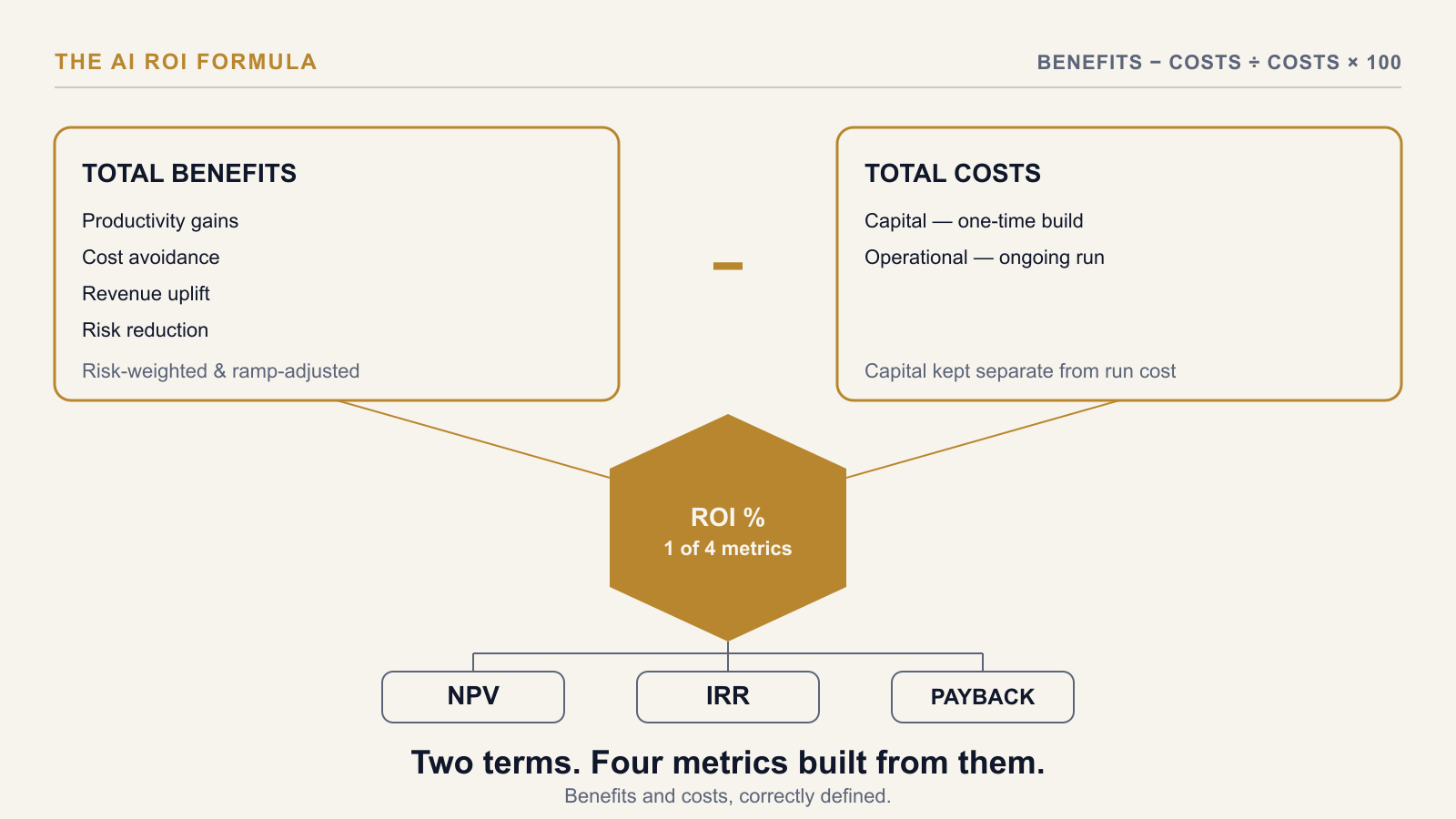
The core AI ROI formula is: ROI % = (Total Benefits − Total Costs) ÷ Total Costs × 100. Benefits and Costs are not single numbers — each is a sum of several distinct categories, and getting the formula right is mostly about not leaving a category out of either term, not about the arithmetic itself.
What Belongs in "Total Benefits"
Total Benefits is the sum of every quantified gain the AI initiative produces, time-adjusted for when it actually arrives. Four categories cover most AI programs: productivity gains (time saved, converted to its fully-loaded cost), cost avoidance (errors, rework, or manual processing the system removes), revenue uplift (new or retained revenue directly attributable to the initiative), and risk reduction (quantified exposure the initiative removes — harder to measure, and the category most often left out or overstated as a result).
Two adjustments belong inside this term, not bolted on afterward. First, a benefit ramp curve: AI value depends on adoption, and adoption builds over time, so full benefit figures from day one overstate the term — a common default is 40% of stated benefit in Year 1, 80% in Year 2, full run-rate from Year 3. Second, a risk weighting: a claimed benefit that hasn't been validated against this organisation's own data should be discounted, not taken at face value, before it enters the sum.
What Belongs in "Total Costs"
Total Costs is the sum of everything the initiative consumes, split into two kinds that behave differently and should stay visible as separate figures even after they're summed: capital cost (one-time build — development, integration, infrastructure setup, initial training) and operational cost (ongoing run cost — inference or licensing, monitoring, periodic retraining, continued change management). A business case that blends CAPEX and OPEX into one number obscures the permanent commitment the operational share represents.
AI-specific costs that are easy to leave out of this term entirely: an allowance for a second development or tuning cycle if the first model doesn't clear its performance threshold (AI development is iterative in a way standard software estimation isn't), and opportunity cost — the value of the internal time the initiative diverts from other work, which doesn't appear on an invoice but is real.
Why ROI % Is Only One Formula Built From These Two Terms
Benefits and Costs, once defined this way, don't just produce one number. They're the two inputs behind every standard investment metric a finance review will ask for — ROI % is the simplest of them, but Net Present Value discounts the same benefit-minus-cost cash flows to today's value over a chosen time horizon, Internal Rate of Return finds the discount rate at which NPV hits zero, and payback period asks how many months of cumulative benefit it takes to clear cumulative cost. Each answers a different question finance has about the same underlying numbers, which is why a credible AI business case presents more than ROI % alone. For the full walkthrough of all four metrics, what each one is built to answer, and what a CFO will challenge in each, see The Four Financial Metrics Every CFO Expects in an AI Investment Case.
A Hypothetical Worked Example
Picture an AI initiative with a Year 0 capital cost of $200,000 and an ongoing operational cost of $40,000 a year. In Year 1, ramp-adjusted benefits come to $120,000; by Year 3, full run-rate benefits reach $300,000 a year. Summed over three years: Total Benefits of roughly $620,000 against Total Costs of roughly $320,000 produces an ROI % just under 95% — a single figure that, on its own, still doesn't say whether the investment clears this organisation's hurdle rate or how long it takes to pay back. That's exactly why ROI % is reported alongside NPV and payback, not instead of them.
Building the Formula Without Starting From a Blank Spreadsheet
Correctly populating both terms of this formula — risk-weighted, ramp-adjusted benefits across multiple categories; capital and operational costs kept separate; an AI non-linearity allowance included rather than assumed away — is the entire job of a structured cost and benefit model, not an afterthought once a number is needed for a slide.
The AI Investment ROI Model provides a 10-tab Excel workbook that builds both terms of this formula for you — a cost model and a benefit model across Conservative, Base, and Stretch scenarios — then auto-calculates NPV, IRR, payback period, and benefit-cost ratio from the same inputs, with sensitivity analysis showing which assumption moves the result most.
→ Available at www.viksya.com