
Three-Scenario Modelling for AI ROI
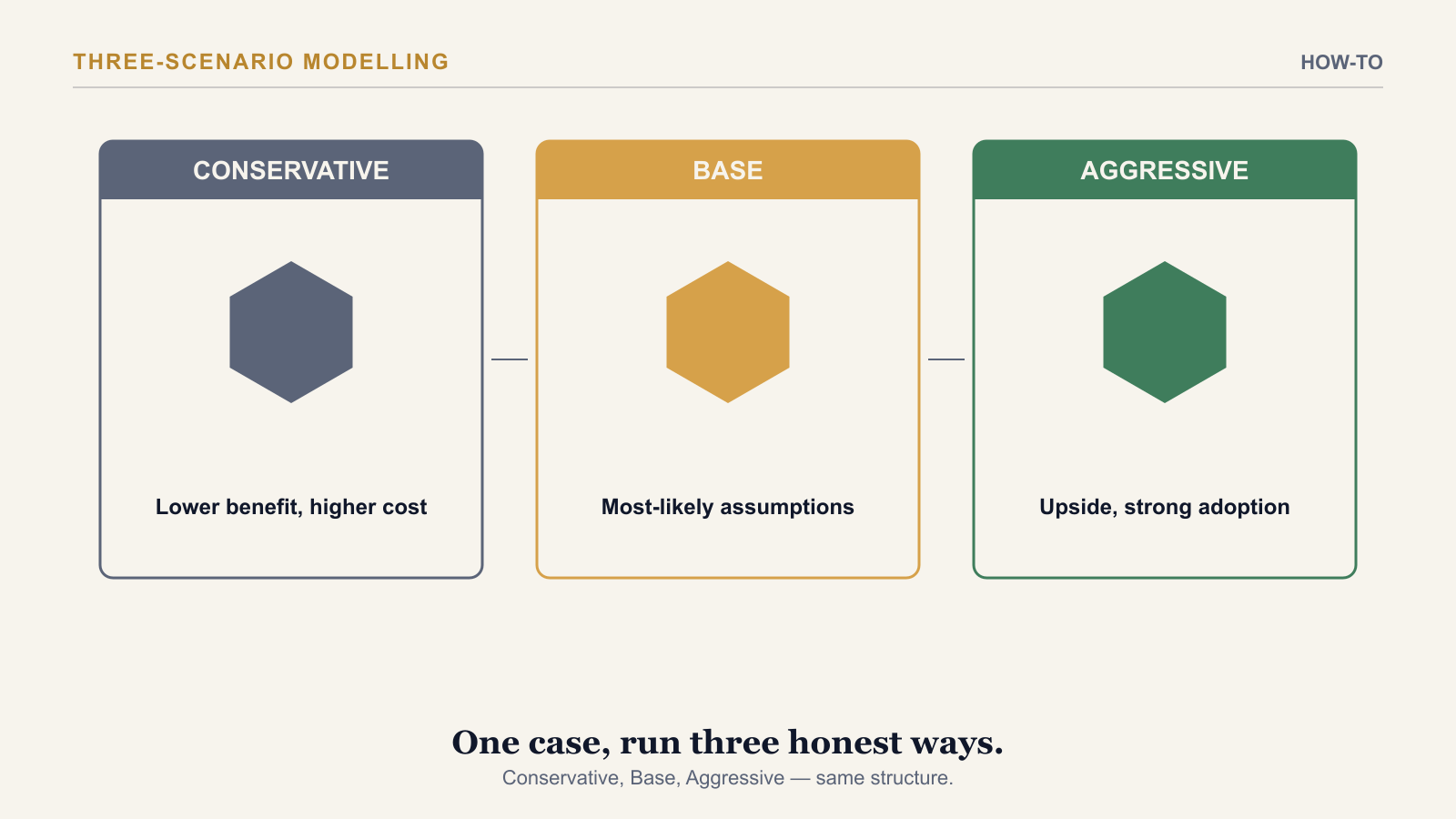
To run three-scenario AI ROI analysis, build the same cost and benefit model three times — Conservative, Base, and Aggressive — keeping the structure identical and varying only the assumptions: benefit realisation, cost variance, adoption ramp speed, and discount rate. A business case built on one scenario claims more certainty than any programme team can honestly have; a finance reviewer who sees only a single number will discount it accordingly, whether or not that discount is ever said out loud.
Step 1: Keep the Structure Identical, Vary Only the Inputs
All three scenarios should run through the exact same cost and benefit model — same line items, same formula, same time horizon. The only thing that changes between Conservative, Base, and Aggressive is the assumption set feeding each line. If the scenarios use different structures, the comparison between them stops meaning anything, because any difference in the output could be a structural artifact rather than a genuine reflection of more or less optimistic assumptions.
Step 2: Set the Base Case First
Base Case assumptions should reflect the single most likely outcome, grounded in comparable programme benchmarks and any vendor commitments already in writing — not an average of best and worst case, and not a deliberately soft middle ground. This is the scenario finance will treat as the primary basis for the funding decision, so it needs to be defensible on its own, not just "the one in the middle."
Step 3: Derive the Conservative Case
Conservative assumptions reduce benefit realisation, increase cost, slow the adoption ramp, and raise the discount rate relative to the Base Case — each adjustment should be a specific, named percentage or figure, not a vague "worse" label. A well-built Conservative case also includes an AI-specific non-linearity allowance: the cost of one additional model training or tuning cycle if the first attempt does not clear its performance threshold, a scenario common enough in AI delivery to treat as a planning assumption rather than a remote risk. For the specific default percentages used across a representative AI programme, see The Four Financial Metrics Every CFO Expects in an AI Investment Case.
Step 4: Derive the Aggressive Case
Aggressive assumptions move in the opposite direction — higher benefit realisation, lower cost, a faster ramp, a lower discount rate — representing the upside if sponsorship is strong, the technology performs as expected, and adoption exceeds plan. This scenario is useful context, not the number to lead a funding conversation with; presenting Aggressive as the headline figure is one of the fastest ways to lose a finance reviewer's trust.
Step 5: Apply the Resilience Decision Rule
Check whether the Conservative scenario still returns a positive ROI with a healthy benefit-to-cost ratio. If it does, the programme has genuine financial resilience and the case can be presented with confidence even before accounting for any Base or Aggressive upside. If the Conservative case is the only one that clears the bar, or Conservative turns negative, that is important information the steering committee needs before approval — not a result to quietly drop from the presentation.
Step 6: Present All Three, Not Just One
Show Conservative, Base, and Aggressive side by side, with the specific assumption deltas behind each one documented rather than left implicit. A business case that shows its work this way signals that the programme team has thought through what failure looks like and still believes the investment is worth making — which is a materially different conversation than a single optimistic number that collapses under the first tough question.
The AI Investment ROI Model runs Conservative, Base, and Stretch scenarios from the same inputs automatically, with an AI non-linearity adjustment built into the Conservative case and a Go/No-Go signal on the Executive Summary tab based on how the three scenarios compare.
→ Available at www.viksya.com