
Which AI Use Cases Get 2027 Funding: Ranking Candidates Before the Budget Closes
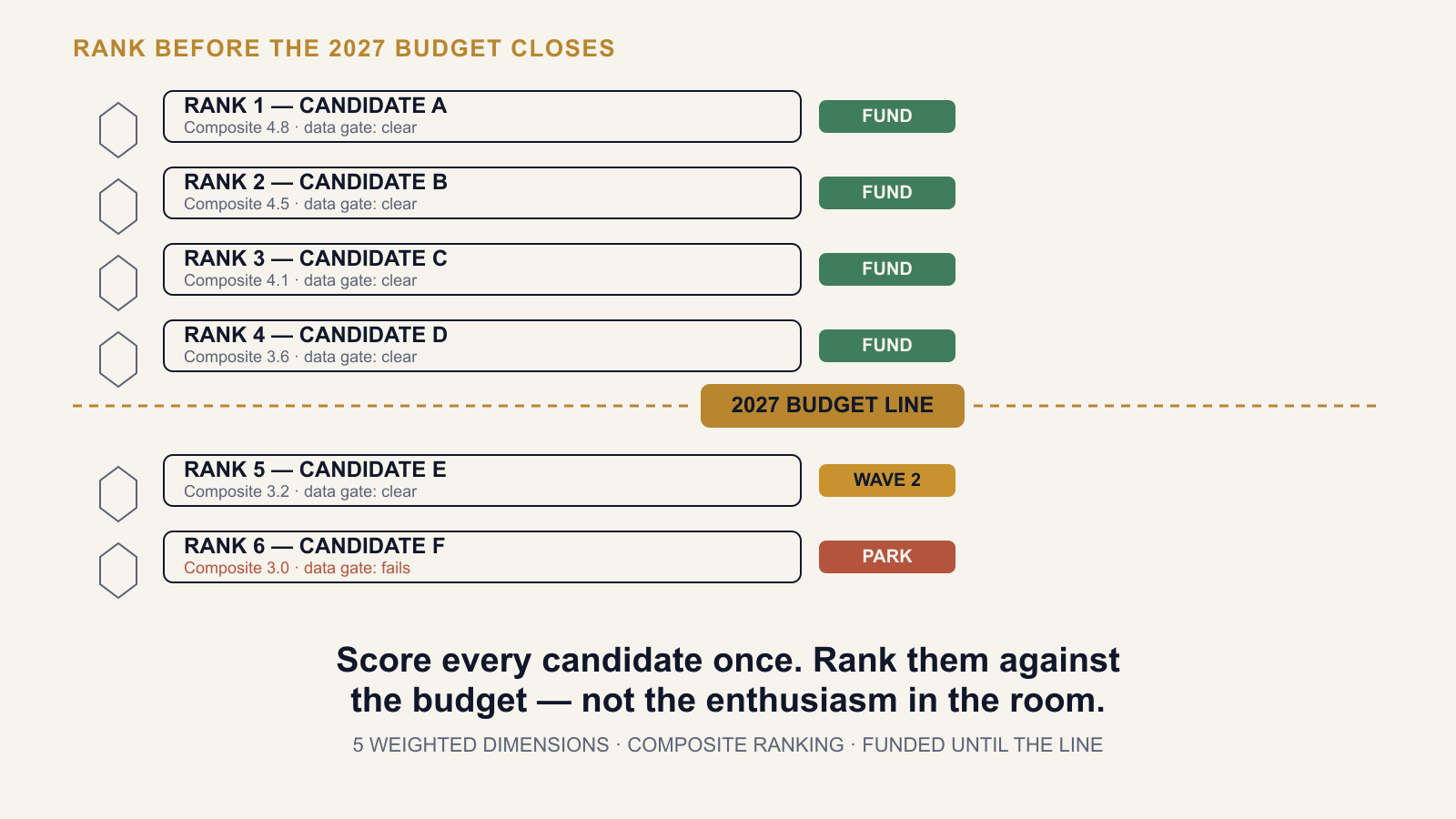
Fund the candidates that clear the data-readiness hard gate and sit in the top band of your weighted composite score, in rank order, until the Wave 1 capital envelope runs out — not whichever use cases generated the most enthusiasm in the Q4 planning room. If a shortlist is already scored, the 2027 funding decision is a ranking-and-cutoff exercise, not a re-debate of which use cases are good ideas. Here is how to draw that line before the budget window closes.
Ranking Is a Different Problem Than Scoring
Most of the groundwork for this decision happens earlier. Business Value vs. Technical Complexity covers how to score any single candidate — plotting business value against build difficulty, reading the four resulting quadrants, and avoiding the common scoring errors that come with an inverted complexity scale. That is a per-candidate evaluation problem, and it is already solved by the time a programme reaches Q4 planning season.
What is not solved by scoring alone is what to do with a full shortlist once every candidate has a number and the capital envelope for 2027 is fixed. A list of twelve scored use cases does not fund itself. Somewhere on that ranked list sits a line: candidates above it get built in Wave 1, candidates below it wait, get re-scoped for Wave 2, or get parked. Finding that line, and holding it against pressure to move it, is a separate exercise from scoring — and it is the one that actually determines what gets funded.
Why the Closing Budget Window Changes the Decision
During most of the year, prioritisation is a planning exercise: scores can be revisited, candidates can be added or dropped, and nothing is final. Q4 planning season is different. The organization is working against a capital allocation that is about to close for the fiscal year, and whatever ranking exists when that window shuts is effectively the funded list. A use case that would have scored well under calmer review gets no benefit from that if it is not above the line when the budget locks.
This is the moment where an informal, enthusiasm-driven process does the most damage. A candidate championed by a senior stakeholder in the final planning meeting can displace a higher-ranked candidate simply because the meeting happened before the line was fixed on paper. A ranked, dated shortlist — produced before the room convenes, not negotiated inside it — is what keeps that from happening.
Drawing the Funding Line
Rank every candidate by its weighted composite score, highest to lowest. Walk down that list and mark the point where the organization's Wave 1 capacity — however it is expressed, whether as a headcount of parallel builds the delivery team can actually support or a capital ceiling set by finance — runs out. Everything above that point is funded for Wave 1. Everything below it is not, regardless of how compelling any individual candidate's story is in the room.
The line should be set once, before the planning meeting, and treated as the default. Moving it in the room, candidate by candidate, is how a defensible ranked list quietly turns back into a workshop debate.
The Hard Gate Still Overrides Rank
A candidate's position on the ranked list is not the only thing that determines whether it gets funded. The Data Readiness dimension is a hard gate: a candidate that fails it is removed from Wave 1 regardless of how high its composite score ranks it. A use case that scores well on business value, feasibility, time to value, and risk, but has no viable data foundation, does not get funded on the strength of the other four dimensions. It gets flagged and excluded, and the funding line moves down to the next candidate that clears the gate.
This matters specifically at budget-closing time because the pressure to fund a high-ranked, gate-failing candidate anyway is highest when the capital window is about to shut and the list looks thin. Holding the gate under that pressure is what keeps Wave 1 from inheriting a data problem that was visible before a single sprint started.
What Happens Just Below the Line
A candidate that ranks below the funding cutoff is not rejected outright. It is either reassigned to Wave 2 with its existing score intact, so it re-enters consideration at the next planning cycle without being re-scored from zero, or parked with a named owner and a re-score date, if something specific — a data-readiness gap, an unresolved dependency — needs to change before it is worth reconsidering. What it should not become is an informal exception that gets funded anyway because it was close to the line and someone advocated for it after the ranking was already set.
A Worked Example
Picture a programme heading into Q4 2026 planning with six already-scored candidates and Wave 1 capacity for four parallel builds. Candidates A through D clear the data-readiness gate with composite scores of 4.8, 4.5, 4.1, and 3.6 — all above the funding line at rank four. Candidate E scores 3.2, clears the gate, but ranks fifth: it moves to Wave 2 with its score preserved. Candidate F scores 3.0 on composite but fails the data-readiness gate outright: it is parked regardless of where 3.0 would otherwise have placed it on the ranked list, with a named owner responsible for closing the data gap before its next re-score.
Four candidates get funded. Two do not. The decision took the shape it did because the line was drawn from the ranking and the gate before the planning meeting, not negotiated inside it.
Avoiding the Two Mistakes That Reopen the Debate
Two patterns undo a properly drawn funding line. The first is rounding the headcount up — funding five candidates because five is a tidier number for the steering committee slide, when capacity and the ranked list support four. The second is a portfolio-concentration blind spot: funding the top four candidates by score alone without checking whether they all belong to the same business unit, which trades a scoring problem for a delivery-risk problem the moment Wave 1 starts competing for the same stakeholders and the same engineering time. Reviewing the funded list's portfolio balance after the cutoff is drawn, not just the ranking that produced it, is what catches this before the budget locks.
The AI Use Case Prioritization Framework provides the ranked shortlist this funding decision runs on: up to 12 use cases scored across five weighted dimensions with a data-readiness hard gate, sorted automatically into Wave 1, Wave 2, or Park/Revisit, with a portfolio-balance check that flags business-unit concentration before it becomes a delivery problem.
→ Available at www.viksya.com