
Why AI Pilot Costs Mislead: Estimating the Step From Pilot to Production
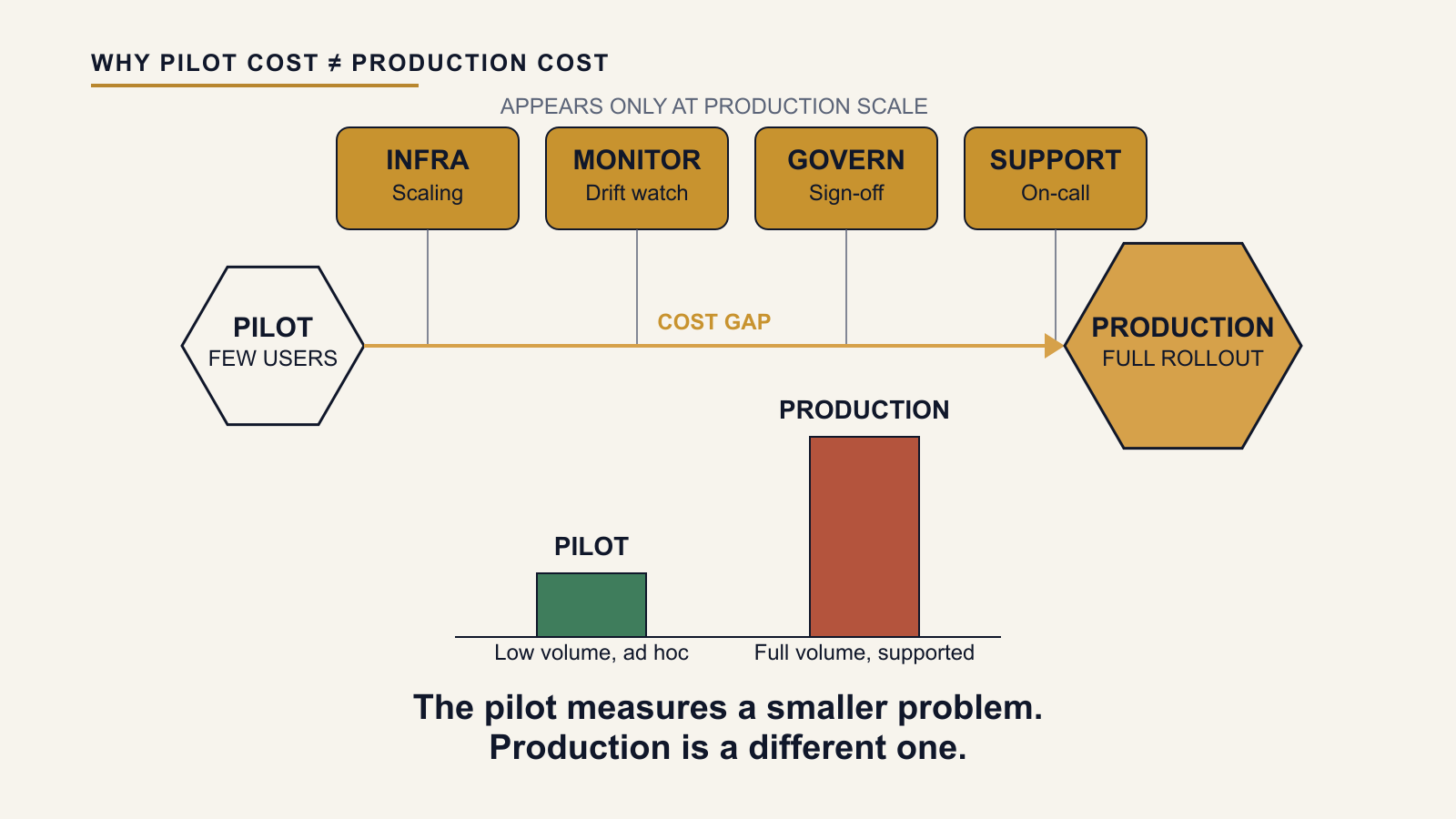
AI pilot costs do not scale to production because the pilot and the production system are, in cost terms, two different objects wearing the same name. A pilot typically runs at a sliver of production volume, on improvised infrastructure, with no monitoring, support, or governance layer attached — three cost categories that exist in production and none of which show up on a pilot's bill. The pilot's actual spend is a measurement of a smaller, simpler problem; treating it as an early sample of the production number is one of the most common sources of AI budget surprise after go-live.
Volume Is the Obvious Driver. It Is Not the Only One.
The most visible gap between pilot and production cost is volume. A pilot serving a handful of internal users generates a tiny fraction of the API calls, storage reads, and compute cycles that a full rollout to a department or a customer base generates. Multiplying the pilot's bill by the expected user-count ratio looks like a reasonable first pass at a production number. It understates the real figure, because volume growth does not arrive alone. It crosses thresholds that trigger cost categories a pilot never had to carry at all, and it changes the per-unit cost of the work the pilot was already doing.
Four Costs a Pilot Never Has to Carry
A pilot is, by design, a controlled exercise: a small group of users, a known set of inputs, and an engineer watching the system closely enough to catch problems before they matter. None of the following exists at that scale — all of them exist once the system is live for an organization that depends on it.
- Redundancy and uptime — a pilot can go down for an afternoon with no consequence. A production system serving live users needs failover, load balancing, and rate-limit handling built in, which is infrastructure spend a pilot's architecture never needed.
- Monitoring and drift detection — a pilot's handful of outputs can be eyeballed by the team that built it. Production needs ongoing observability: tracking output quality, latency, and model drift across a volume no person can review manually.
- Governance and sign-off — a pilot is an internal experiment. A production system making or influencing decisions for real users typically needs a compliance and risk review before launch, and periodic re-review afterward.
- Support and incident response — when a pilot breaks, the team that built it fixes it on its own schedule. When production breaks, someone is on call, and the cost of that coverage does not appear anywhere in a pilot's budget line.
None of these is a hypothetical risk to plan around later. They are standing costs that a production rollout has to carry from day one — costs a pilot, by construction, never had to carry at all.
Why the Per-Call Cost Rises, Not Just the Call Count
For AI systems built around an LLM, there is a second effect that compounds the volume gap: the cost of each individual call tends to rise between pilot and production, not just the number of calls. Picture a pilot that answers short, single-turn questions from a brief prompt with no retrieved context — a cheap call by token-cost standards. Production versions of the same system usually add retrieval-augmented context to ground answers in real data, carry conversation history across multiple turns, and handle edge cases the pilot's narrow test set never encountered. Each of those additions inflates the input token count of a typical call, so the production system is not just making more calls than the pilot — it is making more expensive calls, too. A cost model built by multiplying the pilot's per-call price by an expected production call volume understates the number on both dimensions at once.
A Different Kind of Non-Linearity
This is a distinct phenomenon from the project-complexity non-linearity covered in What Is AI Project Non-Linearity, which concerns how effort compounds during model development — data quality, architecture complexity, and training iteration cycles interacting to multiply build effort. That post makes a specific, related point worth building on directly: for LLM integration projects, as distinct from model-development-from-scratch projects, effort scales more predictably, because "the primary estimation challenge is not compounding complexity in training — it is accurately forecasting token-based API costs at production volume." This post is that forecasting problem, worked through in full — not training-effort non-linearity, but the step change in infrastructure, governance, and support that volume growth triggers, plus the real rise in per-call cost described above. The mechanics of token pricing itself — how input and output tokens are priced, and how call volume translates into a monthly bill — are covered in How to Estimate an AI Project Cost; this post is about why a pilot's own observed numbers are the wrong starting point for that calculation.
Estimating From Production Assumptions, Not Pilot Observations
The practical fix is to stop treating the pilot's bill as a baseline to scale up, and instead build the production estimate from production assumptions directly: the call volume, concurrency, and context size the system will actually carry once it is live, priced against the infrastructure, monitoring, governance, and support model production will require — not the one the pilot happened to get away without. The pilot is still useful. It validates that the approach works and surfaces early signal on model quality and user behavior. It is just not a cost estimate, and presenting it as one to a budget committee creates the same credibility gap that a single-point estimate without a confidence range creates: a number the team will be held to that was never built to carry that weight.
The AI Project Estimation Model provides a dedicated LLM Token Cost Model tab that estimates monthly and annual inference cost by model choice and usage volume, inside the same P50/P80/P90 confidence-ranged workbook used for the rest of the estimate.
→ Available at www.viksya.com