
Why Enterprise Token Costs Overran the 2026 Budget
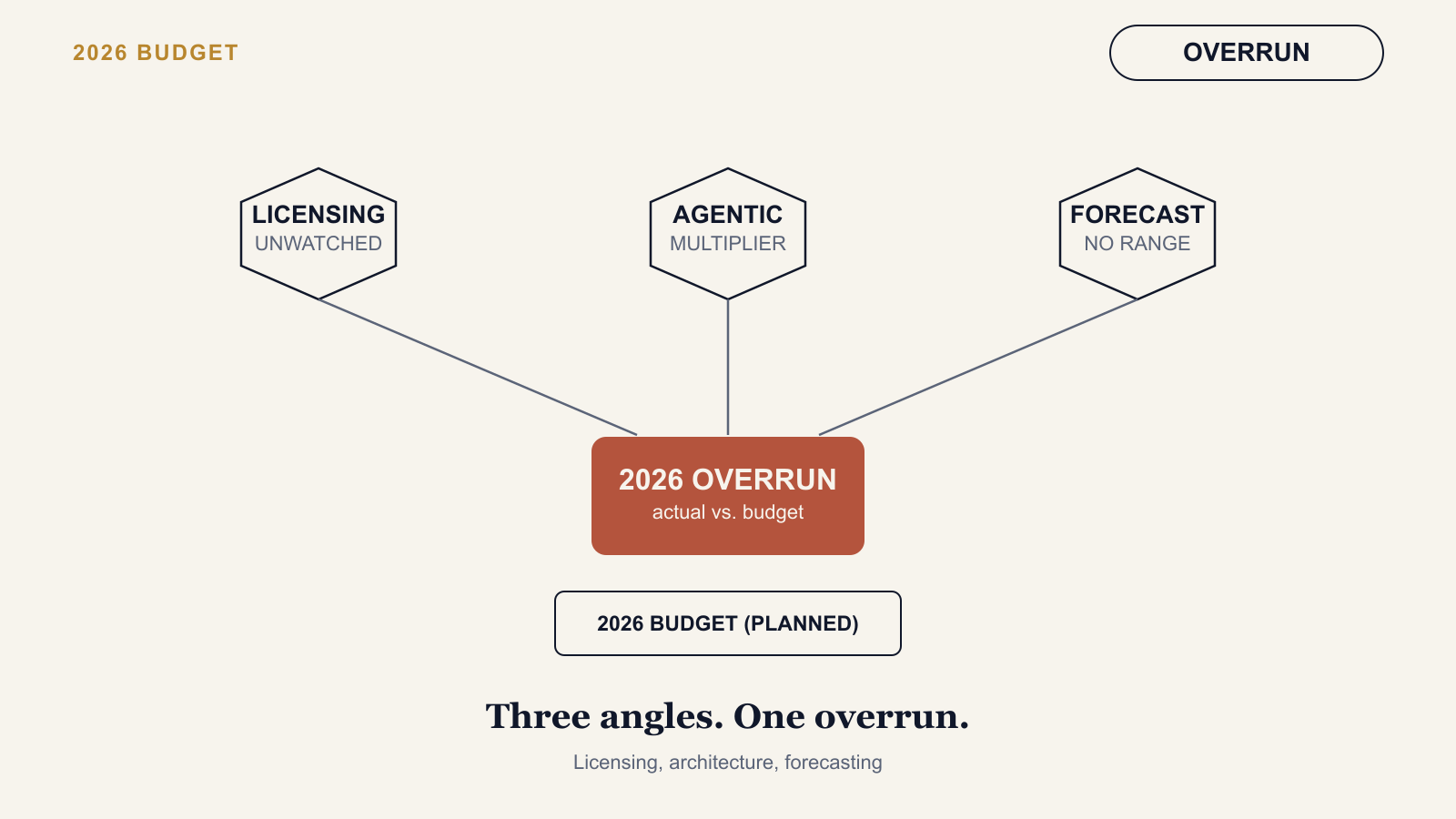
Enterprise AI token costs exceeded budget in 2026 for three compounding reasons: broad, largely unmonitored adoption during the experimentation phase; an architecture shift — agentic workflows and reasoning models — that multiplied token consumption per completed task faster than per-token prices fell; and a forecasting process that never caught up with either. None of this was a pricing failure. It was a visibility failure, in how the tools were rolled out and used, in how they were actually built, and in how the resulting usage was forecast.
Angle One: Liberal Licensing Met Unmonitored Experimentation
Through 2026, licences for Copilot-style assistants, ChatGPT-class general tools, and Codex-style coding agents were distributed broadly across the workforce, often deliberately, as part of pushing adoption. That is a reasonable instinct: an organization that wants employees to learn these tools has to give them access. What went missing was any attention to token usage during that phase. The rollout was framed, understood, and budgeted as a licensing decision — a fixed monthly line, approved once — when a meaningful share of what employees actually did with that access ran through consumption-priced, token-metered systems underneath.
Employees did exactly what broad access and encouragement invited them to do: experimented, explored, found new uses, adopted the tools into daily work, at a scale nobody had modelled, because nobody had been asked to model it. No one person or team owned token consumption as a line item during this phase. The organization learned the actual number for the first time when the bill arrived, and leadership's reaction — genuine surprise — is what triggered finance to start questioning the ROI of the whole initiative. As the next two sections show, that question turned out to be harder to answer than it should have been.
Angle Two: The Architecture Multiplied the Bill
The single largest driver of the 2026 overrun was probably not how many people used these tools, but how many model calls a single task now quietly generates. A user typing one request into an agentic workflow no longer triggers one model call. It triggers a chain: a planning step, one or more tool-use calls, often a retry when a tool call fails or returns something unexpected, and frequently a self-check step before the final answer is returned. Each link in that chain consumes its own tokens. Measured per API call, the cost looks stable or even improving as per-token prices fell through the year. Measured per completed task — the unit that actually matters to a budget — cost rose, because the number of calls behind each task rose faster than the price of any individual call fell.
Reasoning models compounded this in a second, separate way. Extended-thinking models generate and bill for internal reasoning tokens the user never sees in the final response — often a materially larger bill per answer than a standard completion produces for the same question. Without model-routing discipline — a deliberate policy of matching task complexity to model capability — teams defaulted to the most capable model available for every task, including routine ones a smaller, cheaper model would have handled adequately. The post's earlier point about prompts and context growing quietly (below) describes tokens per call creeping up gradually. This is a different and larger effect: the number of calls, and the cost per call, both moved upward at once, for reasons that had nothing to do with how any individual prompt was written.
A related, adjacent cost worth naming separately: agentic and retrieval-heavy workflows also generate spend on retrieval, embeddings, and vector storage that sits next to token spend proper, not inside it. Some of what gets reported internally as a "token overrun" is really the cost of the inference stack as a whole — worth distinguishing, because the fixes for each are different.
Angle Three: The Forecasting Gap
Even where rollout was deliberate and model choice was disciplined, a third problem showed up: the budget itself was built from assumptions that didn't hold once the system was actually live.
The Pilot-to-Production Volume Gap
A pilot's usage pattern is light and curated: a handful of trained users, a narrow set of test scenarios, usage concentrated in a few hours a week. Production usage looks nothing like that. Once a system goes live for a real user base, call volume typically runs several times the pilot's run-rate within two quarters of launch. A 2026 budget built directly from pilot volume, without an explicit scale-up multiplier applied before the number was submitted, was structurally undersized from the day it was approved.
Prompts, Context, and Pricing Tiers All Moved at Once
As teams iterate on answer quality, they add more system instructions, more retrieved context, more conversation history carried into each call — each addition raises the input token count per call, usually without anyone re-running the cost model that produced the original budget. This compounds with a second, quieter problem: providers price input, output, cached, and reasoning tokens at different rates, and a simple per-call estimate built on one blended average rate is wrong the moment the actual mix shifts toward output-heavy or reasoning-heavy calls — which, per Angle Two, it increasingly did through the year.
Some of 2026's increase also arrived from outside the organization entirely: vendors bundled AI features into existing SaaS contracts, or shifted specific products from seat-based to consumption-based pricing mid-contract. Modelling that specific shift — what changes when a vendor moves from a licence to a usage meter — is covered in Seat Licences vs Consumption Pricing.
One Number Instead of a Range
A single flat monthly estimate has no capacity to absorb any of the pressures above. The moment actual volume, actual call-chain length, or actual per-call token mix exceeds the point estimate — and given the first two angles, it almost always does, on all three at once — the entire line reads as over budget, because there was never a stated upper bound it could land within instead.
Shadow AI and the Missing Cost Attribution
Angle One's governance gap goes deeper than unmonitored experimentation on sanctioned licences. Some 2026 token spend never ran through a central, budgeted channel at all: team-level API keys obtained directly from a provider, departmental credit cards, and AI features bundled into existing tools and switched on by default each generated real spend that never appeared in the budget being reviewed in the first place. Some of the "overrun" was never a line item capable of being overrun. It simply wasn't visible to whoever owned the number.
Spend that did run through sanctioned channels usually fared little better, for a different reason: it was rarely tagged by team, product, or use case. Without that tagging, nobody inside the organization could separate productive spend from waste at the point the bill arrived — which is exactly why finance's question wasn't really "is this too expensive." It was closer to "we don't actually know what this is for," a harder question to answer after the fact than before it.
Both problems trace to the same root as Angle One: leadership in many organizations set adoption targets — active users, use cases launched — without a paired cost or value target. A team measured on adoption and never asked what that adoption cost has no structural reason to economize, and every reason to keep encouraging the liberal experimentation Angle One describes.
Falling Prices Didn't Help — They Made It Worse
Token prices, if anything, fell over 2026. That fact is worth explaining rather than noting in passing, because it points the wrong way if left unexplained. A falling per-token price lowers the cost of each individual use, which increases how much a given workflow, team, or experiment gets used — the same dynamic that shows up whenever the unit cost of a resource falls faster than demand is fixed. A cheaper token is not evidence a budget should have gone down. On its own, it is a reason consumption had more room to grow, and 2026 is a case where, combined with Angles One and Two, it did.
Not All of This Was Waste
Some share of the 2026 overrun was real, valuable demand: workflows that got genuinely more useful, and got used more, because they worked. Without unit economics — cost per resolved ticket, cost per completed task, rather than a single total spend figure — leadership has no way to tell this apart from the waste described above, which is a large part of why finance's ROI conversation often had no clean answer. "Was this worth it" cannot be answered from a total spend number alone; it can be answered from spend per unit of output, compared against what that output was worth. That reframing doesn't make the overrun smaller. It makes the next conversation with finance a more useful one than "costs went up."
A Hypothetical Illustration
Picture an organization that opens Copilot-style and ChatGPT-class access to most of its workforce in Q1 2026, framed internally as a licensing cost already approved in the annual software budget. Employees adopt enthusiastically, exactly as encouraged, with nobody tracking token consumption because nobody was told to. In parallel, a specific support-automation workflow moves from pilot to production, built on an agentic pattern that calls a tool, checks the result, and retries on failure — a design choice made for reliability, with no one costing out what the retry path would do to the token bill at scale. By Q3, three things have compounded at once: broad experimentation has generated usage nobody sized, the specific workflow's call-chain length and model tier have both pushed its per-task cost well above its original per-call estimate, and neither of these was visible as a separate, named number until the Q3 invoice arrived as one combined total. The finance conversation that follows treats the whole AI programme as having "blown the budget," when in fact it was several distinct, nameable causes that had never been separated out, let alone individually tracked.
What the Overrun Should Change Going Into 2027
Several actions follow, one for each cause above. Treat broad tool licensing and token consumption as two separate decisions from the start of any rollout, not one bundled approval. Assign ownership of token consumption monitoring from day one of any adoption push, including spend that runs outside central procurement. Set a model-routing policy that matches task complexity to model capability, rather than defaulting every task to the most capable available model, and put spend caps on agentic loops so a retry failure can't run unbounded. Apply prompt caching and batching where the workflow allows it, so the organization isn't paying full price for context it already sent once. Tag spend by team, product, or use case as a standing practice, not a forensic exercise after the bill arrives. Track cost per completed task alongside total spend, so real demand and waste can be told apart. And build the next budget as a range tied to a stated growth assumption — covering adoption volume, call-chain length, and model mix together — not a single number presented with false confidence for any one of them.
Why This Is Not a One-Time Fix
None of these causes are events that happen once and stop. Experimentation keeps finding new uses after the first surprising bill, agentic workflows keep growing more complex as teams add steps to make them more reliable, and a budget re-based once in Q4 2026 is just as exposed to the same drift by Q4 2027 if nothing changes about how usage, architecture, and attribution are monitored in between. The fix is not a bigger number for next year. It is ongoing visibility into how broadly these tools are used, how they are actually built, and what each unit of output costs — so none of the three surprises the budget the way 2026 did.
The AI Project Estimation Model provides an 11-tab Excel workbook with a dedicated LLM Token Cost Model tab for monthly and annual inference spend by model and volume, a P50/P80/P90 confidence-ranged cost engine, and a non-linearity multiplier for AI-specific complexity — built to replace a single flat estimate with a defensible range.
→ Available at www.viksya.com