
AI Business Case Template: Sections Finance Expects
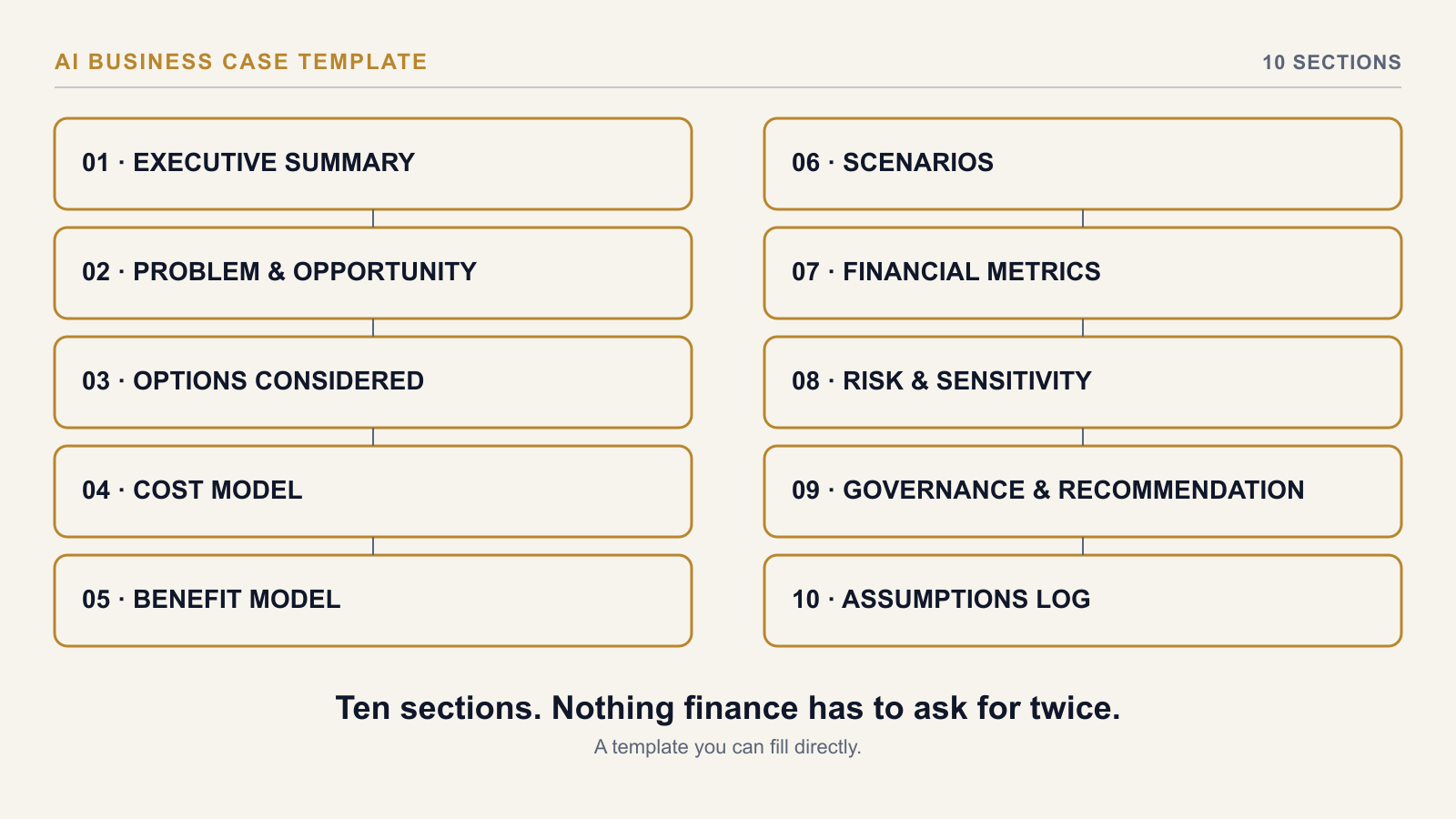
A finance-ready AI business case template has ten sections: Executive Summary, Problem & Opportunity Statement, Options Considered, Cost Model, Benefit Model, Scenario Comparison, Financial Metrics, Risk & Sensitivity, Governance & Recommendation, and an Assumptions Log. Missing any one of these is what most often sends a case back for rework — not a weak number inside a section that's present, but a section finance expected to see and didn't.
What follows is the template itself: what belongs in each section, in the order a finance reviewer expects to read them.
1. Executive Summary
One page. The investment ask, the recommendation (approve, conditionally approve, or reject), and the headline numbers — NPV, IRR, payback period, benefit-cost ratio — stated up front, not buried after nine pages of build-up. This is the section a time-constrained reviewer reads first and sometimes reads only.
2. Problem & Opportunity Statement
What specific business problem or opportunity this initiative addresses, in operational terms a non-technical reviewer can evaluate — not a description of the AI technology itself. A reviewer should be able to judge whether the problem is worth solving before reading a single number.
3. Options Considered
The alternatives weighed, including "do nothing" and any non-AI approach, with a short rationale for why the proposed option was selected. A case that presents one option as the only option reads as a decision already made, not a decision being proposed.
4. Cost Model
Capital cost (one-time build) and operational cost (ongoing run) presented as separate figures, not blended into one total — they sit in different budget categories and go through different approval processes. A complete cost model also accounts for an AI-specific non-linearity allowance (the cost of an additional development cycle if the first model doesn't clear its performance threshold) and opportunity cost (internal time the initiative diverts from other work). For the full breakdown of cost categories most AI business cases miss, see Why Most AI Business Cases Collapse Under Finance Scrutiny.
5. Benefit Model
Quantified benefits by category — productivity gains, cost avoidance, revenue uplift, risk reduction — each risk-weighted rather than taken at face value, and time-phased against a realistic adoption ramp rather than assumed at full value from day one.
6. Scenario Comparison
Conservative, Base, and Stretch cases, built with the same structure and different assumptions, shown side by side. A case presenting only one scenario is presenting more confidence than any programme team can honestly have, and an experienced finance reviewer will discount it accordingly.
7. Financial Metrics
Net Present Value, Internal Rate of Return, payback period, and ROI %, calculated from the same cost and benefit figures across all three scenarios — not a single-point estimate. For what belongs in each of these terms, see The AI ROI Formula and What Belongs in Each Term.
8. Risk & Sensitivity
A short list of the assumptions the case is most exposed to, with a sensitivity view showing how the outcome changes if each one moves — the question a finance reviewer asks right after seeing the headline numbers, answered before they have to ask it.
9. Governance & Recommendation
The funding decision being requested, the staged checkpoint (if any) where continued investment will be reviewed against evidence, and who owns the decision. This section states explicitly what approval authorizes and what it does not.
10. Assumptions Log
Every input used across the cost, benefit, and scenario sections, documented with its source — not left implicit in a spreadsheet nobody attached. This is the section that lets a reviewer challenge a specific number instead of the case as a whole.
How This Template Fits the Process
This template is the document structure — what goes where. It doesn't cover who builds which section, in what sequence, or how to handle a finance reviewer pushing back on a specific number; that process is covered in How to Build an AI Business Case Finance Will Approve.
The AI Investment ROI Model provides a 10-tab Excel workbook that builds sections 4 through 7 of this template directly — cost model, benefit model, three-scenario comparison, and an auto-calculated NPV/IRR/payback/BCR dashboard — with an Executive Summary tab that assembles section 1 as a print-ready one-pager.
→ Available at www.viksya.com