
How to Calculate the ROI of an AI Project, Step by Step
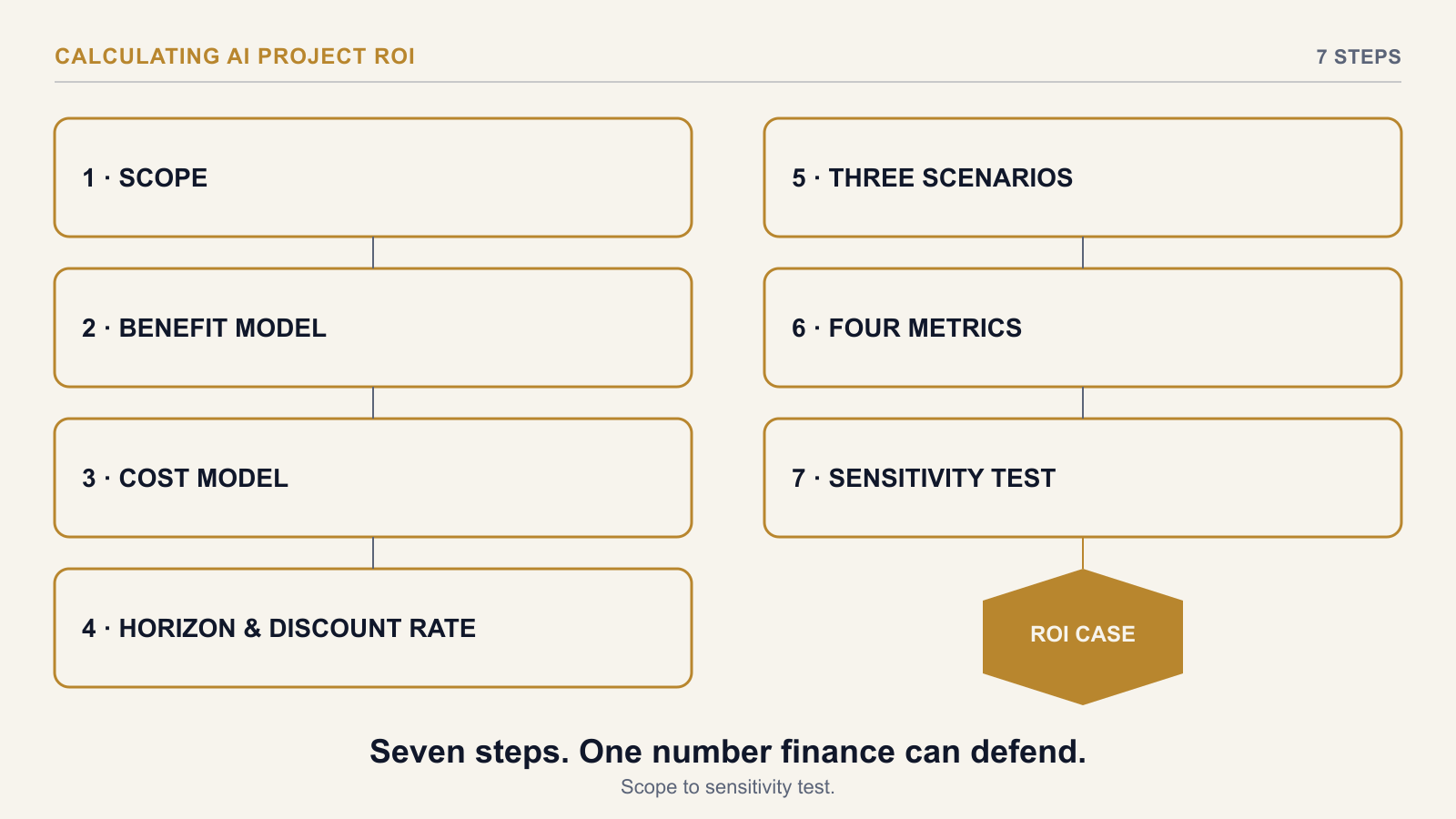
To calculate the ROI of an AI project, scope what's being measured, build a complete benefit model and a complete cost model, choose a time horizon and discount rate, run the calculation across Conservative, Base, and Aggressive scenarios, and calculate NPV, IRR, payback period, and ROI % from the result — then stress-test the numbers before presenting them. Each step below is where most AI ROI calculations actually go wrong, not the arithmetic at the end.
Step 1: Scope What's Being Measured
Before any number gets built, define the boundary of what this calculation covers: one project, one program with several linked initiatives, or one use case within a larger platform investment. A calculation that mixes project-level and program-level costs or benefits without saying so produces a number nobody can defend in a review, because the reviewer can't tell what it actually measures.
Step 2: Build the Benefit Model
Quantify benefits by category — productivity gains, cost avoidance, revenue uplift, risk reduction — and apply two adjustments before any of them enter the calculation: risk-weight each claimed benefit rather than taking it at face value, and apply a benefit ramp curve (commonly 40% of stated benefit in Year 1, 80% in Year 2, full run-rate from Year 3) so the model reflects how long adoption actually takes, not an assumption of full value from go-live day.
Step 3: Build the Cost Model
Separate capital cost (one-time build — development, integration, infrastructure, initial training) from operational cost (ongoing run — inference or licensing, monitoring, periodic retraining, continued change management), and keep them as two figures rather than one blended total, since they sit in different budget categories. Include an AI-specific non-linearity allowance — the cost of an additional development or tuning cycle if the first model doesn't clear its performance threshold — rather than assuming the first attempt succeeds.
Step 4: Choose a Time Horizon and Discount Rate
Three years is the credible default horizon for an AI program: one year is almost always negative given a large Year 0 outflow and ramp-adjusted Year 1 benefits, and five years introduces more forecast uncertainty than most finance teams will accept without challenge. For the discount rate, use this organisation's own WACC or hurdle rate — typically 8% to 15% — rather than an arbitrarily low rate that inflates NPV; finance will apply their own rate regardless, and a lower one than the organisation's standard signals optics management rather than analysis.
Step 5: Run Three Scenarios, Not One
Calculate the full model three times — Conservative, Base, and Aggressive — with the same structure and different assumptions on benefit realisation, cost variance, ramp speed, and discount rate. A business case built on a single scenario claims more certainty than any programme team can honestly have, and an experienced finance reviewer discounts it accordingly. A useful decision rule: if the Conservative scenario still returns a positive ROI with a benefit-to-cost ratio at or above 1.2×, the case is financially resilient before accounting for any upside.
Step 6: Calculate the Four Metrics
From the same benefit and cost figures, calculate Net Present Value, Internal Rate of Return, payback period, and ROI % for each scenario. These are related but distinct answers to different questions a finance review will ask, and each has specific build rules and common AI-specific pitfalls worth understanding before presenting them — covered in full in The Four Financial Metrics Every CFO Expects in an AI Investment Case. For what the underlying formula's two terms actually contain, see The AI ROI Formula and What Belongs in Each Term.
Step 7: Stress-Test Before Presenting
Run a two-variable sensitivity table — typically benefit realisation percentage against cost variance percentage — to show how the result moves as each assumption shifts independently of the scenario modelling in Step 5. This answers the question a finance reviewer asks right after seeing the headline numbers: what happens if we're wrong about one input. Presenting that table alongside the three-scenario comparison is what separates a case finance trusts from one it sends back for more work.
A Hypothetical Worked Example
Picture an AI project with a Year 0 capital cost of $250,000 and $45,000 a year in ongoing operational cost, scoped to one well-defined use case. Benefit modelling across productivity and cost-avoidance categories, ramp-adjusted and risk-weighted, produces roughly $140,000 in Year 1 benefit rising to $310,000 by Year 3. Run across three years at a 10% discount rate, the Base case returns a positive NPV with a payback period inside the 18–30 month range finance treats as credible; the Conservative case still clears payback, later and with a thinner margin. Sensitivity testing shows the result is most exposed to the benefit-realisation assumption, not the cost estimate — exactly the kind of finding a reviewer wants to see stated up front, not discovered by asking.
The AI Investment ROI Model provides a 10-tab Excel workbook that runs all seven steps above from your own inputs — a benefit model and cost model, Conservative/Base/Stretch scenario modelling, auto-calculated NPV/IRR/payback/BCR, and a two-variable sensitivity table — with an Executive Summary tab that assembles the result into a board-ready one-pager.
→ Available at www.viksya.com