
The 2027 AI Budget: What to Decide Before Funds Are Locked
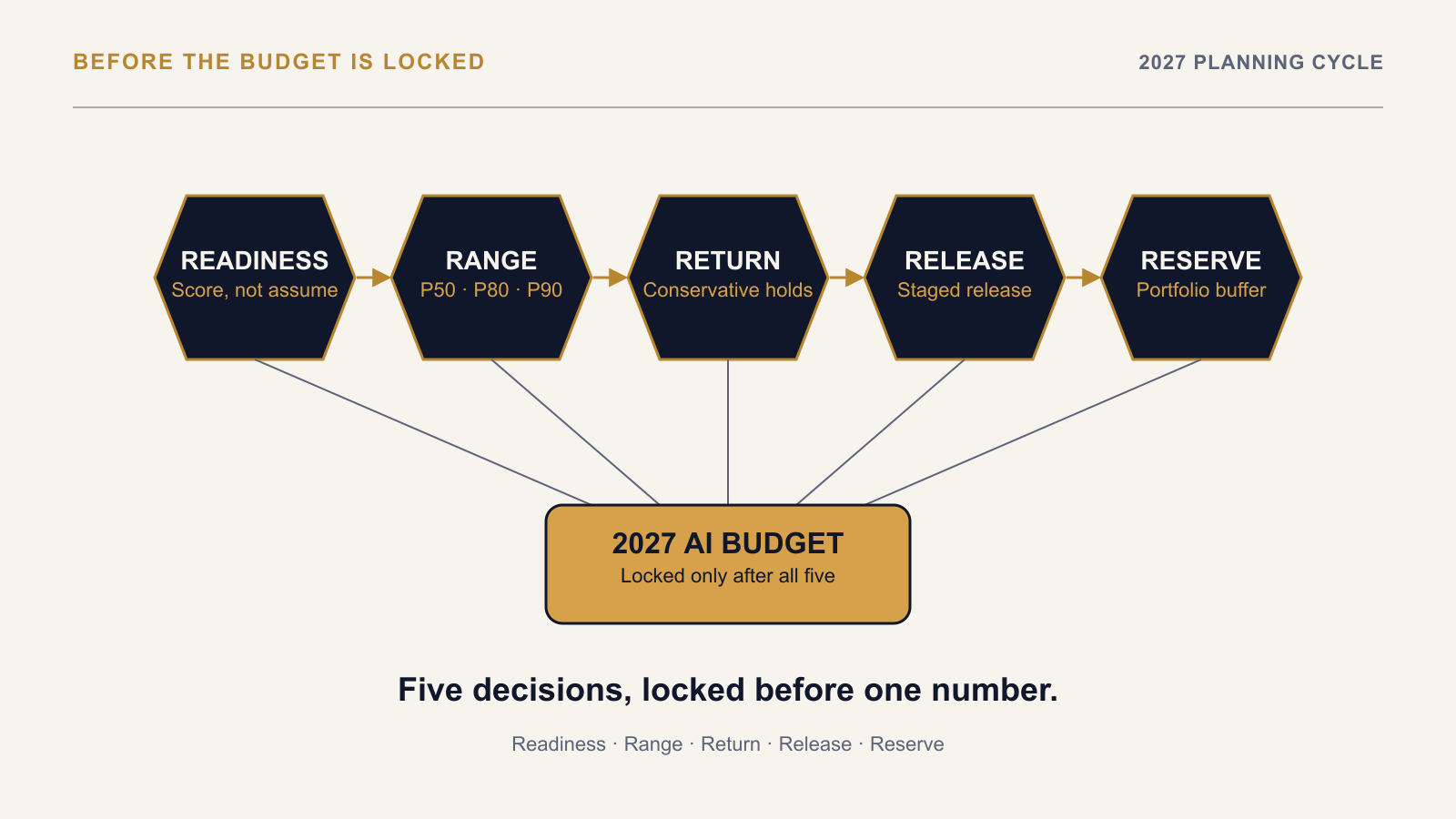
Planning the 2027 AI budget, before any total figure gets locked, means making five decisions in order: which candidate initiatives have actually cleared a readiness bar, what each one costs across a range rather than a single guess, whether the expected return justifies that range in the conservative scenario and not just the base case, how the approved money will actually be released, and how much contingency the whole portfolio needs on top of what any one initiative reserves for itself. Set the headline number before deciding these five things, and the number is a guess wearing a budget's clothing. Decide them first, across every initiative on this year's list, and the figure that comes out the other end is one a CFO can interrogate line by line without the whole case falling apart.
Decide Which Initiatives Have Actually Cleared Readiness, Not Just Which Ones Have a Sponsor
The first decision is not a cost question at all. Before a single dollar is attached to an initiative, decide whether it has actually cleared a readiness bar — scored evidence across the dimensions a specific AI investment depends on, not a sponsor's confidence that the team can figure it out once funded. An initiative that enters the 2027 list on the strength of executive enthusiasm alone, with no readiness score behind it, is the initiative most likely to consume its allocation discovering problems a readiness check would have surfaced before the budget cycle even started. Score every candidate initiative first. Rank them by readiness tier. Only then decide which ones are in scope for 2027 funding at all — a budget conversation that starts with the list already triaged this way is a materially shorter and more defensible conversation than one that starts from a spreadsheet of hopeful numbers.
Replace Each Single-Number Estimate With a Range
The second decision is how each initiative's cost gets expressed. A single point estimate for AI development cost is not a conservative number or an optimistic one — it is an incomplete one, because AI delivery cost is non-linear by nature: data distributions surprise teams, feature engineering runs long, and a first model missing its performance threshold triggers a second full tuning cycle nobody budgeted for. Decide, for every initiative on the 2027 list, that its cost will be presented as a confidence-ranged estimate — a P50, P80, and P90 figure, not one number — before that initiative's line item is accepted into the budget at all. A programme that can only produce a single number has not actually finished estimating. It has stopped early.
Confirm the Return Holds Up in the Conservative Case, Not Just the Base Case
The third decision is whether the number is worth funding at all, and it cannot be answered from a single scenario. Run each initiative's business case across conservative, base, and aggressive scenarios, and confirm the conservative case is still positive before it goes on the 2027 list — not just that the base case looks attractive. We have written in detail about which specific financial metrics belong in that case and how to build them for an AI programme in The Four Financial Metrics Every CFO Expects in an AI Investment Case; the decision at the budget-planning stage is simpler than the mechanics of building any one case — it is whether an initiative earns a place on the list at all, which depends on the conservative scenario holding up, not the aggressive one.
Decide How the Money Gets Released, Not Just How Much
The fourth decision is about structure, not size. A 2027 AI budget built as a single lump sum per initiative commits capital before the data foundations and the model's early performance are actually known, and locks the organization into a number before the normal discoveries of AI delivery have had a chance to happen. Decide, before the budget is finalized, that funding for each initiative releases in stages tied to performance milestones rather than all at once. We cover the mechanics of structuring that staged release — gate criteria, go probabilities, and the risk-adjusted expected investment that results — in Staged AI Investment Gates: The Smarter Way to Fund AI Programs. The decision that belongs at the portfolio level, before any individual gate is designed, is simply this: will 2027 funding be staged by default across every initiative on the list, or will exceptions be allowed, and on what grounds.
Reserve a Portfolio-Level Contingency, Not Just a Per-Initiative One
The fifth decision is the one most 2027 budgets skip entirely. Most AI business cases, built one initiative at a time, now account for the cost of a single additional tuning cycle inside that initiative's own conservative scenario — a practice we have written about at the individual-case level in Why Most AI Business Cases Collapse Under Finance Scrutiny. A portfolio-level 2027 budget needs a second, separate contingency on top of that: a reserve sized to the likelihood that more than one initiative on the list needs its additional cycle in the same year, not just the likelihood that any single one does. Picture an organization carrying six AI initiatives into 2027, each with its own conservative-case buffer already built in for its own risk of needing a second tuning cycle. Even if each initiative has, independently, only a modest chance of needing that extra cycle, the chance that at least two of the six need theirs in the same budget year is higher than any single initiative's own number suggests — and a portfolio reserve that was never sized to that aggregate exposure, only inferred from one initiative's buffer repeated six times, has not actually reserved against the portfolio's risk at all. Decide the portfolio contingency as its own line, sized to the number of initiatives being funded, not inferred from any one initiative's conservative scenario.
Put the Five Decisions in One View Before the Number Goes to the Board
None of these decisions is difficult on its own. What makes a 2027 AI budget defensible is making all five before the headline number is presented — readiness, range, return, release structure, and portfolio contingency — in that order, rather than presenting a total first and backfilling the reasoning behind it afterward. A budget built this way survives the question every finance review eventually asks, initiative by initiative: why this number, and what happens if it is wrong. A budget built the other way around answers that question for the first time in the room, under scrutiny — which is the worst possible place to discover that an initiative was never actually ready, that its estimate was a guess, or that its return only works in the scenario where nothing goes wrong.
The AI Transformation Suite provides the three frameworks this sequence of decisions runs on, in one purchase: an AI Transformation Readiness Assessment scored across thirty criteria and six dimensions with a RAG dashboard, an AI Project Estimation Model built on PERT-based P50/P80/P90 estimation with a non-linearity engine, and an AI Investment ROI Model covering NPV, IRR, BCR, and payback across a three-scenario model — delivered as three Excel workbooks built to carry one consistent evidence thread from first assessment to funded budget.
→ Available at www.viksya.com