What IRR Tells You About an AI Investment
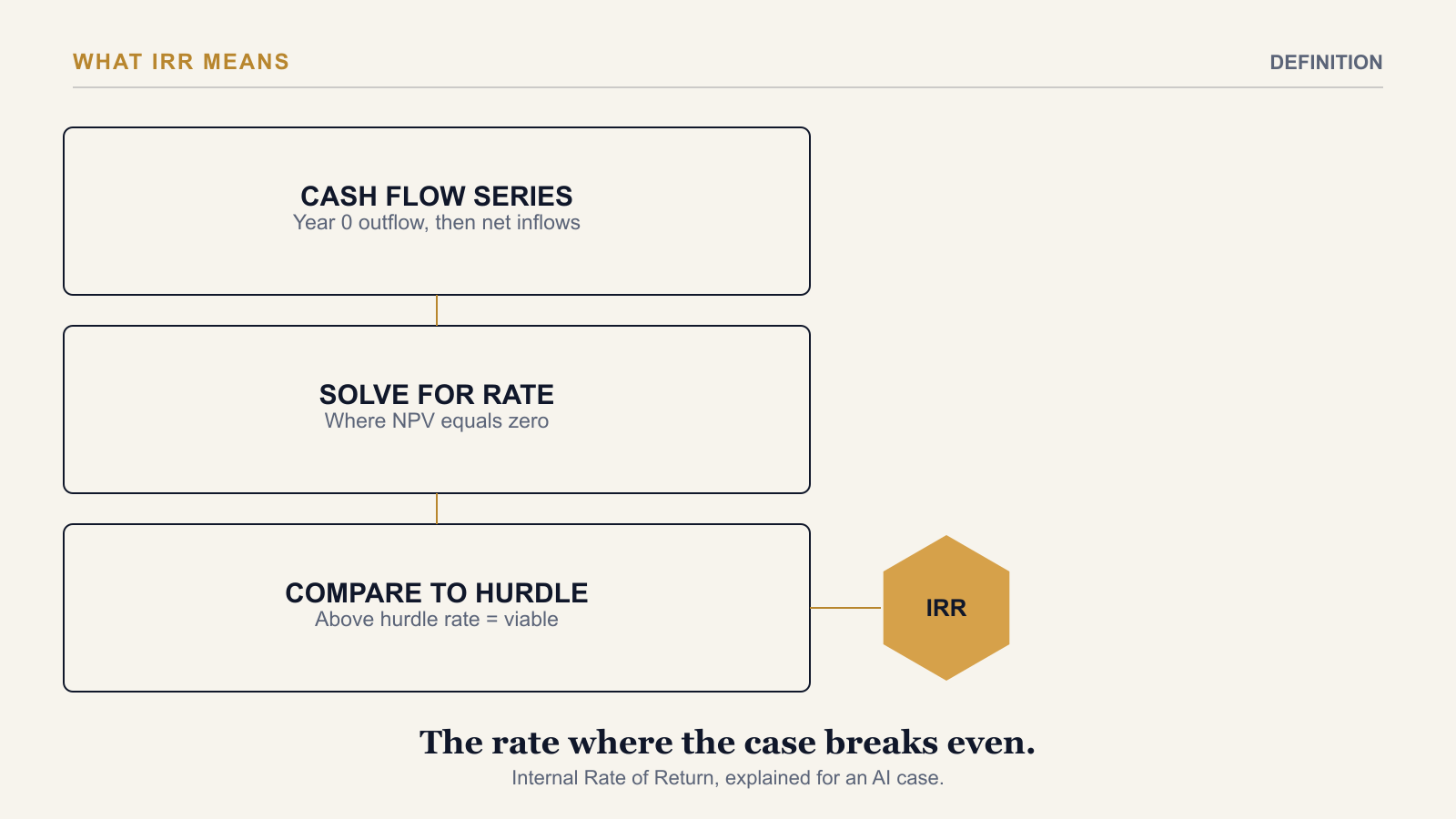
IRR — Internal Rate of Return — in an AI investment is the discount rate at which the programme's net present value equals exactly zero: the breakeven rate of return the investment is expected to generate. If that rate is higher than the organisation's hurdle rate, the investment clears the bar; if it is lower, it does not. IRR matters most when an AI programme is not the only option on the table — it is the metric that lets a CFO compare fundamentally different investments on a single, comparable scale.
What IRR Actually Measures
Where NPV answers how much value an investment creates in today's dollars, IRR answers a related but different question: what rate of return does this investment effectively deliver? The calculation finds the discount rate at which the present value of benefits exactly equals the present value of costs — the rate at which the investment breaks even rather than creating or destroying value. A higher IRR signals a more efficient use of capital; a lower one signals the opposite, regardless of the investment's absolute size. See What NPV Means in an AI Business Case for the metric IRR is derived alongside.
When IRR Earns Its Place
IRR is most useful in a steering committee conversation where the AI programme is competing against other capital requests — a manufacturing upgrade, a geographic expansion, a different technology investment — because it produces one comparable rate across fundamentally different kinds of spend. If the AI programme is the only item on the table, NPV and ROI % already do that job, and IRR mostly adds a sanity check.
The Limitation Worth Knowing Before You Present It
IRR assumes any interim cash flow is reinvested at the IRR rate itself — an assumption that is rarely realistic, and one that matters more for AI programmes than for steadier investments, because AI cash-flow profiles are typically irregular: a large Year 0 outflow followed by benefits that build gradually as adoption ramps. That shape can produce an IRR figure that reads higher than the investment's real economic return. The practical guidance: include IRR in the business case, because finance will expect it, but present it alongside NPV rather than lead with it as the primary decision metric. For the full build-out of IRR alongside NPV, payback, and ROI %, see The Four Financial Metrics Every CFO Expects in an AI Investment Case. For payback period, the third metric in this cluster, see How to Calculate Payback Period for an AI Project.
A Hypothetical Worked Example
Picture an AI initiative with a Year 0 cost of $220,000 and net benefits ramping from roughly $90,000 in Year 1 to $210,000 by Year 3. Solving for the discount rate at which that cash-flow series nets to zero produces an IRR somewhere in the high teens to low twenties — comfortably above a typical 8–15% organisational hurdle rate, and a figure a CFO can place directly alongside a competing capital request without translation. If the same programme's IRR had come out at 9% against a 12% hurdle rate, that would be the signal to revisit the benefit assumptions before the business case goes to committee, not to lead with NPV and hope the IRR question does not come up.
The AI Investment ROI Model calculates IRR automatically alongside NPV, payback period, and benefit-cost ratio, across Conservative, Base, and Stretch scenarios, with the Executive Summary tab presenting IRR in the same board-ready format as the other three metrics.
→ Available at www.viksya.com