What NPV Means in an AI Business Case
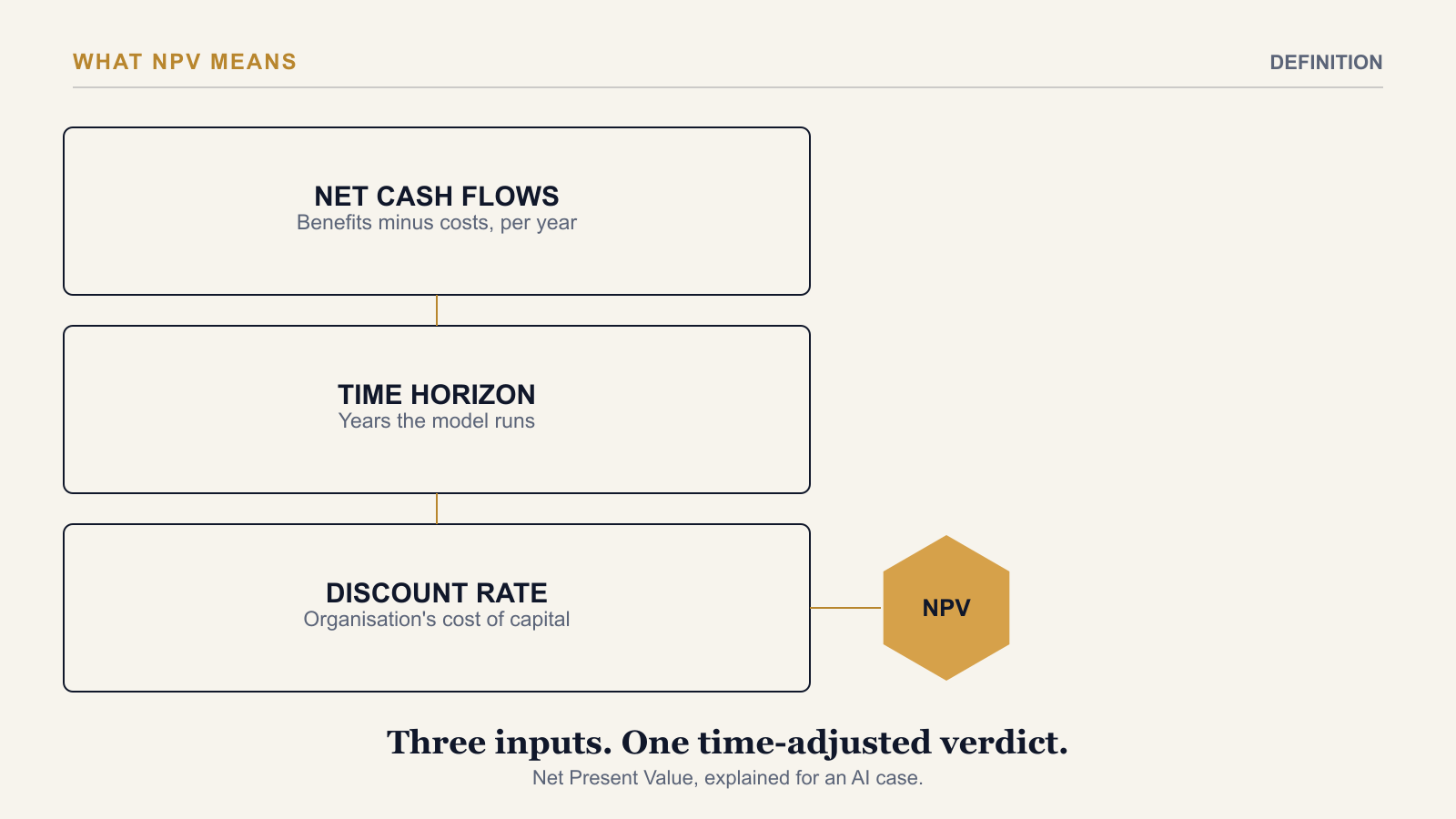
NPV — Net Present Value — in an AI business case is the sum of a programme's projected future cash flows, benefits minus costs in each year, discounted back to today's value using the organisation's own cost of capital. A positive NPV means the investment is expected to create more value than the same capital would earn deployed elsewhere; a negative NPV means it would not. It is also the metric most CFOs ask for first in an AI funding conversation, because it compresses a multi-year, multi-scenario case into one comparable number.
The NPV Formula, in Plain Terms
NPV discounts each year's net cash flow — that year's benefits minus that year's costs — back to today's value, then sums the result across the investment horizon. A dollar of benefit three years from now is worth less than a dollar today, because money available now could be earning a return elsewhere in the meantime; the discount rate is what converts a future dollar into its present-day equivalent. Summed across every year in the horizon, the result is a single figure: the value the programme is expected to add, in today's terms, after accounting for both its cost and the time it takes to pay off.
Three Inputs That Make or Break an AI NPV Calculation
The arithmetic itself is standard finance. What makes an AI NPV calculation easy to get wrong is three AI-specific judgment calls behind the inputs.
Net cash flows should reflect how AI benefits actually arrive — adoption builds over time, so a model that assumes full benefit value from the day the system goes live overstates every year's cash flow, and the NPV along with it. Time horizon should run at least three years for an enterprise AI programme: shorter horizons are dominated by the large Year 0 outflow and rarely clear a positive NPV, while horizons much longer than three years introduce more forecast uncertainty than most finance teams will accept without challenge. Discount rate should be the organisation's own cost of capital or hurdle rate, not an arbitrarily low figure chosen to inflate the result — finance will apply their own rate regardless, and a rate lower than the organisation's standard reads as managing optics rather than analysis.
For the full detail on how to build each of these inputs correctly, and the specific adjustments an AI programme needs that a standard capital project doesn't, see The Four Financial Metrics Every CFO Expects in an AI Investment Case.
NPV Doesn't Travel Alone
NPV answers one question: does this investment create value, in today's terms, given what it costs and when that value arrives? It doesn't answer how long the money stays tied up before the programme breaks even, or how this investment compares to a different one competing for the same budget — that is what payback period and IRR are for, respectively. See How to Calculate Payback Period for an AI Project and What IRR Tells You About an AI Investment for each. A business case that presents NPV alone is presenting one-third of what finance will ask for.
A Hypothetical Worked Example
Picture an AI initiative with a Year 0 cost of $220,000 and ramp-adjusted net benefits of roughly $90,000 in Year 1, $160,000 in Year 2, and $210,000 in Year 3. Discounted at a 10% hurdle rate over three years, the cumulative present value of those benefits comes in above the Year 0 outflow — a positive NPV, and a credible basis for a funding conversation. Change the discount rate to 15%, or stretch the horizon to five years with the same inputs, and the number moves meaningfully — which is exactly why the discount rate and time horizon are inputs worth defending, not defaults worth skipping past.
The AI Investment ROI Model calculates NPV automatically from your own cost and benefit inputs, alongside IRR, payback period, and benefit-cost ratio, across Conservative, Base, and Stretch scenarios — with a two-variable sensitivity table showing how NPV moves as your assumptions change.
→ Available at www.viksya.com