
Why AI ROI Is Hard to Prove, and What Makes It Provable
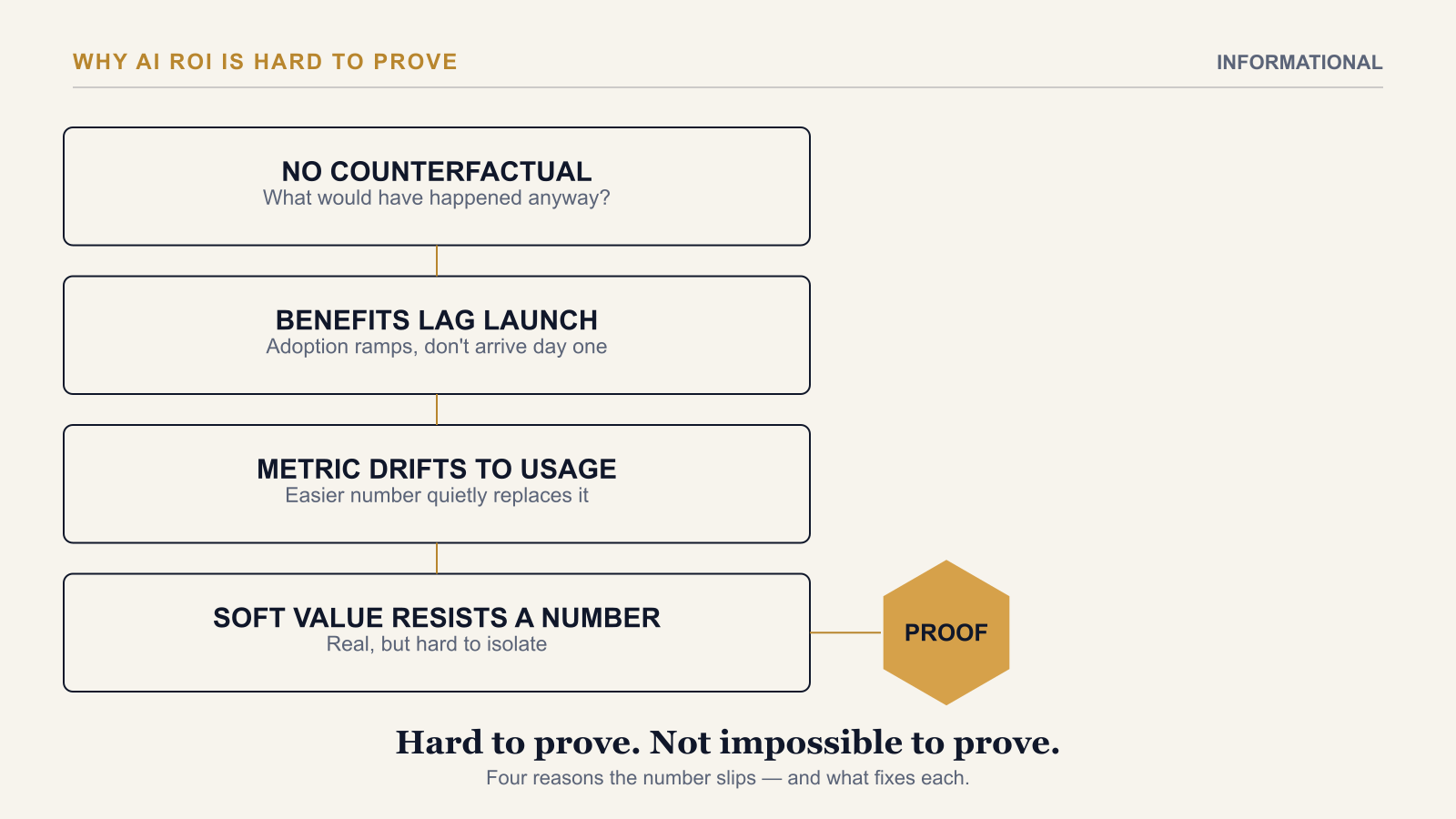
AI ROI is hard to prove for four structural reasons: there is rarely a clean counterfactual showing what would have happened without the system, benefits lag the launch date because adoption takes time to build, the tracked metric tends to drift from the business-case outcome to whatever usage figure is easiest to pull, and some real value — faster decisions, better morale — resists being reduced to a single number. None of that makes AI ROI unprovable. It means provability has to be designed in before launch, not reconstructed afterward.
Reason 1: No Clean Counterfactual
Proving ROI means showing what happened against what would have happened without the AI system — and the second half of that comparison does not exist by default. Other things change in parallel: a process gets simplified, a seasonal pattern shifts, a different initiative launches in the same quarter. Without a baseline captured before launch and a clear view of what else was changing at the same time, a post-launch improvement is suggestive, not proof.
Reason 2: Benefits Lag the Launch Date
Value depends on adoption, and adoption builds over months, not instantly at go-live. Measuring ROI too early — before the ramp curve has run its course — produces a number that looks disappointing not because the investment failed, but because the measurement happened before the benefit had time to materialise.
Reason 3: The Metric Drifts to Usage
The outcome metric the business case was funded on requires someone to deliberately re-measure it; a usage or adoption figure is instrumented automatically by the tool itself, at zero extra effort. Left unmanaged, reporting quietly shifts from the harder, more meaningful number to the easier one — and a rising usage chart can sit directly on top of a business case that never actually came true. See Most AI ROI Metrics Measure Usage. Real AI ROI Metrics Measure the Business Case. for exactly how that substitution happens.
Reason 4: Some Real Value Resists a Number
Faster decisions, improved employee experience, and reduced strategic risk are genuine benefits that do not reduce cleanly to a dollar figure without assumptions stacked on assumptions. Treating them as unprovable and ignoring them loses real context; treating them as provable and forcing a speculative number onto them damages the credibility of the hard numbers next to them. Provability, for these, means naming them clearly rather than monetising them by guesswork.
What Makes AI ROI Provable
Provability is a design choice made before launch, not a measurement technique applied afterward: lock the specific metric and capture its baseline before go-live, name an owner for re-measurement who is not the delivery team, set a cadence tied to the programme's funding gates, and re-run the original financial model with actual figures rather than reporting a usage substitute. For the ownership and cadence discipline in full, see How to Get Real AI ROI, Not Reported ROI; for the specific recalculation steps once go-live happens, see How to Measure AI ROI After Go-Live.
The AI Investment ROI Model's Assumptions Log tab captures the baseline, the metric, and the source for every input at business-case time — the specific record that makes a later comparison against actuals a provable recalculation rather than a reconstructed guess.
→ Available at www.viksya.com